Photo courtesy of Lockheed Martin Corp.
President Donald Trump has issued a proclamation giving permission to the Department of Commerce (DOC) and the Office of the United States Trade Representative (USTR) to negotiate with other nations regarding their volume of shipments of nickel, cobalt and rare earth elements (REEs) to the U.S.
“Depending on the outcome of such negotiations, I may consider alternative remedies in the future, including minimum import prices for specific types of critical minerals," Trump says in the approximately 2,000-word mid-January statement.
Trump cites aspects of Section 232 of the Trade Expansion Act of 1962 as granting him the power to direct the DOC and the USTR to jointly pursue negotiating agreements or to continue any current negotiations of agreements regarding critical minerals.
Throughout the proclamation, the president refers to the national security aspects of processed critical minerals and their derivative products (PCMDPs), including their applications in the defense and technology sectors.
In addition to specifically referring to nickel and cobalt, the statement specifically mentions uranium, REEs gallium, germanium, indium, praseodymium terbium and yttrium.
A study commissioned earlier by the White House found that as of 2024, the U.S. was 100 percent net import-reliant for 12 critical minerals and 50 percent or greater net import-reliant for a further 29 critical minerals.
“Even where the U.S. has domestic mining capacity, such as for cobalt, nickel and rare earth elements, the U.S. lacks the domestic processing capacity to avoid downstream net import reliance," the statement says.
That study also found the price volatility of critical mineral markets had hindered private sector investment in nations with market-based economies, leading to facility closures and threatening the long-term viability of domestic mining, processing and downstream manufacturing capacity.
“In light of these findings, the Secretary [of Commerce] recommended a range of actions, including actions to adjust the imports of PCMDPs so that such imports will not threaten to impair the national security,” the statement says.
“For example, the secretary recommended that I negotiate agreements with foreign nations to ensure the U.S. has adequate critical mineral supplies and to mitigate the supply chain vulnerabilities as quickly as possible. The Secretary also suggested that it may be appropriate to impose import restrictions, such as tariffs, if satisfactory agreements are not reached in a timely manner.”
In response to the proclamation, Philip K. Bell, president and CEO of the Washington-based Steel Manufacturers Association (SMA), says, “We commend President Trump for his consistent recognition of the vital role critical minerals play in modern society. Critical minerals, in particular, demand swift action to secure reliable supplies, while also necessitating close collaboration with our allies to build resilient, diversified supply chains.”
Throughout the tariff-intensive first year of the second Trump administration, several potential investments and projects focused on REE or critical mineral production have been announced.
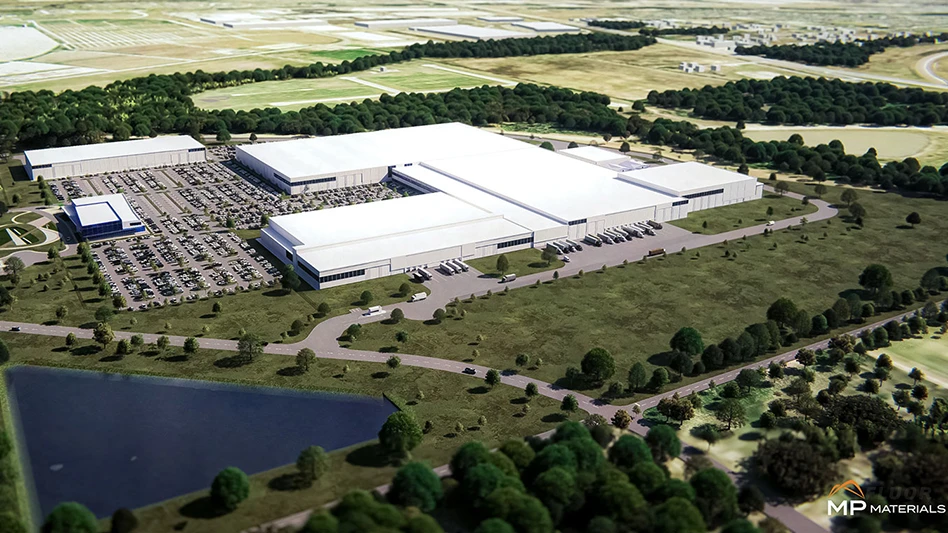
In July 2025, Apple Inc. announced a commitment to invest $500 million in MP Materials, a company the electronics firm says is the only fully integrated rare earth producer in the United States.
As part of the arrangement, the two companies will work together to establish a REE recycling line in Mountain Pass, California, and develop what Apple calls novel magnet materials and innovative processing technologies to enhance magnet performance.
In December, Seoul-based metals producer Korea Zinc announced its intention to work in cooperation with the DOC and the Department of Defense to build a $7.4 billion smelting facility in Clarksville, Tennessee. The company foresees annual production capacity of 540,000 combined tons of 13 different nonferrous metals in Tennessee and says the proposed facility will be modeled after its existing Onsan smelter in South Korea.
Latest from Recycling Today
- DOWA: Center of catalytic converter recycling
- Ocean Legacy Foundation expands plastic testing laboratory services
- CMI, HCPA publish aerosol recycling guide for MRFs
- 2026 Plastics Recycling Conference: A look at PCR contracts
- Remade Institute hosts Circular Economy Tech Summit & Conference in March
- Befesa sees record performance in 2025
- North Carolina county receives FRC foam recycling grant
- Cascades tissue business falls short in Q4