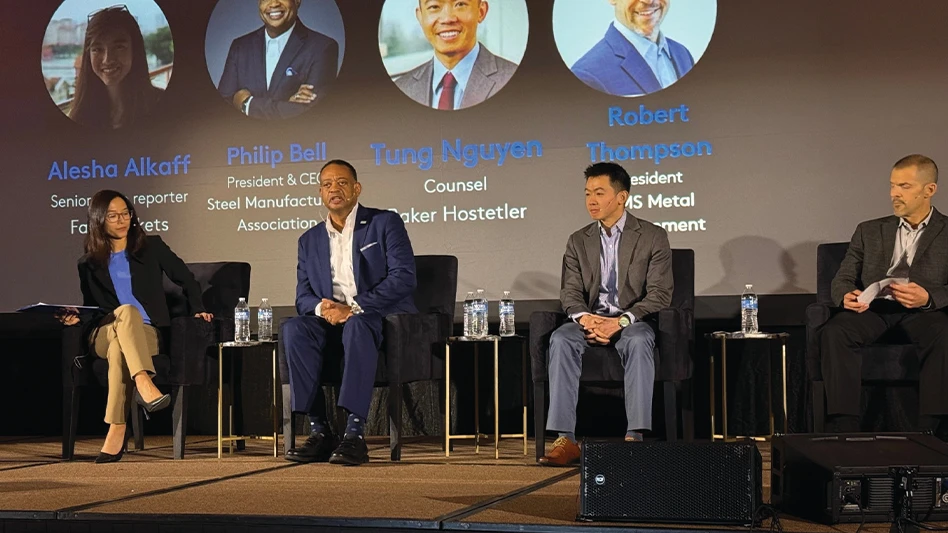
Photo by Chris Voloschuk
In order to understand the United States’ tariff landscape in 2025, it is important to understand what it looked like when President Donald Trump took office last January, according to Steel Manufacturers Association (SMA) President Philip Bell.
Speaking as part of a panel of steel industry participants at the 2026 Fastmarkets Circular Steel Summit in Houston Jan. 28, Bell pointed out that by the end of 2024, 18 percent of steel imports into the U.S. were covered by Section 232 tariffs for a variety of reasons, “many of which went underreported.”
RELATED: Tariff opposition in US turns up volume
Taking a global view during the End-to-End Supply Chain Perspectives on Tariffs session, Bell said Canada and Mexico were previously exempt from Section 232 tariffs because of the United States, Mexico and Canada (USMCA) trade agreement, while the European Union also was exempt for “a variety of reasons” as it attempted to negotiate a “global arrangement,” which he described as an attempt to weave trade policy with climate policy and “use tariffs as a way to lower carbon emissions.”
“Those talks fell apart like a $5 watch,” Bell said.
Additionally, he said large steel-producing countries such as Brazil, Argentina and South Korea weren’t paying 232 tariffs. “On top of that, you had an exclusions and exemptions process that lacked transparency and was often gamed by petitioners.”
Bell described “massive import surges” from Canada and Mexico of long products, structural steels and piping, saying they “were not really living up to the spirit of the USMCA.”
“With that, [Trump] said, ‘Hey, one of my landmark trade policies is not being fully enforced, and here’s what I’m going to do,’” Bell said. “And he immediately put 25 percent tariffs on everyone, including our USMCA partners and the EU. He immediately got rid of the exemptions process and instead added an inclusions process so end users of steel products could get some material relief.”
In addition to that, Bell noted the administration doubled the tariffs to 50 percent to prevent countries such as South Korea, for example, from sidestepping tariffs by selling through other countries. He said that during the Biden administration there were 31 countries exempt from 232 tariffs, but that number is down to just one—the United Kingdom.
“We see a regime that is, in Trump’s mind, working,” Bell said. “[232 tariffs] have been in effect for eight years and it’s bipartisan. If Biden wanted to remove them, he could’ve, but he didn’t. So, it’s full steam ahead from the administration’s point of view.”
Gauging the response
When the ramp-up of Section 232 tariffs was announced last February, there was a mix of optimism and confusion for members of the domestic steel value chain.
“Section 232 as a tariff has done a tremendous job for the return of health to the steel and aluminum industry in North America,” said Robert Thompson, president of Sims Metal, an Australia-based metals and electronics recycler with operations across the U.S. “We want healthy customers.”
On the demand side, however, he acknowledged that questions persisted as customers were installing new equipment and needed raw materials suitable for their operations. “That is ongoing, but they’re good problems to have.”
Thompson said that on the operations side, the cost effect of the tariffs has yet to be felt.
“It hasn’t changed how we go to market,” he said. “We’re selling scrap metal to companies in the United States, Canada and all over the world. The ambiguity of the tariffs is the challenging part. As human beings we sit at home and try to figure out how this affects us, and the same goes for people in the C-suite. You’re trying to find answers for questions you don’t have answers for.”
When it comes to sourcing material domestically, Thompson said he hadn’t seen much change since the tariffs took effect.
“We’re at the beginning of what this is all going to be,” he said. “Domestically, there’s plenty of raw material supply here. Products are flowing to their natural homes. Raw materials are still coming in and there’s still a flow between borders at this time. If that changes, there could be some major supply chain challenges, but we’ll work those out as they come up. There’s plenty of product.”
Tung Nguyen, an international trade lawyer at Cleveland-based Baker & Hostetler LLP, noted that his clients are more interested in lower tariffs and would like to see more clarity regarding the rules.
“What’s been done in the last year is the U.S. built a tariff wall, which hurt products coming into the market, but created different levels of compliance,” he said. “You must understand the complexities of this new regulatory environment. The 232 tariffs have been in place since 2018, and I don’t see them going away any time soon. However, I do think there needs to be more transparency and predictability built into the system, because right now it’s hard for companies to navigate the tariffs currently in place.”
Nguyen added that companies were quick to try to adapt to the new higher-tariff environment. “Common strategies are to determine whether your products are subject to tariffs or not, or can you classify them one way or different ways,” he said. “Do you invest in production in the U.S. to ensure long-term availability of material in this market? There are strategies to mitigate the impact of tariffs.”
Domestically, Thompson said tariffs had helped bring investment confidence back to the industry.
“It’s made steel, aluminum and now, potentially, copper, more competitive from the innovation point of view,” he said. “The unintended consequence is that now there’s this thing I’ll call ‘tariff exhaustion.’ It’s hard to keep up with the rules of the game, and it’s affecting budgeting, capex, things like that.”
Money back?
As of yet, the U.S. Supreme Court has not issued a ruling on the president’s authority to issue tariffs. But if the court ruled against the administration, could affected companies then seek refunds for the duties paid?
With billions of dollars at stake, Bell and Nguyen didn’t see a clear pathway.
“I agree that the government would not be willing to refund everything that has already been collected,” Nguyen said. “And other tariffs could be put in place to recover whatever was removed by that court decision.”
According to Bell, “the fact that [the court ruling] is taking so long indicates that they’re trying to split the baby, if you will. I don’t think they’re going to go back and try to figure this out. They’re going to say, ‘We made a decision, we’re moving forward and here’s what we’re going to do.’ Maybe they could issue [something similar to a refund] through tax refunds.”
Nguyen pointed out that if refunds went back to importers, new issues could arise.
“The way that tariffs were allocated has to do with how parties in contracts were shifting,” he said. “If you’re the importer and you get the refund, how will the other parties that shared that burden get their fair share? They’re learning now what they need to do to get refunds, then what to do with them afterward. But there is confusion right now.”
Adapting on the fly
The steel industry has been navigating the up-and-down nature of the administration’s tariff regimen for nearly a year, and the panelists pointed to the industry’s ability to stay nimble and quickly adapt as particularly helpful.
Bell added that any company concerned about tariffs has the right and obligation to petition the government to share its concerns, though it might require a certain strategy.
“The best strategy with this administration is they want to talk with CEOs,” Bell said. “They see guys like me every day. They see lobbyists every day. When you have CEOs articulating their point of view and the impacts tariffs will have on the communities where they operate, the jobs and livelihoods of the people there, it impacts things more. They want to hear chief executives’ point of view.”
Nguyen said that while concerned parties can lobby and communicate with the government, there still isn’t clear regulatory guidance or guardrails to make sure outcomes are applied evenly among players.
“You end up with the idea that government can choose winners and losers in this environment,” he said.
Looking to how the domestic steel industry will fare this year, the panel offered optimism.
“I think 2025 was a year where high tariffs were announced,” Nguyen said. “I think 2026 will be the year enforcement will be the focus. Companies need to make sure they comply.”
Said Thompson, “From the hope perspective, I think we’ll get a calming on some of the [tariff] threats and the need to filter what they mean for us. How do we stimulate the demand for these companies we’ve helped create?”
Latest from Recycling Today
- Hamburger Recycling announces promotions
- Nth Cycle signs offtake agreement with Trafigura
- WeSort.AI recovers critical raw materials from recycling plants
- ReMA provides economic impact report, industry update
- Collective Waste Solutions acquires Alcop Resource Recycling transfer station
- Volatility continues in nonferrous metals
- Neste chemical recycling plant is ready to scale up
- Indonesia’s nickel pig iron spigot reopens