Image courtesy of PepsiCo.
Global beverage and consumer products company PepsiCo Inc. has expanded its reusable cup program inside Levi’s Stadium for the Super Bowl and will leverage artificial intelligence (AI) to support recycling efforts at the stadium.
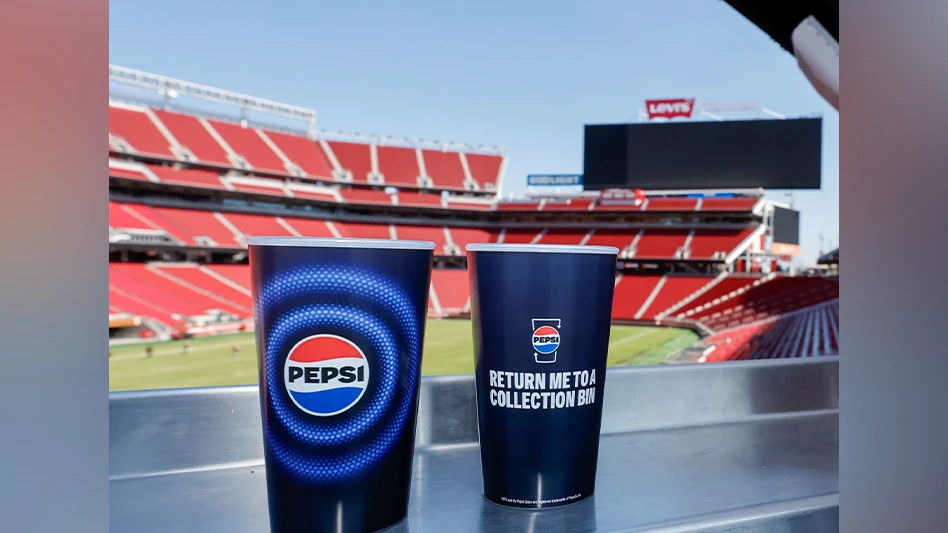
PepsiCo and the NFL’s San Francisco 49ers launched a reusable cups pilot program for the 2025-2026 NFL season. In an effort to reduce plastic waste, fans seated in select sections at 49ers home games received their beverages in reusable cups. The company says the program, which was announced Aug. 14, 2025, helped to divert more than 32,000 cups from landfill throughout the season.
The reuseable cups are made from bisphenol A- (BPA-) free polypropylene (PP) and hold 32 ounces. The cups design features a message that encourages fans to return them to designated collection bins.
“By using plastic in a reusable system, we help extend each item’s life, help reduce the need for new materials and deliver a safer, more practical and more sustainable solution,” Burgess Davis, PepsiCo North America chief sustainability officer, says.
One of the reasons the program is a pilot project is to test new systems, which she says is why the program is focused only on select sections of the stadium.
“Advancing reuse requires collaboration, financial incentives and a systemic shift to help make the reusable option a convenient and accessible option for consumers to enjoy their beverage,” Davis says. “Pilot programs like this one are important to better understand how reuse can be scaled as a convenient and preferred option for consumers while improving packaging circularity and reducing single-use packaging waste.”
The selected seating areas will have the infrastructure needed to implement the reusable cups program, including collection bins where cups can be returned and sanitized for future use. Fans that are seated in these areas, which will cover about 4,000 seats, will receive their beverage in the reusable cup.
Davis says the intent of the program is to advance packaging circularity and to keep cups within the system so they can be collected, sanitized and reused, reducing the need for new cups to be produced.
“Making reuse a convenient and preferred option for consumers is critical to the success of any reusable cups initiative,” she says. “The cup being offered to fans [is] durable and lightweight, aiming to enhance the consumption experience. Collection bins are clearly marked and conveniently located, making returning cups simple for fans.”
PepsiCo and the San Francisco 49ers collaborated to launch this pilot, and say Bold Reuse, a reuse systems company headquartered in Portland, Oregan, played an important role in the logistics of collecting, sanitizing and redistributing cups for future use, along with Levy, the stadium’s hospitality provider.
Super Bowl recycling initiatives
In 2024, PepsiCo partnered with Intuitive AI, Vancouver, British Columbia, to launch its AI-powered recycling assistant, Oscar Sort, at locations across the United States. The technology identifies discarded items and guides users to place them in the correct bins, helping to improve recycling accuracy and reduce contamination.
Davis says Oscar Sort can detect organic residue in food containers and prompt users to empty liquids or remove lids. This technology will be implemented at the Super Bowl Experience at the Moscone Center, where fans can hold an item to the Oscar camera and the technology will tell them where it belongs—recycling, compost or trash.
“Oscar Sort’s interactive digital display also gamifies the recycling experience, offering real-time feedback that helps educate and engage consumers,” she says.
PepsiCo will also provide 200 collapsible recycling bins at the Super Bowl across event spaces. The bins, which hold two 45-gallon bags, will be serviced throughout the game. The AI recycling units are serviced throughout the week by venue teams, Davis says.
“Sustainability is a team sport,” she adds. “It requires collaboration and active engagement. Efforts like these can provide important insights into how systemic shifts can be achieved and solutions can be further scaled, while having an immediate impact in reducing waste.”
Latest from Recycling Today
- Cyclyx International to be restructured
- Fornnax appoints new sales partner in Germany
- S&P Global Energy Aluminum Symposium 2026: EGA America exec talks about the company’s growth in the US
- EPRC announces European Paper Recycling Awards winner
- ArcelorMittal finishes 2025 with profitable quarter
- Aurubis earnings drop in late 2025
- Yale feature emphasizes pedestrian safety
- In memoriam: Marcel Braud