Photo courtesy of Stadler Anlagenbau GmbH
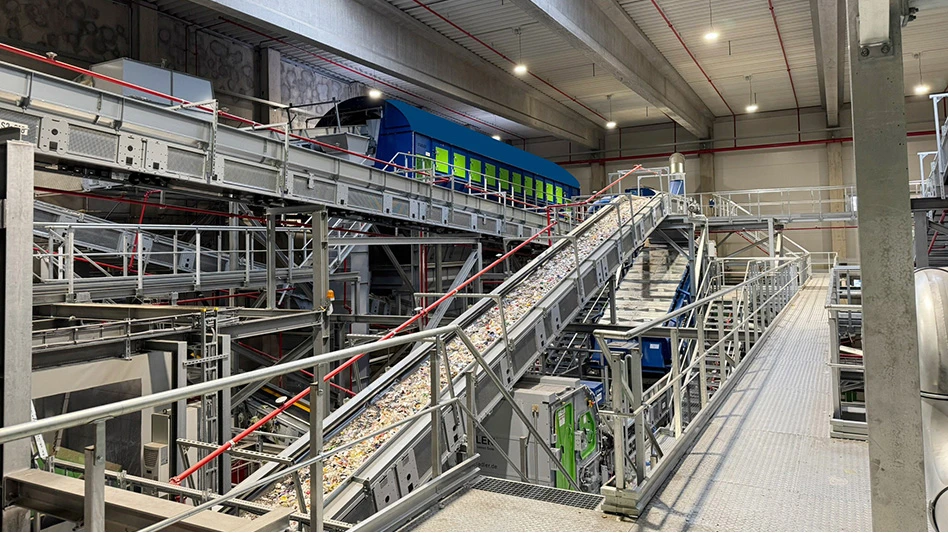
Altshausen, Germany-based Stadler Anlagenbau GmbH says it has worked with by Nehlsen AG and PreZero Recycling Deutschland GmbH to redesign and equip a lightweight packaging sorting plant in Bremen, Germany.
The facility jointly operated by the two Germany-based firms handles approximately 120,000 tons per year of mixed materials, including discarded packaging made from plastic films, paperboard and aluminum.
Stadler, which has a United States business unit based in North Carolina, says the Bremen facility has resumed operations “with a redesigned sorting concept, significantly enhanced fire protection and preparation for automated battery extraction.”
The Sortierkontor Nord (SKN) lightweight packaging facility in Bremen experienced two fires in 2022, damaging parts of the plant, says Stadler. The equipment provider says it was tasked by Nehlsen and PreZero Recycling with the redesign and rebuild of the affected sections with a focus on future-ready safety, automation and operational reliability.
The rebuilt plant, which accepts discarded packaging from a dual-stream collection system in Bremen and surrounding areas, was commissioned in early 2025, says Stadler.
“Fire incidents in light packaging plants tend to cause immense damage because hazardous components such as lithium-ion batteries are often concealed in the material stream,” says Tom Schmitt, a sales manager at Stadler.
“In redesigning the Bremen facility, our priority was to ensure stable sorting performance while significantly increasing fire safety,” he continues. “This involved architectural changes, new system layouts and the integration of technologies inspired by our latest projects.”
One change in the new design was relocating the first classification steps—air separation, magnetic separation and 2D Flex sorting—into a room structurally separated from the main machinery area, says Stadler. Isolating these early process stages is intended to reduce the plant’s overall vulnerability to fire-related incidents.
The rebuilt sections of the plant feature what Stadler calls an optimized flow that reduces material bottlenecks. Three trommel screens, previously positioned in a single area and connected by long conveyor belts, are now arranged opposite each other “for smoother, more accessible operation,” says Stadler.
Plastic films, one of the highest-volume fractions, are now sorted fully automatically, with the option of integrating a third sorting stage in the future. The SKN now produces transparent light-density polyethylene (LDPE) and mixed-film fractions “with improved consistency and reduced manual handling,” according to Stadler.
Stadler describes output from the plant as including 12 high-purity mono-material fractions, including polypropylene (PP), polyethylene terephthalate (PET), polyethylene (PE), polystyrene (PS), mixed polyolefins, a paper, cardboard and carton fraction, aluminum and “additional composite materials.”
The redesign also has provided for the future integration of automated battery extraction technology similar to a system installed at a PreZero lightweight packaging facility in Sollenau, Austria, that can detect and remove batteries.
“Restoring and securing the sorting capacity was our first priority,” says Benjamin Kreie, managing director of SKN. “But together with Stadler, we went far beyond reconstruction. The modified sorting technology, the creation of more monitored fire sections and the possibility to integrate battery extraction all raise the plant to a new level: safer, more robust and better suited for current and future waste streams.”
“Achieving the highest possible level of fire protection, technically and organizationally, was crucial for us,” says Andreas Thiel, a branch manager at PreZero Recycling. “The new plant structure, together with state-of-the-art sorting systems, allows us to operate with greater reliability and significantly reduced risk, ensuring the facility meets both operational and insurability requirements.”
“Fire risks in light packaging sorting can never be completely eliminated,” says Wolfgang Köser, a Stadler sales director. “With the measures implemented in Bremen, including structurally separated classification halls, monitored fire zones, sprinklers and integrated fire suppression systems, the plant now operates at significantly lower risk and with much greater resilience. This project shows what can be achieved when long-term partners work together to rebuild not only what was lost, but to create a facility ready for current and future challenges.”
Latest from Recycling Today
- LyondellBasell scales back recycling target
- Former Liberty UK mills eyed by 3 suitors
- Essity to begin production at UK paper recycling facility
- Georgia-Pacific develops retiree staffing program
- Nova commercializes new rPE grades for packaging
- Indorama Ventures, AMB Spa introduce recyclable PET multilayer tray
- Circ announces new Fiber Club partners
- Fleetio report finds 53.3 percent of fleets researching, piloting AI