Photo courtesy of Nexans
Nexans, a Paris-based producer of wire and cable products with roots tracing back to the 1870s, says it used more than 95,000 metric tons of recycled materials in the making of its products last year.
In its 2025 sustainability report released the second week of this March, Nexans also indicates the copper it used had an average of 19 percent recycled content last year, moving it closer to a 2028 target of 25 percent.
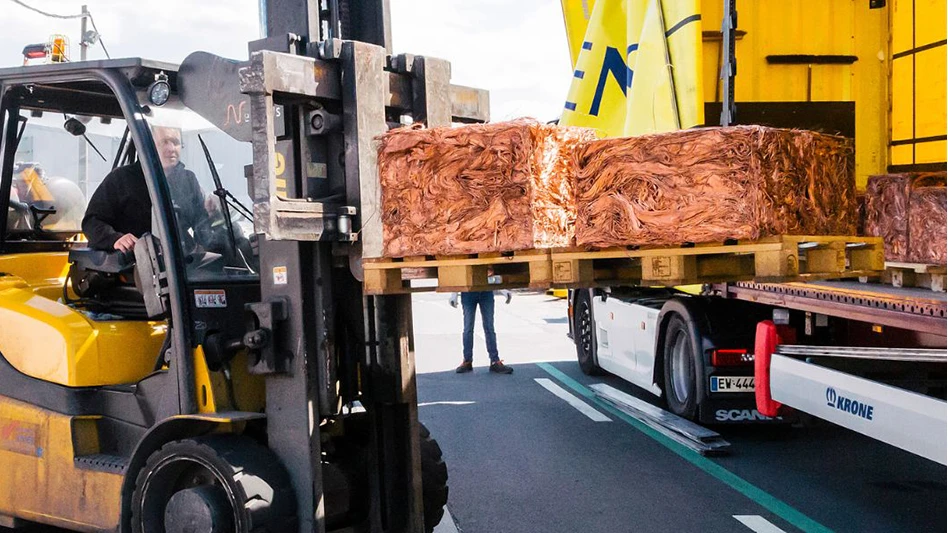
The company is a vertically integrated manufacturer of electric cables that operates copper rod mills in Canada, France, Chile and Peru—facilities where it says it uses an increasing volume of recycled copper in its production processes.
Among the more than 95,000 metric tons of recycled materials it used last year, copper (at 84,300 metric tons, or about 88 percent) was the largest contributor. The company also used more than 5,500 metric tons of recycled-content plastics, 3,760 metric tons of recycled-content steel and another 1,810 metric tons of recycled-content aluminum in 2025.
In terms of plastic, Nexans says the wire and cable coatings it uses that can accept recycled material back into the manufacturing loop include polyvinyl chloride (PVC), polyethylene (PE) and cross-linked polyethylene (XLPE).
Regarding aluminum, Nexans collects aluminum scrap from its cable manufacturing and recycling processes, sells it to aluminum producers and then purchases aluminum with recycled content.
In 2022, Nexans and Germany-based recycled aluminum producer Trimet launched what they call Europe’s first aluminum rod for electricity applications containing 10 percent recycled aluminum. Nexans used the Trimet-produced rod to manufacture new power cables.
In its recently released sustainability report, it refers to substituting virgin raw materials with secondary or reused materials as a policy, adding that it has followed up on that policy by creating recycling channels with customers, suppliers, recycling partners and plants.
In Europe, Nexans has been part of a joint venture along with environmental services firm Suez that focuses on the collection of end-of-life wire and cable. That JV, known as RecyCâbles, was started in 2008.
On its website, France-based Suez says RecyCâbles collects and processes 36,000 metric tons of cables each year, adding that reaching that volume mainly depends on custom logistics solutions followed by the quantifiable and transparent recovery of materials collected.
From that stream, Suez says it can produce 18,000 metric tons of metal granules, including 99.9 percent pure copper chops, and 13,000 tons of marketable recycled plastic.
Regarding downstream metals production, Nexans announced in 2024 an agreement with Italy’s Continuus-Properzi to commission a recycled copper production line at an existing Nexans site in Lens, France.
In the circular economy section of its website, Nexans puts a price tag of 90 million euros ($103 million) on the Nexans Continuous Casting & Recycling (NCCCR) project and expects it to be commissioned in 2027.
NCCCR will enable Nexans to convert up to 80,000 tons of copper scrap annually, strengthening supply resilience while reducing reliance on primary raw materials, the company says.
Nexans points to the global copper supply and demand situation as a factor beyond sustainability backing its strategy to use more recycled material.
The consumption of raw materials essential to electrification is expected to jump in the next five years, the firm says, adding that an estimated 39 million metric tons of copper will be consumed in 2030, up from 29 million in 2020.
“Meanwhile, global annual production [of primary copper] is not likely to exceed 24 million metric tons," Nexans adds, pointing to the growing role of recycling.
On the sustainability side, Nexans says its own materiality assessment shows that mining operations for copper production have significant environmental impacts on ecosystems, including soil, air and water pollution, water use and biodiversity loss.
“By substituting primary resources with secondary resources, such as recycled copper, we can reduce our dependency on natural resources, shrink our environmental impact and decarbonize our cable systems, leveraging Nexans’ end-to-end vertical expertise,” the company says.
More from our latest newsletter
- EY says India’s need for scrap imports will continue
- Conflict poised to increase aluminum’s value, ING says
- USTR to study additional steel, aluminum tariffs
- Indonesia’s nickel pig iron spigot reopens
- Volatility continues in nonferrous metals
- PureCycle loses $182M in 2025
- Smurfit Westrock expands in Latin America
- Recovered paper prices show signs of rebound
- Neste chemical recycling plant is ready to scale up
- Hamburger Recycling announces promotions