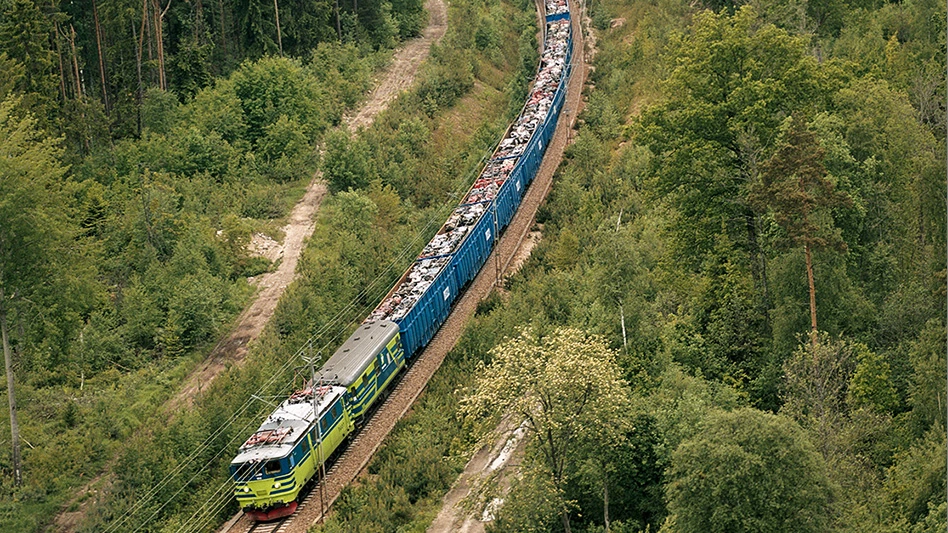
Photo courtesy of SSAB
The Brussels-based World Steel Association (Worldsteel) predicts modest growth in worldwide steel production next year, though a Worldsteel committee member and economist points to “inherent uncertainties” in the global economy.
The latest short-range outlook from Worldsteel covers global demand in 2025 and 2026 and thus demand for the scrap iron and steel consumed in steelmaking furnaces around the world.
Worldsteel, which consists of about 70 national steel organizations, predicts global steel demand in 2025 will be flat compared with 2024, reaching about 1.75 billion metric tons. The group predicts a modest rebound of 1.3 percent for 2026, pushing global demand to about 1.77 billion tons.
“Despite a considerable escalation of the global trade war and inherent uncertainties, we are cautiously optimistic that global steel demand will bottom out in 2025 and demonstrate moderate growth in 2026,” says Alfonso Hidalgo de Calcerrada, who chairs the Worldsteel Economics Committee and serves as chief economist of the Spanish Steel Producers Association. “This positive outlook is underpinned by the demonstrated resilience of the global economy, continued strength in public infrastructure investments in most major economies of the world, and the expected ease in financing conditions.
“The projected growth in 2026 is driven by a mix of powerful regional trends. We expect to see a slowdown in the decline of steel demand from China, coupled with strong growth in developing economies like India, Vietnam, Egypt and Saudi Arabia. Critically, we also anticipate the long-awaited return of steel demand growth in Europe.”
For generators, collectors and processors of recycled steel in North America and Europe, demand growth in India, Vietnam and Egypt could serve as good news, with those nations serving as buyers of imported recycled steel. Industry growth in Europe also would be welcomed by steel recyclers there.
“The path forward isn’t without its challenges," Hidalgo de Calcerrada says. "First, the global manufacturing sector continues to face a squeeze from elevated production costs and sustained affordability pressures on consumers. Second, escalating trade tensions are having a direct, negative impact on steel demand in economies heavily reliant on the export of steel-intensive goods, such as machinery and automotive components. Finally, geopolitical uncertainties act as a major deterrent, chilling both consumer and investor confidence, and dampening steel demand across key markets.”
Worldsteel predicts demand for finished and semifinished steel in China will drop by about 2 percent this year and another 1 percent next year, driven primarily by the ongoing downturn in the housing market.
Meanwhile, Worldsteel forecasts robust growth in steel demand beyond China of about 3.4 percent this year and 4.7 percent in 2026.
“This expansion is primarily driven by strong performance in India, and some ASEAN [Association of Southeast Asian Nations] and MENA [Middle East and North Africa] countries,” Worldsteel says.
The organization foresees Indian steel demand growing by around 9 percent in 2025 and 2026, driven by continued growth in all steel using sectors. The nation’s growth trajectory this decade means steel demand in India could be about 75 million metric tons higher in 2026 compared with 2020.
In the U.S., steel demand is expected to rebound by 1.8 percent this year thanks to front-loading of production ahead of increased tariffs and continued growth in infrastructure spending, Worldsteel says. The organization predicts an identical 1.8 percent growth rate next year, aided by pent-up demand in residential construction and private investment, easing financing conditions and reduced uncertainty.
In the European Union and United Kingdom, steel demand could grow by 1.3 percent this year and 3.2 percent in 2026, according to Worldsteel.
“The long-awaited return of steel demand growth in the EU reflects the impact of increased infrastructure and defense spending in the continent in combination with improving macroeconomic conditions such as lower inflation, easing credit conditions, and improvements in real household income,” the organization says.
Latest from Recycling Today
- SDI, SGH submit revised final offer to acquire BlueScope Steel Ltd.
- Republic Services spends big on acquisitions, reports growth for 2025
- 2026 Circular Steel Summit: The view from Nucor
- Minespider launches digital marketplace for circular batteries
- SWANA, Fire Rover develop fire incident reporting tool
- Recycle BC launches flexible plastics recycling carts in Vancouver
- Shapiro continues leadership appointments
- Iron Crest forms waste equipment manufacturing platform