Matteo served as the moderator for the World Tire Expo workshop titled “How to Get Your State to Participate in the Growing Market for Civil Engineering Uses for Scrap Tires.” Also addressing those in attendance were Dr. Dana Humphrey, professor of engineering at the University of Maine; Paul Routhier of J.P. Routhier & Sons Inc., Littleton, Mass.; and Bob Durand, former Secretary of Environmental Affairs, Commonwealth of Massachusetts.
“The civil engineering market is growing very rapidly,” Humphrey said. “At this point, it’s hard to know the limit of the market. There’s unlimited growth in the short term.”
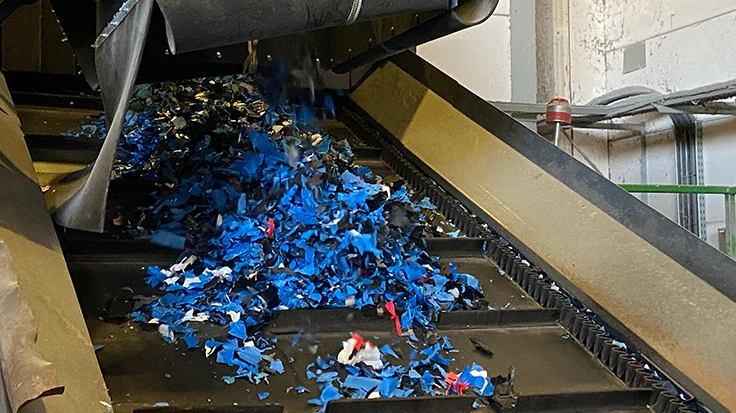
He added that tire shreds in the 3-inch to 12-inch size range, which he prefers to call tire-derived aggregate (TDA), are a “valuable engineering material” because they provide the properties that engineers need at a lower cost than alternative light-weight fill material. The valuable properties include low earth pressure, thermal insulation, better drainage and compressibility.
However, he stressed the TDA should not be used in all cases but reserved for projects that make use of its unique properties. “The owner needs to get a benefit from the tires’ special properties,” Humphrey said.
He added that small sections of civil engineering projects could use large numbers of tires. However, engineer willing to use tire-derived aggregate needs the cooperation of state DOTs, Departments of Environmental Protection and tire processors. Humphrey said it’s best to source the tire-derived aggregate from “true business people” who will provide the product on time and at the proper specification.
ASTM specification D6270 is available as a guideline to direct the use of TDA in civil engineering projects, Humphrey noted. He cited examples of various projects where the material was used successfully at a lower cost than alternative lightweight fill materials, including a project in San Jose, Calif., that used TDA below rail tracks to reduce noise and vibration by 30 percent to 40 percent.
Routhier discussed his permitting problems in the state of Massachusetts. J.P. Routhier & Sons had been producing rubber for use in rubberized asphalt. However, when the ISTEA mandate was repealed in 1995, “crumb rubber for highways was out the window,” he said. The company then turned to the tire-derived fuel (TDF) market. The Massachusetts Department of Environmental Protection responded by claiming its permit was not longer valid, defining the company as a solid waste handler rather than a recycler because Massachusetts does not consider TDF a form of recycling.
“We had no problem getting tires,” Routhier said. “The problem was with accumulation, so we started looking for other avenues.”
Routhier then embarked on long processing educating the Mass. DEP and engineering companies on the civil engineering benefits of TDA.
He also stressed that producing a clean TDA product is an involved process that requires significant equipment investment, saying it took a while for his company to produce a product that met the job’s specification.
Durand closed by saying the burden of proof for any recycling venture lies with the recycler, not with the state regulators. He suggested “finding a godfather” in the administrative or regulatory arena who can weigh in on the decisions that affect recycling.
“If your looking to create legislation, you must engage a state representative,” Durand said, suggesting that interested recyclers go to the state’s environmental community in order to gain allies. “It’s important to be creative,” he said, suggesting that recyclers attempt to attach recycling-related activities to the state budget and start committees to study the benefits of recycling and provide a vehicle to make its case.
Durand closed by saying that if civil engineering uses for TDA can be permitted in Massachusetts, they can be permitted anywhere because of the state’s rigid regulations.
The World Tire Expo, sponsored by the Tire Industry Association, was held in Louisville March 26-28 at the Kentucky International Convention Center. It included workshops on recycling, technical issues, legal considerations, business and finance, as well as an exhibit hall with a variety of equipment and service providers.
Latest from Recycling Today
- Nth Cycle signs offtake agreement with Trafigura
- WeSort.AI recovers critical raw materials from recycling plants
- ReMA provides economic impact report, industry update
- Collective Waste Solutions acquires Alcop Resource Recycling transfer station
- Volatility continues in nonferrous metals
- Neste chemical recycling plant is ready to scale up
- Indonesia’s nickel pig iron spigot reopens
- Ecore says study backs crumb rubber use on sports surfaces