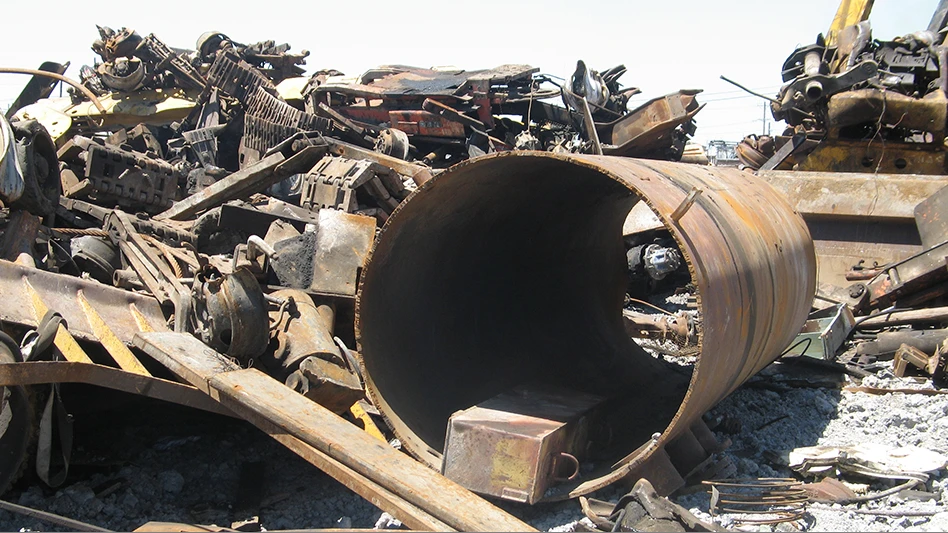
Although China’s government and customs officers have been shoring up their defenses to prevent obsolete computers and television sets from being imported, an exception is being made for end-of-life vehicles.
At a session at the World Recycling Forum, held in Hong Kong in mid-November, Scott Horne, general counsel of ISRI (the Institute of Scrap Recycling Industries Inc.), said a Chinese government official in Beijing had conveyed to him that shredder operators in China’s Jiangsu province had been granted permission to import flattened auto hulks.
The policy change was confirmed by scrap recycler and equipment manufacturer Scott Newell of The Shredder Co., Canutillo, Texas, and scrap recycler Michel Dubois of Luxembourg-based Recylux Group, each of whom told attendees they had seen evidence of the new policy.
Dubois told attendees at a Forum session that in Europe he has witnessed trailer loads of flattened autos “being loaded into bulk vessels and shipped directly to China.” Dubois added, “It is being imported as iron scrap; this is a fresh idea.”
Newell commented that four different shredder locations in Jiangsu province each had received licenses to import up to 400,000 tons per year of auto hulks. “I think it’s a mistake to think this is not going to happen,” he stated.
ISRI’s Horne confirmed that an AQSIQ (Administration of Quality Supervision, Inspection and Quarantine) official in Beijing had handed him a notice “that clearly indicates it’s legal to import flattened or baled autos. That was a huge surprise,” he remarked.
Newell said the shredder operators in Jiangsu province, some in the city of Zhangjiagang and some of them Shredder Co. customers, were feeding the hulks to their shredding plants and were now operating “very sophisticated systems” to remove nonferrous metals from the auto shredder residue (ASR).
Newell indicated that the remaining plastic ASR or fluff was going into landfills, although shredder operators in Zhangjiagang were aware of the “worldwide push to recover the energy units” from ASR. “It can be seen as a positive, green energy thing” if they do this, said Newell.
Jim Puckett of the Basel Action Network (BAN), Seattle, expressed concern about the presence of mercury switches, lead solder and other hazardous materials potentially found in auto hulk shipments. “China has always been a vocal supporter of the Basel Convention,” he noted.
Dubois said European exporters are well aware of de-pollution techniques to remove hazardous materials and characterized compliance with such measures in Europe as high, especially in northern Europe.
When asked if European recyclers might push for a law to prohibit their shredder feedstock from being exported, Dubois of Recylux was skeptical that Brussels would respond quickly. “In Europe, if you want to pass a law it takes years,” he commented.
The 2011 World Recycling Forum, hosted by ICM AG, was Nov. 15-18 in Hong Kong.
Latest from Recycling Today
- Novelis resumes operations in Greensboro, Georgia
- Interchange 360 to operate alternative collection program under Washington’s RRA
- Waste Pro files brief supporting pause of FMCSA CDL eligibility rule
- Kuraray America receives APR design recognition for EVOH barrier resin
- Tire Industry Project publishes end-of-life tire management guide
- Des Moines project utilizes recycled wind turbine blades
- Charter Next Generation joins US Flexible Film Initiative
- Vecoplan to present modular solutions at IFAT 2026