Waste facilities today are dealing with an increasingly unstable operating environment. Material streams shift from season to season, labour shortages continue to pressure staffing models and safety risks remain constant across every shift. Automation is gaining traction, but the value of a robot isn’t in how impressive it looks. It’s in whether it actually reduces daily operational friction.
That’s the lens Waste Robotics Chief Engineer Pier Grenon uses in every product decision. After years spent inside MRFs, observing lines, troubleshooting equipment and listening to supervisors describe what slows them down, his view is straightforward: automation must be engineered for real conditions, not theoretical ones.
A clear picture of what operators struggle with
When asked about the issues he hears most often, Pier points to a familiar list that now spans nearly every region.
- Constantly shifting streams.
The inbound mix changes more often than most systems were built for. Holidays, local events and lifestyle patterns all influence what arrives at the line. Equipment that is rigid or slow to adapt forces operators into reactive decisions.
- Labor shortages and turnover.
Facilities struggle to maintain consistent staffing levels. When people don’t show up or leave midshift, productivity stalls.
- Repetitive, physically demanding tasks.
Manual sorting exposes workers to heavy lifting, repetitive motions and unsanitary conditions. That combination raises safety concerns and accelerates fatigue.
- Variable sorting quality.
Human performance fluctuates. A line can operate very differently depending on who is working that day, which complicates forecasting and quality control.
- Limited hours dictated by manpower.
Even when facilities want to extend production, staffing constraints often make it unrealistic. These issues form the backdrop of every automation discussion, and they shape how Waste Robotics approaches product design.
What automation must actually solve
For Pier, the value of automation lies in its ability to deliver stability. He highlights four areas where facilities expect measurable results.
- Adaptability without disruption.
Robots must respond to changing conditions immediately. Waste Robotics systems allow operators to switch recipes quickly so sorting logic matches the stream without slowing production.
- Predictable throughput and consistent quality.
With automated reporting, supervisors see real numbers, not estimates. It becomes easier to evaluate performance and plan operations.
- Availability that supports extended shifts.
Where human crews rotate or fatigue, robots provide steady uptime, allowing facilities to operate more hours with fewer staffing challenges.
- Reduced dependence on manual labour.
Automation absorbs the repetitive, physically demanding tasks, allowing teams to shift toward safer, higher-value roles.
These improvements are not positioned as promises. They are baseline expectations for any system intended to stabilize production.
Designed specifically for MRF environments
When prospects compare options, Pier returns to a core idea. Robots must be built for the realities of the MRF floor.
That means designing with:
- A tolerance for dirt, moisture and vibration that would disrupt more delicate systems
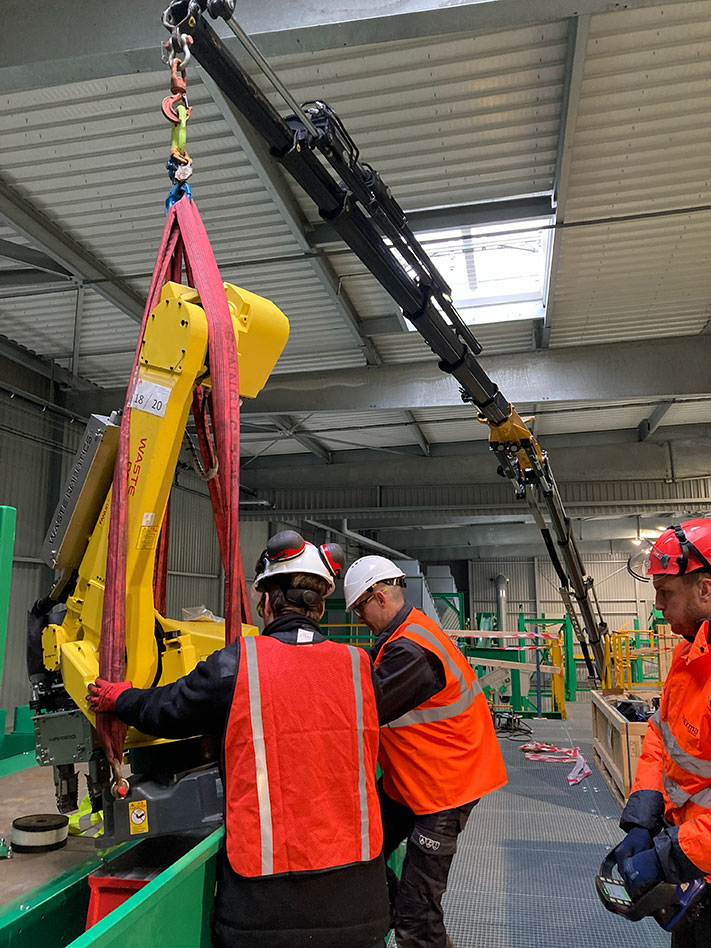
- Straightforward maintenance so technicians can work efficiently with minimal training
- Modularity and scalability to accommodate changing material profiles and business needs
- Performance validated in real conditions, not controlled demonstrations
These principles guide how Waste Robotics engineers its systems. The objective is simple: build automation that works where operators actually work.
Moving forward with practical automation
As the waste sector evolves, automation is shifting from an optional enhancement to a practical operational requirement. Facilities need stability, safer working conditions and predictable outcomes, not hype or inflated expectations.
Pier Grenon’s product philosophy reflects this shift. His approach prioritizes systems that respond to real-world constraints, support operators and adapt as the industry continues to change.
Waste Robotics remains committed to developing automation that serves the daily realities of MRFs, with systems designed deliberately for the environments that depend on them.
Learn more
Metal recovery facilities and integrator partners interested in deploying the WR robots or requesting a live demonstration can contact Waste Robotics at (info@wasterobotic.com) or visit (https://www.wasterobotic.com).
Latest from Recycling Today
- Fleetio launches AI capability to accelerate fleet maintenance approvals
- The Metals Agency receives approval for export credit insurance
- Recycle Ann Arbor extends drop-off station operating hours
- Sybilion seeks to help manufacturers confidently address volatility
- Rio Tinto, Prysmian partner on low-carbon aluminum solutions for data centers
- Unilever criticized for plastics approach
- USTR to study additional steel, aluminum tariffs
- Electrified Materials adds processing capacity