VTT Technical Research Centre of Finland Ltd., a research and development partner based in Espoo, Finland, has announced that it has demonstrated how chemical recycling offers an alternative to incineration and possibly to mechanical recycling through a two-year Business Finland WasteBusters project.
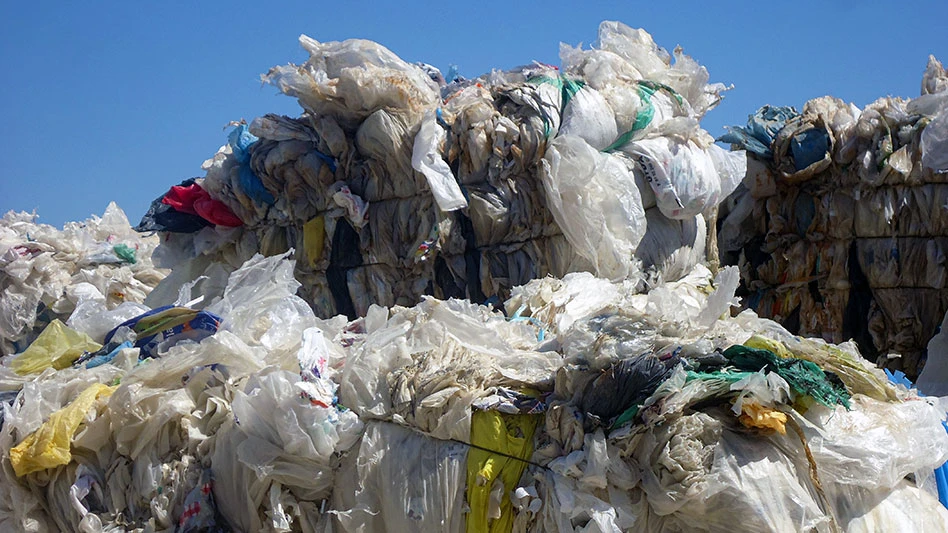
According to a news release from VTT, mechanical recycling suits the most common plastic bottles, bags and wraps to sort, wash, melt and mold them into new products. However, about 40 to 60 percent of separately collected plastic waste in Finland ends up incinerated, VTT reports. Additionally, the quality of plastic weakens with use and the number of recycling loops.
“By chemical recycling, however, plastics and their mixtures can be broken down into separate raw materials, whose quality is equal to that of respective virgin materials,” says Anja Oasmaa, senior principal scientist at VTT.
Oasmaa says legislation in Finland does not recognize chemical recycling of plastics as being equal to mechanical recycling. VTT is currently compiling an account of chemical recycling of plastics for the nation’s Ministry of Environment, VTT reports in a news release.
WasteBusters research
In the WasteBusters project, long polymer chains of plastics and their mixtures were pyrolyzed (i.e., heated in the absence of oxygen) and chopped into shorter chains. The resulting pyrolysis wax or oil can likely be processed with traditional methods at oil refineries, VTT reports in a news release.
“Pyrolysis oil can be distilled into separate monomers, diesel and other fractions, some of which can be used directly as fuels and some as raw material for plastics and other chemicals,” Oasmaa adds.
The project focused on pretreatment and pyrolysis of plastic waste and also on posttreatment of the product. Oasmaa says improvements of pretreatment in particular are decisive for a cost-effective concept.
“There are all kinds of films as well as both dense and porous pieces together in plastic waste, which makes it difficult to handle,” Oasmaa says. “We managed, however, to make it homogenous with the Modix-extruder developed by VTT.”
Market interest
The supply of plastic waste in Finland has been considered too small for pyrolysis, VTT reports. Scientists, however, calculated in the project that a network of approximately 10 pyrolysis plants could prove profitable, if pyrolysis of plastic waste and wood waste were combined. They suggested that pyrolysis plants be attached to waste recycling plants.
This topic has actually stirred up some interest in the market during the WasteBusters project, VTT reports in a news release.
“For example, the recycling of polystyrene has aroused a lot of business interest, as not all polystyrene waste can be mechanically recycled,” Oasmaa says. “Also, chemical recycling provides raw material for the production of other materials besides polystyrene, such as latex.”
VTT is already preparing further studies on related topics, such as recycling of polystyrene; removal of hazardous compounds from plastic waste; and production of diesel fuels from plastic waste to be used in flexible power generation and marine transport, the research partner reports in a news release.
“Companies are interested in the fact that plastic waste can be turned into other chemicals besides plastics, which will then replace virgin fossil raw materials in a sustainable manner,” Oasmaa says. “We want to develop this line of business with sustainable solutions in close cooperation with companies.”
Latest from Recycling Today
- Nashville Waste Services launches new digital route system
- Arconic expands in Iowa
- Cascades invests $6.9M in recycled boxboard plant
- Ocean freight interruptions poised to continue
- Danieli to supply shredder to Australian company
- Equipment from the former Alton Steel to be auctioned
- Novelis resumes operations in Greensboro, Georgia
- Interchange 360 to operate alternative collection program under Washington’s RRA