AndreiNN | stock.adobe.com
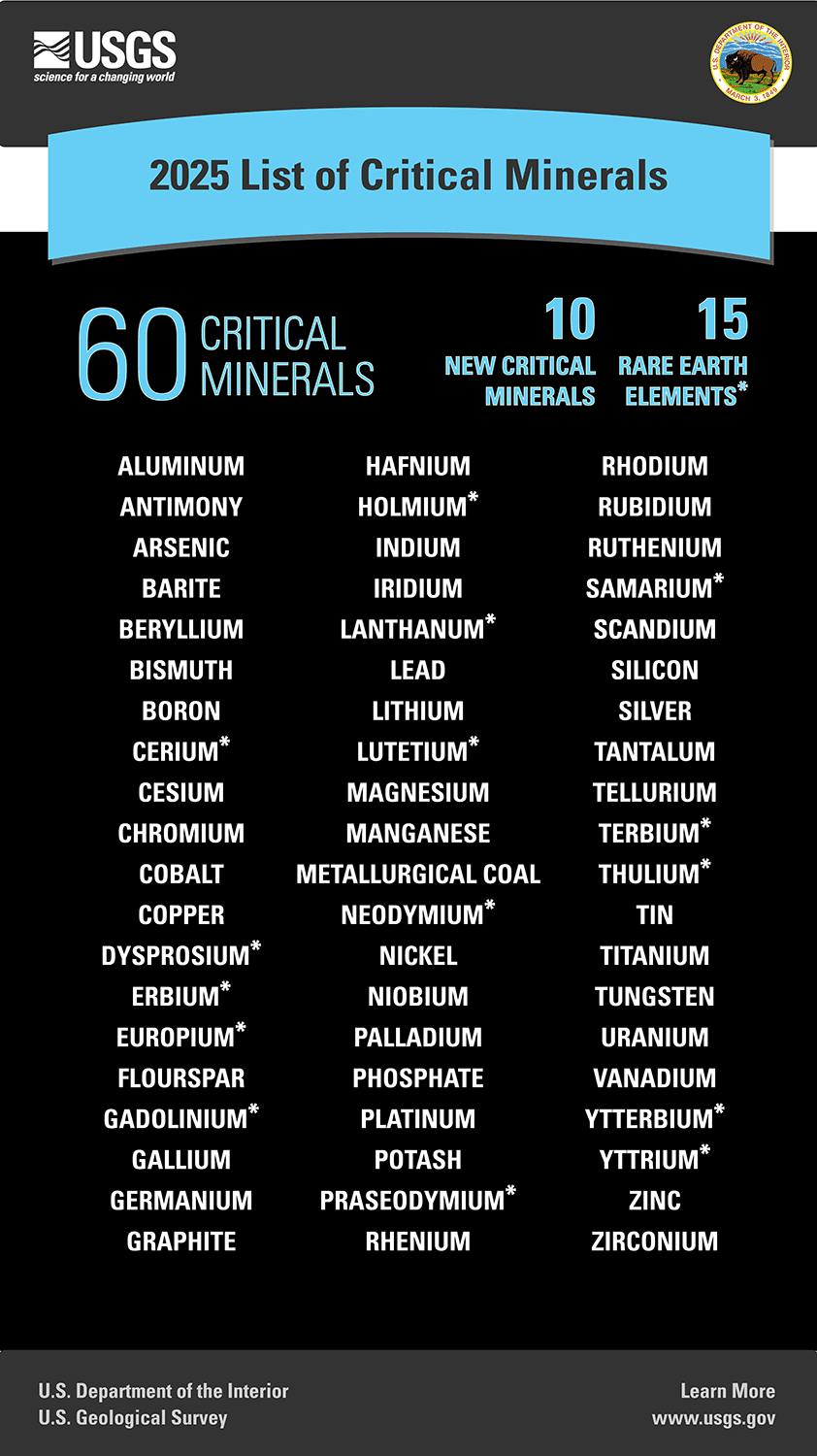
The U.S. Geological Survey (USGS) has finalized its List of Critical Minerals for 2025, updating its 2022 list. The list of 60 minerals features 10 new minerals, including copper for the first time.
Originally created in 2018, the U.S. Critical Minerals List contains minerals deemed essential to U.S. economic or national security that have supply chains vulnerable to disruption. The list by statute is intended to be updated every three years at a minimum, however, the Secretary of the Interior can update it at any time.
RELATED: Critical Mineral Consistency Act passes House
Compared with the draft list released in late August for comments, the final list added arsenic, boron, metallurgical coal, phosphate, tellurium and uranium, with the Federal Register notice citing Department of Energy advocacy for metallurgical coal and uranium and Department of Agriculture advocacy for phosphate as reasons for inclusion.
Arsenic and tellurium, which were recommended for removal by USGS on the draft list, were included because of national security concerns raised by the Department of Defense, while boron was added given additional information USGS received during the public comment period that indicated the mineral has similar supply chain vulnerabilities to other critical minerals like silicon and titanium.
In addition to copper, the draft list included lead, potash, rhenium, silicon and silver, which remain on the final list.
Gold, which several Trump administration actions have recognized as “critical,” was not added to the final list.
Copper’s criticality finally recognized
When compiling the 2022 list, USGS used a new qualitative methodology to assess the supply risk score by calculating the economic vulnerability, disruption potential and trade exposure of various minerals. USGS stopped calculating with 2018 data when compiling the 2022 list, resulting in copper missing the required 0.4 supply risk score threshold for automatic inclusion.
However, in early 2023, Copper Development Association (CDA), McClean, Virginia, released a report noting that copper met the USGS’ benchmark Supply Risk score of 0.4 for automatic inclusion on the U.S. Critical Minerals List. According to the CDA, the report replicates the USGS methodology used to determine mineral criticality.
At that time, the CDA noted that new USGS data show the share of copper consumption in the U.S. met by net imports had increased from 33 percent in 2018 to 44 percent in 2021 and 41 percent in 2022. In the first half of 2022, the net import reliance stood at 48 percent, the CDA says.
"We strongly support USGS' decision to add copper to the Critical Minerals List," CDA President and CEO Adam Estelle says. "As CDA has long championed through our #CopperIsCritical campaign, copper holds the key to achieving America's top policy objectives, including energy dominance, A.I. supremacy, national security and re-industrialization. The United States cannot grow in strategic sectors without a strong power grid, which cannot exist without a strong domestic copper industry. This is a massive step in the right direction that will accelerate progress in bringing more supply online in the face of surging demand."
In a news release the CDA issued after copper made the draft list, the association says the flow of U.S. copper to market has been stymied by "convoluted permitting, overreaching regulations" and a lack of strategic industrial policy to protect domestic producers from what it says are trade-distorting practices of China and other nonmarket economies.
"The timing is crucial as the U.S. needs to rapidly implement an ‘all-of-the-above’ sourcing strategy to meet the projected doubling of copper demand by 2035," CDA continues. "This must involve increased domestic mining, refining, recycling and continued trade with reliable partners.
“Critical Minerals status is the missing piece of a holistic set of policy solutions required to ensure a stronger, more reliable and more resilient domestic copper industry. With the new Section 232 national security tariffs focused on protections for midstream and downstream copper product manufacturers, Critical Minerals status is essential to address remaining upstream issues in copper mining and refining through a different set of policy tools.”
Guiding strategies to secure supply chains
According to a document from the Department of the Interior scheduled to be published in the Federal Register on Nov. 7, the U.S. is home to mineral resources that can create jobs and significantly reduce the country’s reliance on foreign nations for these minerals. The department adds that the government is taking actions to facilitate domestic mineral production and that the List of Critical Minerals guides strategies to secure the nation’s mineral supply chains.
Earlier this year, President Donald Trump signed an executive order to expedite domestic mineral production, invoking Section 301 of Title 3 of the United States Code. The order positions the new National Energy Dominance Council (NEDC), chaired by Secretary of the Interior Doug Burgum, to take a leading role overseeing the progress associated with the order.
In his “Immediate Measures to Increase American Mineral Production” executive order, the president writes, “The United States was once the world’s largest producer of lucrative minerals, but overbearing federal regulation has eroded our nation’s mineral production. Our national and economic security are now acutely threatened by our reliance upon hostile foreign powers’ mineral production. It is imperative for our national security that the United States take immediate action to facilitate domestic mineral production to the maximum possible extent.”
The executive order is intended to help facilitate permitting for mineral production projects.
During the public comment period for the draft 2025 list, USGS asked for comments on whether to move to annual updates of the Critical Minerals List. In the document to be published to the Federal Register, the Department of the Interior notes that mineral criticality changes over time, therefore, the 2025 List of Critical Minerals is not a permanent list but will be updated no less than biannually to reflect current data on supply, demand and concentration of production, as well as current policy priorities.
Latest from Recycling Today
- Fleetio launches AI capability to accelerate fleet maintenance approvals
- The Metals Agency receives approval for export credit insurance
- Recycle Ann Arbor extends drop-off station operating hours
- Sybilion seeks to help manufacturers confidently address volatility
- Rio Tinto, Prysmian partner on low-carbon aluminum solutions for data centers
- Unilever criticized for plastics approach
- USTR to study additional steel, aluminum tariffs
- Electrified Materials adds processing capacity