The Recycling Partnership
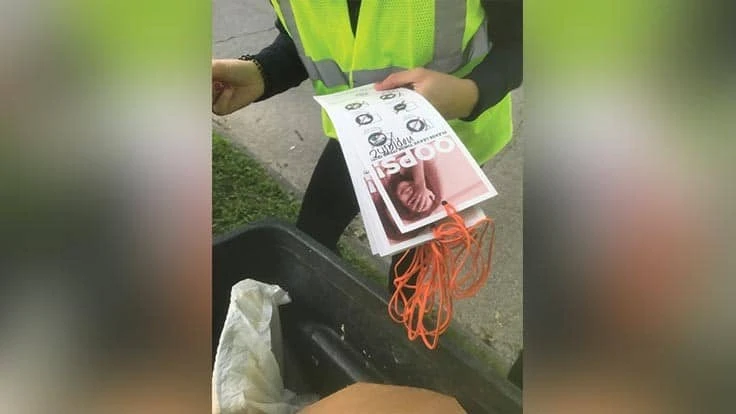
The Environmental and General Services Department (EGSD) in Tucson, Arizona, has announced that it has launched The Recycling Partnership’s Feet on the Street cart tagging initiative in an effort to improve the quality of recycling in single-stream curbside recycling bins by providing residents with personalized and real-time curbside recycling education and feedback.
Tucson is one of 10 recipients of Falls Church, Virginia-based The Recycling Partnership’s Leadership Grant in the fall of 2020. The city received $140,750, which is now going to the Feet on the Street campaign. Other leadership grantees are the cities of Baltimore; Detroit; Houston; Omaha, Nebraska; Philadelphia; Portland, Oregon; San Diego; Tacoma, Washington; and Washington.
According to a news release from EGSD, the initiative will help the city to achieve its 50 percent waste reduction by 2030 and zero waste by 2050 goal outlined in its Climate Emergency Declaration that passed by the mayor and city council in the fall of 2020.
According to The Recycling Partnership, the Feet on the Street program is intended to increase the amount of quality recyclables. It has helped communities to achieve economically efficient recycling programs, reduces the number of new resources used in packaging and improves the health of communities.
"After reducing and reusing, recycling is one of the best ways to decrease waste locally," says Tucson Mayor Regina Romero. "Recycling properly reduces the extraction of raw materials to produce new goods and enables our community to participate in local solutions to combat climate change. Through the Feet on the Street campaign, we are providing personalized, real-time feedback to enhance local recycling efforts."
The Feet on the Street program is an education and outreach strategy that involves community-based observers visiting each residents’ cart and providing tailored feedback on how to improve what items should go into the cart. EGSD says for Tucson, recyclable should be loose and not in bags; items with food residue, batteries, small electronics and polystyrene should not be placed in recycling carts.
“The Recycling Partnership’s Feet on the Street program works by providing the public personalized and real-time feedback on what is and is not recyclable in their curbside recycling cart,” says Jill Martin, director of community programs at The Recycling Partnership. “Through this recycling education initiative, we are helping Tucson capture more quality recyclables that are then transformed into new materials, creating a more circular economy, a less wasteful planet and stronger, healthier communities.”
To date, The Recycling Partnership has implemented this educational program in more than 70 communities across the U.S., with some communities seeing a 57 percent decrease of nonrecyclables in recycling and a 27 percent increase in the overall capture of quality recyclables.
Latest from Recycling Today
- U.S. Aluminum Co. explores aluminum fabrication plant in Oklahoma
- Sonoco completes portfolio transformation
- Eriez Shred1 data demonstrates scalable copper control
- RCI selects CurbWaste as exclusive operational management platform
- Updated: Supreme Court strikes down IEEPA tariffs
- Recycling Today Media Group launches Scrap Expo Lunch & Learn Webinar Series
- LyondellBasell scales back recycling target
- Former Liberty UK mills eyed by 3 suitors