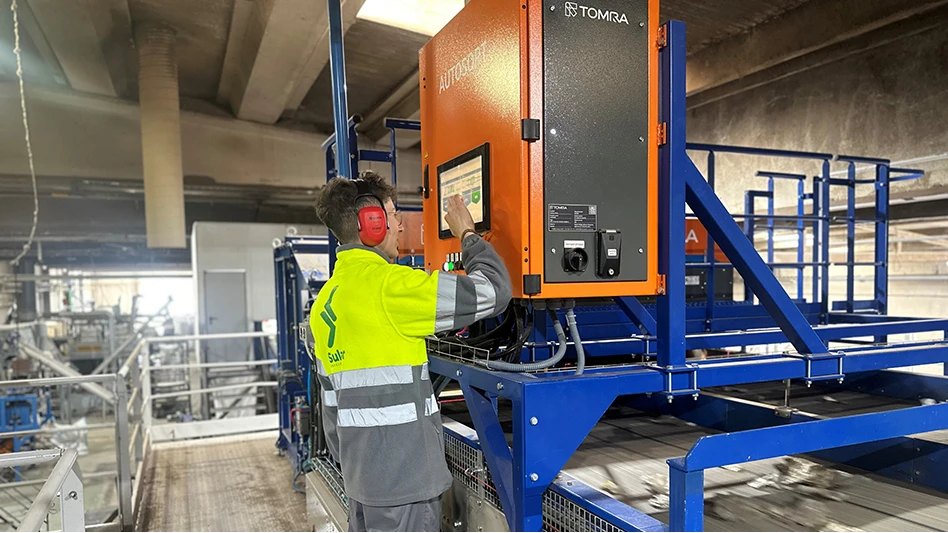
Photo courtesy of Tomra Recycling
Tomra Recycling, the sorting technology business unit of Norway-based Tomra Group, says its equipment has been deployed at a Sulayr Recycling facility in Spain that accepts discarded thermoformed polyethylene terephthalate (PET) food trays to recycle them back into food-contact PET.
Sulayr Recycling, based in Granada, Spain, specializes in recycling complex and multilayer thermoformed PET trays, says Tomra. “By optimizing its sorting infrastructure, Sulayr is establishing a stable and scalable model for circular PET packaging in Europe,” says the technology provider.
More than 5 million tons of PET packaging enter the European market annually, with PET trays representing roughly 25 percent of that volume, according to the companies.
According to Tomra, Sulayr currently is serving more than 100 customers in Europe and it produced more than 50,000 tons of recycled PET last year, which the firms calls equivalent to a production capacity of more than 4 million trays per day.
Much of the material Sulayr processes is sourced from extended producer responsibility (EPR) systems in Europe. Depending on its geographic origin and the time of year, the input material varies significantly, involving a blend of PET types, multilayer structures and polymer contaminants.
“As quality requirements evolved, stability became just as critical as purity,” says Sergio Collado, chief technology officer at Sulayr. “For tray-to-tray applications, you need a process that delivers consistent results every single day, not just under ideal conditions.”
To achieve the desired level of consistency, Sulayr asked Tomra Recycling to co-design and optimize the sorting process.
Tomra says it provided advice on optimal machine positioning and pre-treatment steps that can help ensure material reaches the sorting units in peak condition. The objective was to engineer “a stable, scalable process architecture rather than simply installing standalone machines,” says the technology provider.
“This was far from a standard supplier relationship,” says Jesús Espinar, an area sales manager at Tomra Recycling. “We collaborated closely with Sulayr to align with their targets, material characteristics and operational constraints. Our shared responsibility was to design a process that performs reliably and consistently delivers the high-quality required by current European regulatory standards while providing the flexibility to adapt as those requirements become even more stringent in the future.”
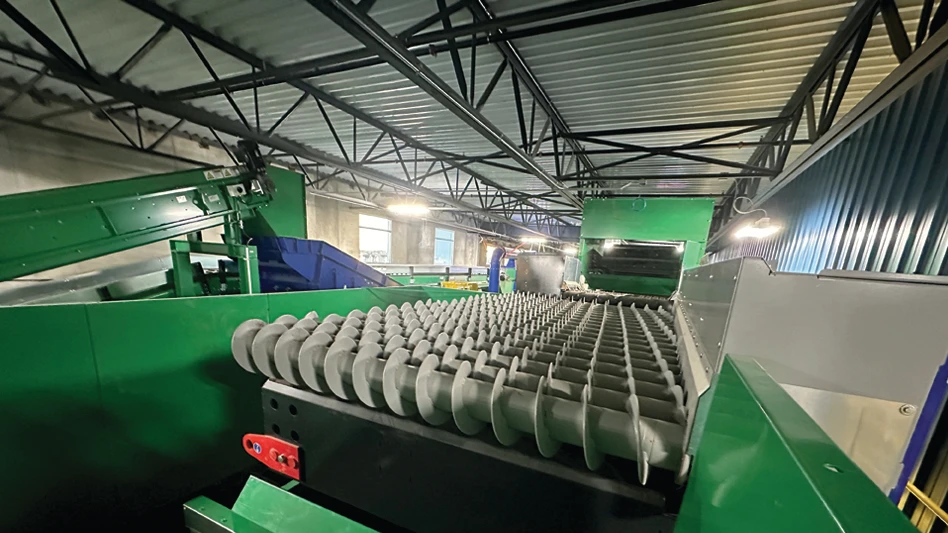
Devices deployed include a dual-track AutoSort and an InnoSort Flake system, both integrated into Sulayr’s wider configuration. The process chain incorporates material reception, optical sorting at tray level, washing, grinding, flake purification and final extrusion into tray-grade rPET, according to Tomra.
In the first step of the AutoSort, clear and light blue PET is positively ejected from the mixed stream. In the second step, the remaining non-target materials are removed to create a high-purity product.
Following shredding, the InnoSort Flake performs the final purification step to detect unwanted flakes by polymer type, color and transparency in a single sorting step, ensuring precise separation even at small particle sizes.
The result is an end product stream with consistently high and stable purity levels above 99.8 percent, says Tomra. “This enables immediate reuse in food-grade applications and supports Sulayr’s goal of transparent tray-to-tray recycling,” states Tomra.
Thanks to the installations, material recovery has increased and the volume of rejects has been reduced, strengthening Sulayr’s quality and operational profitability, according to Tomra.
While the primary target fraction remains transparent PET trays, certain colored tray fractions also can be sorted and reprocessed depending on market demand and customer specifications.
“What made the difference was how closely we worked together with Tomra during integration,” says Antonio Jesús Marcos, head of marketing at Sulayr Recycling. “It was not just about installing equipment. We aligned on process details, performance targets and long-term stability. The focus was always on results under real operating conditions, rather than on theoretical figures.”
The increased stability of output quality has allowed Sulayr to meet strict customer specifications and access new customer segments, says Tomra Recycling, including converters and packaging producers.
Latest from Recycling Today
- Tariff criticism directed toward steel industry
- Vinyl Institute launches enhanced recycling directory
- McNeilus introduces AI material contamination detection technology
- Closed Loop report identifies opportunities to increase prescription pill bottle recycling
- Organics Recycling Conference 2026: Q&A with keynote speaker Andy McNeill
- CMRA selects Vietnam for 2026 event
- Steel Dynamics foresees profitable Q1
- AF&PA joins NAW lawsuit in Oregon