Photo courtesy of Tomra
Norway’s new national facility for sorting all types of plastic packaging scrap, including plastic that otherwise would be incinerated, officially opened its doors Nov. 5.
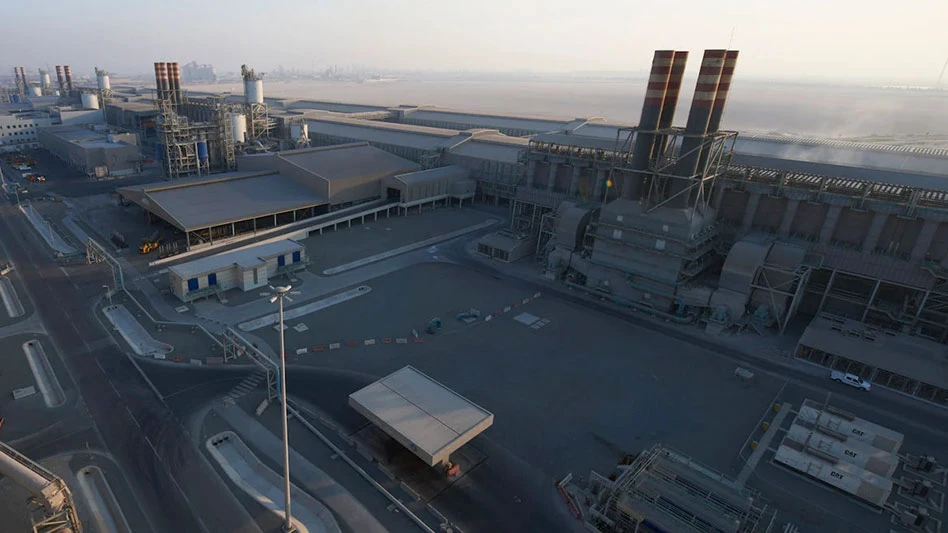
The facility, Områ, spans slightly more than 3 acres and is located just outside Oslo. It is jointly owned by Norway-based companies Tomra (65 percent) and Plastretur (35 percent), a producer responsibility organization. Tomra says the facility is “state-of-the-art” and has the capacity to process 90,000 tons of plastic per year, turning packaging scrap into uniform polymer fractions ready for recycling.
Tomra tells Recycling Today that by 2030, the facility is expected to handle about 80 percent of Norway’s plastic from the residual waste stream. Områ uses advanced sensor-based technology to sort mixed plastic into 10 separate monofractions, including polyethylene (PE), polypropylene (PP), polyethylene terephthalate (PET), polystyrene (PS) and more, enabling improved recovery and increased recycling rates.
“Områ is more than a facility—it’s a missing link in Europe’s circular economy,” Tomra President and CEO Tove Andersen says. “This facility has the capacity to receive and transform all of Norway’s household plastic packaging waste into recyclable fractions, essentially closing the loop for plastics. It is a cornerstone piece of infrastructure providing reliable offtake for mixed waste sorting facilities and can help recover more resources from source separated material.”
Tomra says the new facility will serve as a reliable offtake solution for municipalities and waste management companies considering the introduction of automated mixed waste sorting (MWS), a crucial step for increasing recycling rates without depending solely on household source separation.
To process plastic, trucks deliver baled mixed plastic scrap to the facility, and those bales are offloaded, stored and fed onto conveyors leading to a shredder. Bales are shredded to open bags and loosen material, then oversized pieces greater than 340 millimeters are reshredded to ensure uniform feed size.
The shredded stream continues to the production area, where a drum screen divides material into fine fractions smaller than 150 mm, midsize fractions of 150-240 mm and course fractions of 240-340 mm. Fine material is screened further through the use of star and flip-flop screens to extract plastics, Tomra says, while residual fines smaller than 15 mm are discarded. The company says windshifters remove light plastic films before ballistic separators divide the stream into two-dimensional film and three-dimensional rigid materials.
Next, 2D and 3D streams pass through near-infrared (NIR) sorting lines that identify and separate plastics by polymer type, Tomra says. Sorted output fractions include:
- 2-D plastics such as transparent and colored low-density polyethylene, PP film and mixed polyolefins;
- 3-D plastics such as high-density polyethylene, polyvinyl chloride, PP rigid, PET bottles and trays; and
- residuals such as low-quality or nonrecyclable mixed plastics sent to incineration.
After plastics are separated by type, they are collected in bunkers and baled.
The facility will employ approximately 30-40 people at full operational capacity, though the facility is highly automated.
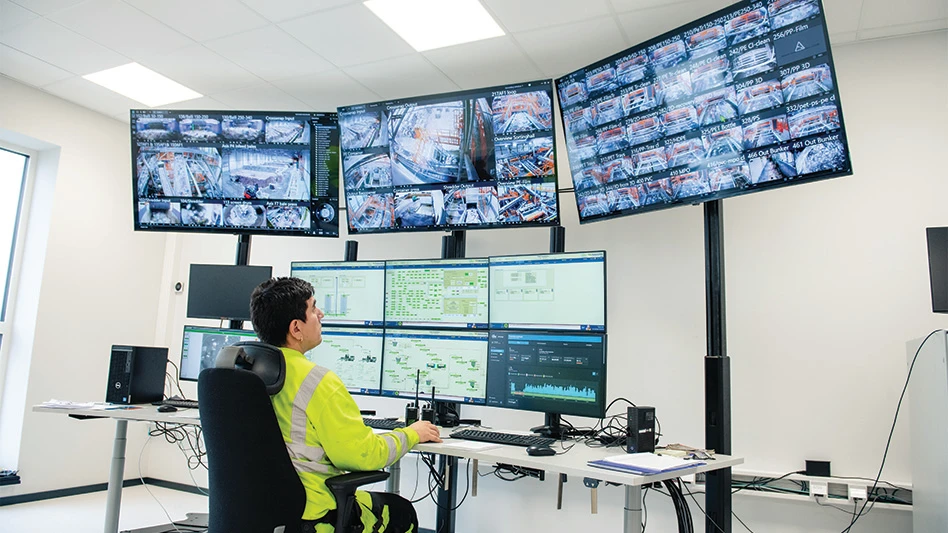
“Advanced sensor-based sorting systems, robotics and digital monitoring technologies handle the majority of material processing, dramatically reducing the need for manual sorting and minimizing contamination,” says Joachim N. Amland, head of Tomra Feedstock. “However, skilled staff are essential for overseeing operations, performing quality assurance, maintaining equipment, managing system performance and addressing any nonstandard materials or process adjustments. This balanced approach ensures both efficiency and operational reliability.”
Tomra notes that by 2030 the European Union requires a minimum 55 percent of plastic packaging scrap to be collected and recycled at scale under the forthcoming Packaging and Packaging Waste Regulation (PPWR). Today, the company claims approximately one-third of Norway’s plastic packaging scrap is recycled, with much of the rest being incinerated.
Amland says a key challenge in raising recycling rates and meeting ambitious recycled content targets has been the limited supply of high-quality, polymer-specific recycled feedstock suitable for reuse in new packaging. To that end, he says Områ is capable of producing clean, high-purity monofractions through its sensor-based and mechanical sorting systems.
“These consistent, high-grade material streams enable recyclers and packaging manufacturers to incorporate more recycled content without compromising quality or performance,” Amland says. “Consequently, Områ not only supports Norway’s national recycling objectives, but also positions the country to meet, and potentially exceed, forthcoming EU regulations on minimum recycled content in packaging materials.”
Amland says the overarching aim of Områ is to enable Norway to take full responsibility for managing its own plastic scrap and to play a central role in the country’s emerging national infrastructure for plastic collection and recycling.
“By doing so, the facility supports the transition towards a truly circular economy, one where plastic is kept in continuous use rather than being disposed of or incinerated,” he says. “Områ will help packaging producers meet recycled content and other regulatory targets while fostering innovation, resource efficiency and environmental stewardship across the value chain. Ultimately, the facility aspires to set a new benchmark for sustainable plastic management in Norway and beyond.”
Latest from Recycling Today
- Fleetio launches AI capability to accelerate fleet maintenance approvals
- The Metals Agency receives approval for export credit insurance
- Recycle Ann Arbor extends drop-off station operating hours
- Sybilion seeks to help manufacturers confidently address volatility
- Rio Tinto, Prysmian partner on low-carbon aluminum solutions for data centers
- Unilever criticized for plastics approach
- USTR to study additional steel, aluminum tariffs
- Electrified Materials adds processing capacity