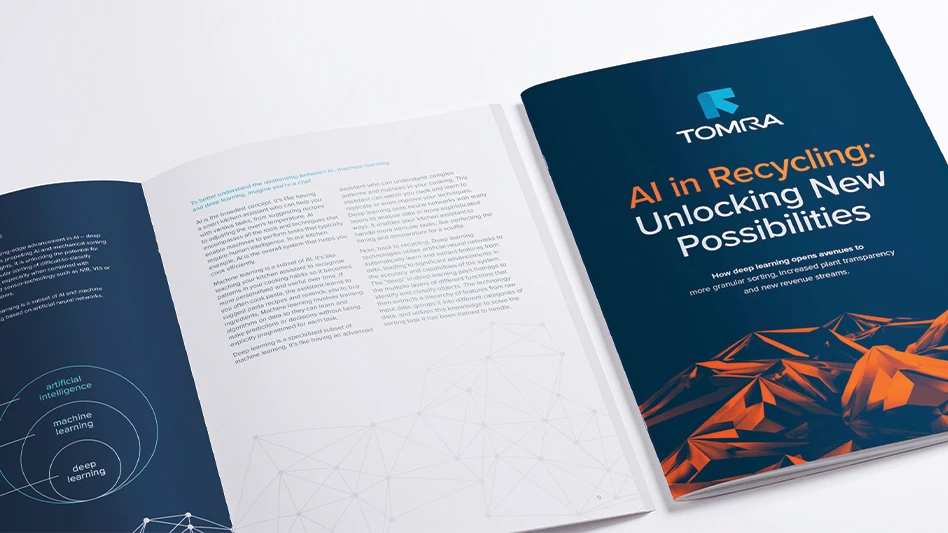
Image courtesy of Tomra Recycling
Tomra Recycling, the sorting and recycling technology business unit of Norway-based Tomra ASA, has published its latest e-book, “AI in Recycling: Unlocking New Possibilities.” The company says the comprehensive guide explores the rapidly evolving role of artificial intelligence (AI), particularly deep learning, in “revolutionizing” the global recycling industry and driving material circularity.
Tomra says the free-to-download e-book aims to demystify deep learning, explaining its mechanisms and showcasing its practical applications in overcoming complex sorting challenges, such as enabling the separation of previously hard-to-classify materials through the training of vast datasets. From manual processes to the prospect of fully autonomous AI-driven systems, Tomra says the evolution of sorting technologies also is examined in detail, alongside the core concepts of AI and deep learning.
Tomra says the e-book details how the synergy achieved by combining deep learning with traditional sensors in optical sorters is unlocking new opportunities for the recovery of valuable resources, enhancing material purity and creating new revenue streams. The company says this is exemplified by its GainNext product for food-grade plastics recovery of polyethylene terephthalate (PET), polypropylene (PP) and high-density polyethylene (HDPE); PET and paper cleaning and high-purity recovery of aluminum used beverage cans (UBCs); and the capabilities of the PolyPerception AI-based material analyzer in providing real-time, end-to-end object tracking and classification of material streams.
According to the company, Readers will gain insights into the tangible benefits of deep learning-based solutions, including enhanced flexibility, the creation of new high-value material streams, superior sorting accuracy, advanced plant automation and optimized processes. The guide also highlights the growing range of deep learning applications developed by Tomra, including real-world examples.
Furthermore, Tomra says its e-book examines the role of AI in meeting the demands of evolving regulations like the European Union’s Packaging and Packaging Waste Regulation (PPWR), which necessitates advanced sorting capabilities to achieve circular economy targets. Looking ahead, the company says the e-book presents a vision for the future where AI could drive fully transparent and self-optimized recycling plants.
“We believe our new e-book will serve as a valuable resource for the global recycling community, providing a clear understanding of how deep learning is not a futuristic concept, but rather a tangible solution that is already delivering significant benefits and paving the way for a truly circular economy,” says Fabrizio Radice, senior vice president and head of sales and marketing at Tomra Recycling. “By demystifying the technology and showcasing real-world applications, our aim is to encourage recyclers and processors to embrace the transformative potential of AI and explore how it can help them achieve their operational goals, meet rising demand for recycled content and take advantage of new, expanded market opportunities.”
Latest from Recycling Today
- Vermont expands battery recycling program
- In memoriam: Bruce Parker
- SDI, SGH submit revised final offer to acquire BlueScope Steel Ltd.
- Republic Services spends big on acquisitions, reports growth for 2025
- 2026 Circular Steel Summit: The view from Nucor
- Minespider launches digital marketplace for circular batteries
- SWANA, Fire Rover develop fire incident reporting tool
- Recycle BC launches flexible plastics recycling carts in Vancouver