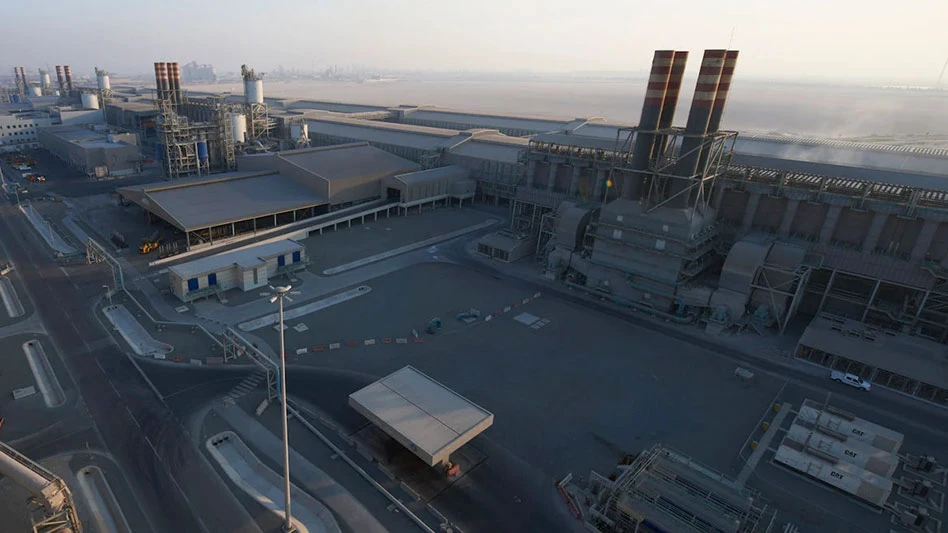
Photo courtesy of Thyssenkrupp Steel Europe
Thyssenkrupp Steel Europe has announced it is preparing to cut back and partially shut down production in its Thyssenkrupp Electrical Steel business unit.
The week of Dec. 15, the Germany-based company says its plants in Gelsenkirchen, Germany, and Isbergues, France, will be fully closed down through the end of the year. In addition, the Isbergues site will operate at 50 percent of its total capacity for at least four months beginning next January.
Thyssenkrupp Steel says its subsidiary is responding to the massively increased inflow of low-priced imports, especially from Asia.
The company says the European market for grain-oriented electrical steel produced at the two facilities is under severe pressure, driven by sharply rising import volumes priced well below the average production costs in the European Union.
Since 2022, imports of such steel have tripled, and they rose a further 50 percent this year, according to the steelmaker.
“These developments have led to a dramatic shift in customer orders and, as a result, to substantial underutilization of the European production facilities,” Thyssenkrupp says.
The move is one of several output cuts made in Europe this decade. Producers there are unhappy both with an energy price spike that occurred after Russia invaded Ukraine and sanctions were introduced in response in 2022 and with the impacts of steelmaking overcapacity in China.
In the longer term, Thyssenkrupp says the market for grain-oriented electrical steel remains attractive, citing a market study that predicts global demand may triple by 2050.
“Grain-oriented electrical steel is an indispensable element for Europe’s energy infrastructure and the energy transition,” Thyssenkrupp Steel Europe CEO Marie Jaroni says.
“We are firmly committed to maintaining production in Europe, and are currently working to ensure effective market protections. These efforts are crucial to securing fair competitive conditions for this strategically vital product and protecting approximately 1,200 high-quality jobs at our sites in Gelsenkirchen and Isbergues.”
As have other European steelmakers, Thyssenkrupp is seeking the near-term implementation of efficient and appropriate trade protection measures at the European level. The company says such moves would help raise capacity utilization at both sites to a sustainable level.
Thyssenkrupp says its Electrical Steel business unit is one of Europe’s two remaining producers of grain-oriented electrical steel, a form of steel used in applications within the energy industry, such as in transformers for substations and wind turbines.
Latest from Recycling Today
- Fleetio launches AI capability to accelerate fleet maintenance approvals
- The Metals Agency receives approval for export credit insurance
- Recycle Ann Arbor extends drop-off station operating hours
- Sybilion seeks to help manufacturers confidently address volatility
- Rio Tinto, Prysmian partner on low-carbon aluminum solutions for data centers
- Unilever criticized for plastics approach
- USTR to study additional steel, aluminum tariffs
- Electrified Materials adds processing capacity