Image courtesy of Thermo Scientific
Global technology provider Thermo Fisher Scientific Inc. says its Niton handheld X-ray fluorescence (XRF) metal analyzers can help recyclers improve profitability while its ASM IV and RadEye radiation detection technology can prevent potentially unsafe and costly incidents.
The company says pairing its handheld Niton handheld XRF metals content analyzers combined with its radiation detectors can provide “unmatched efficiency in scrap metal recycling.”
In the analyzer category, Thermo Fisher Scientific says its Niton units it can deliver fast, accurate alloy identification.
The company’s Niton XL5 Plus handheld XRF analyzer is marketed as offering nondestructive materials identification field inspections for aluminum, red metal and stainless alloys and precious metals in a point-and-shoot manner ideal for scrap recycling operations.
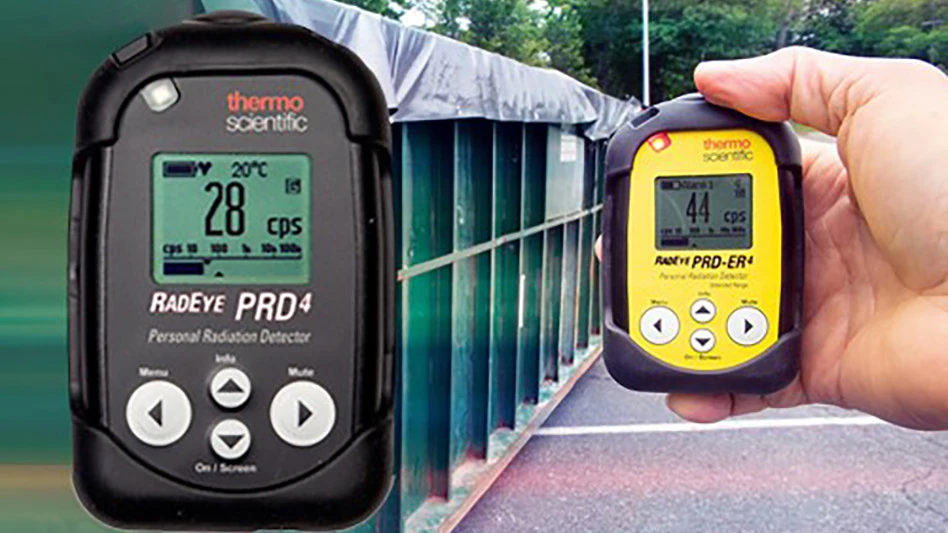
The RadEye PRD4 unit, meanwhile, can provide personal, portable radiation detection, according to Thermo Fisher Scientific.
The RadEye radiation detection product is a small and lightweight personal radiation detection device that can be worn in a holster or on a standard service belt. The RadEye PRD4 and PRD-ER4 radiation detector models use natural background rejection (NBR) technology so the devices can ignore fluctuations in naturally occurring radiation (NORM) while analyzing the energy imbalance of artificial radiation.
Thus, according to Thermo Fisher Scientific, enable accurate dose rate measurements across a broad gamma spectrum, designed to provide a greater assurance of personal safety.
Also available from the company is the ASM IV radiation monitoring and detection system technology, which Thermo Fisher Scientific says can detect radioactive contamination in scrap metal before it enters processing equipment or the supply chain.
The stationary units can be positioned to scan vehicles entering a scrap facility or mounted near processing equipment within a facility.
“With high performance and a low false alarm rate, the system rejects radioactive materials before they can harm people or the environment,” Thermo Fisher Scientific says.
Companies that use updated analyzing and radiation technology and use them in combination, can streamline operations, reduce risk and protect margins, the company adds.
Latest from Recycling Today
- Fleetio launches AI capability to accelerate fleet maintenance approvals
- The Metals Agency receives approval for export credit insurance
- Recycle Ann Arbor extends drop-off station operating hours
- Sybilion seeks to help manufacturers confidently address volatility
- Rio Tinto, Prysmian partner on low-carbon aluminum solutions for data centers
- Unilever criticized for plastics approach
- USTR to study additional steel, aluminum tariffs
- Electrified Materials adds processing capacity