Dzmitry | stock.adobe.com
The Recycling Partnership (TRP), Washington, has awarded a $4.25 million grant to FCC Environmental Services’ material recovery facility (MRF) in Houston, designed to improve the facility’s ability to recover film and flexible packaging (FFP).
The grant, supported by brands PepsiCo Inc., Kraft Heinz Co. and the Film and Flexibles Recycling Coalition, will enable a facility retrofit to recover incidental FFP, address cross-contamination of other recyclable commodities, create high-quality bales and offer data and learnings for building a roadmap to scaling FFP recycling.
TRP notes that FFP plays a critical role in the food and beverage industry, providing a safe and effective barrier for products and offering convenience and extended shelf life for consumers. It adds that FFP, such as plastic bags, pouches and wraps, makes up 34 percent of the total U.S. plastics packaging industry, though it has a low annual recycling rate due to complexities such as disruptions in recycling equipment and contamination of other recyclables like paper, high processing costs and limited end market demand.
TRP says these factors have led to reluctance by both communities and processors to accept FFP in their local programs and facilities.
“Plastic film and flexible packaging are widely used but have historically been excluded from curbside recycling due to processing limitations and contamination concerns,” FCC Vice President of Recycling John Rabon says. “This upgrade represents an important step forward, offering Houston residents new opportunities to recycle more and reduce what ends up in the landfill. While still early, the initiative is designed to strengthen material recovery for the city of Houston and provide learnings that can help guide scalable, sustainable solutions across the country.”
TRP says investments to build recycling infrastructure for FFP are critical as extended producer responsibility (EPR) legislation has been passed in seven states, including California—the world’s fourth-largest economy—whose requirements will impact packaging supply chains nationwide. The organization says EPR is creating pressure to significantly increase the FFP recycling rate, which could lead to seep fines or potential product bans.
Partnerships with companies like PepsiCo and Kraft Heinze, and facilities like FCC’s, are essential steps toward creating scalable solutions to help the industry meet EPR compliance requirements, according to TRP.
“To meet these mandates effectively, investment now in the supply chain to turn FFP into new products is critical,” TRP Chief Impact Officer Kate Davenport says. “That is why we founded the Film and Flexibles Recycling Coalition and its new CalFFlex initiative, aiming to address the longstanding challenges of FFP collection, enhance effective processing and drive demand for these recycled materials. By awarding our largest single grant to an individual MRF, we are developing solutions to demonstrate how effective capture and higher quality at this stage of the value chain could provide feedstock for burgeoning markets to use to make new recycled products and thus provide key data to inform compliance pathways and focused interventions.”
Rachael Lawrence, senior director of sustainability at Plano, Texas-based PepsiCo Foods North America, says the company actively is looking for pathways to improve the recycling system so more of its packaging can be processed.
“Flexible packaging has many food safety and consumer benefits, but its end-of-life options remain a collective challenge for industry and governments to unlock,” Lawrence says. “By investing in the Film and Flexibles Recycling Coalition and the FCC MRF project, we are helping to develop and provide proof points for successful FFP recycling that can be applied at other facilities across the U.S., allowing more of this packaging to be recycled at scale. This work, alongside our other sustainability initiatives and support for enabling policies such as well-designed EPR, are part of our longstanding efforts to deliver sustainable packaging solutions for our customers and the planet.”
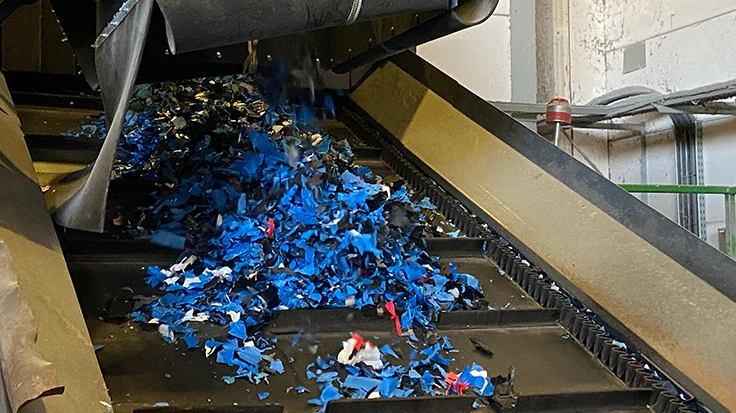
Through the grant, FCC will retrofit its Houston MRF with advanced technology to improve the recovery of plastic film. In partnership with its suppliers, FCC has designed a system intended to meet market specifications and recover plastic film at high levels of purity from a single material stream. The upgrades will include Tomra optical sorters to distinguish film from paper and other materials, along with additional conveyors to enhance processing and efficiency.
“While flexible films play a crucial role in protecting our products and preventing food waste, current recycling infrastructure is not yet equipped to handle these materials at scale,” says Linda Roman, director of packaging research and development at Chicago-based Kraft Heinz. “To address this challenge, we’re intensifying our focus on infrastructure development and investing in organizations like The Recycling Partnership to build a future where all packaging is easily collected and recycled. We’re starting here in Houston and see this as a model for cities across America.”
TRP launched the Film and Flexibles Recycling Coalition in 2020 to convene packaging producers and the industry at large to tackle challenges related to flexible packaging recycling. The coalition has deployed nearly $11 million across 25 projects to demonstrate how to increase material capture and quality and support the incorporation of more recycled content into end market products.
Latest from Recycling Today
- Collective Waste Solutions acquires Alcop Resource Recycling transfer station
- Volatility continues in nonferrous metals
- Neste chemical recycling plant is ready to scale up
- Indonesia’s nickel pig iron spigot reopens
- Ecore says study backs crumb rubber use on sports surfaces
- Fleetio launches AI capability to accelerate fleet maintenance approvals
- The Metals Agency receives approval for export credit insurance
- Recycle Ann Arbor extends drop-off station operating hours