Photo courtesy of Nova Chemicals Corp.
This year has been a challenging one for plastic recyclers across the United States as they have grappled with a wave of imported resins and cheap virgin material.
As companies have tried to weather the storm, Nova Chemicals Corp., in particular, has continued to push forward in its quest to recycle polyethylene (PE) into material suitable for food- and nonfood-grade packaging.
RELATED: Film focused
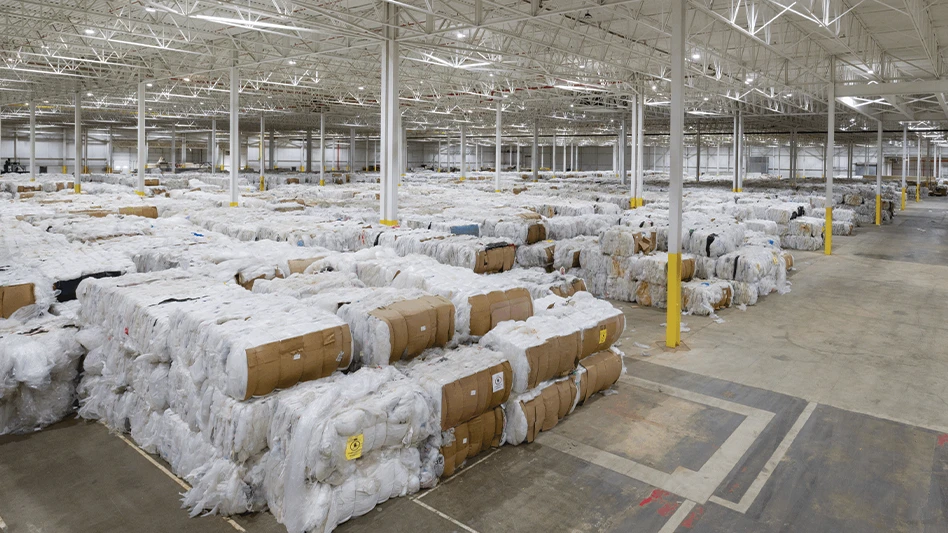
In May, the Calgary, Alberta-based company and its operational partner, North Carolina-based Novolex, officially opened the doors of Nova’s Syndigo1 facility in Connersville, Indiana, a 450,000-square-foot space where linear low-density polyethylene (LLDPE) film is mechanically processed into Nova’s line of Syndigo recycled polyethylene (rPE) pellets. The film is sourced primarily from retailers and distribution centers.
At full capacity, the facility will be able to process up to 130 million pounds of film per year using four mechanical recycling lines. The site’s recycling process has received a letter of nonobjection (LNO) from the U.S. Food and Drug Administration (FDA), confirming its ability to produce postconsumer resin (PCR) suitable for broad food-contact applications, and also has achieved Recycled Material Standard (RMS) certification from Virginia-based nonprofit GreenBlue verifying its pellets are 100 percent postconsumer-recycled content.
Earlier this year, Alan Schrob, director of Mechanical Recycling at Nova, told Recycling Today that the market is still developing for recycled materials—especially film. “A lot of it is collected and downcycled. A big opportunity for the industry is upcycling it into products that can be used over and over or take it and put it into a process like ours.
“We’re working closely with a lot of retailers and distribution centers. We make it easy for film generators to move their material to Novolex. It’s synergistic between our customer base for collecting and creating circularity.”
In the following interview, Schrob provides an update on the Connersville facility and discusses the key roles legislation and investment can play in stabilizing the film and broader plastics recycling markets.
Recycling Today (RT): Can you provide an update on the Syndigo1 facility? What are the big takeaways and what have you learned?
Alan Schrob (AS): All four lines are operational at our Syndigo1 facility in Connersville and production is ramping up. The quality and yield of our rPE are both increasing. By next year, the facility will process up to 130 million pounds of feedstock to supply over 100 million pounds of rPE annually.
Our experience with virgin PE production has informed the design and operation of Syndigo1. Our customers have expressed appreciation for our approach to product stewardship and product quality to deliver rPE that meets their production needs and application requirements. The takeaway has been that despite the current market challenges facing plastic recycling today, long-term demand for rPE remains strong, and our commitment to producing high-quality rPE will help brand owners and retailers successfully adopt more recycled materials.
RT: When it comes to collecting film for processing in Connersville, how large of a network has Nova been able to build and how much can that network expand to ensure you have plenty of feedstock?
AS: We currently source about 30 percent of our feedstock on contract and a large share of the materials come from the Midwest region. Our contracts continue to expand quickly, with significant opportunities present with more brands and retailers within the states bordering Indiana and throughout the rest of the country.
RT: How important is education when working with your film supplies to get the best possible material for your process? Are there common details you work with them on?
AS: Collaborative relationships with our suppliers are essential for what we are building, it's second nature for us to operate this way. We aim to be a strategic partner for our suppliers and for our customers to transform how consumers and businesses see recycled plastic. To reshape how plastics are recycled and preserve their highest value, we must support a better understanding of how plastic recycling works and what it is capable of.
To produce high-quality rPE that can be used in food grade applications, we educate suppliers on the importance of feedstock quality and how certain criteria like maintaining a detailed chain of custody is so important for food packaging applications. We work with our suppliers to develop the necessary protocols, such as tracking film manufacturers and the products they were used to transport, as well as the creation of logistics networks to collect and transport film.
RT: In your perspective, how vital is PCR film to advancing the circular economy for plastics?
AS: Recycled PE made from film is a cornerstone of the plastic circular economy. Effective film recycling enables the reuse of PE in packaging, consumer goods and other applications that go beyond downcycling and keep recycled plastics in the economy in high-value products.
RT: How does a supply of high-quality, food-grade rPE enable film converters and brands to design recyclable, monomaterial packaging without compromising on quality or performance?
AS: Food-grade rPE must meet the same standards as virgin PE under FDA requirements. Maintaining the necessary chain of custody and contamination prevention protocols has been challenging for mechanical recycling facilities in the past. Brand owners struggled to find reliable supplies of high-quality rPE that could be used in flexible packaging, particularly food packaging, slowing the adoption of PCR materials in flexible applications.
As we build supply networks and utilize the latest recycling technologies, Nova is providing customers with access to our extensive expertise in PE material development applied to PCR. We are not only enabling a consistent commercial-scale supply of food-grade rPE, but we are also making truly closed-loop solutions possible, where we collect film from a particular brand or location and the rPE is reused in new products from the same source.
RT: 2025 has been a difficult year for recycled plastics of all types in the U.S. for a variety of reasons, including import competition and the large supply of inexpensive virgin material. We’ve seen some recyclers close their doors. How could investment, policy and value chain collaboration work together to stabilize those recycled resin markets and make them more economically and environmentally resilient?
AS: Policy alignment is key to set up the long-term success of the recycled plastics market. Legislation that supports investment in recycling infrastructure would help ensure consistent feedstock quality and supply. Collaboration between plastics producers, brand owners and recyclers can help drive innovation and accelerate the development of scalable recycling solutions.
RT: In particular, what might be needed to expand the film recycling infrastructure in the U.S.?
AS: In the U.S., emerging extended producer responsibility (EPR) laws have the power to shape the market for recycled plastics. Policies that incentivize producers to contribute to the expansion of recycling infrastructure will help strengthen feedstock supply. Recycled content mandates are also important, but they must be structured correctly to encourage the adoption of recycled materials and not utilize fee structures that dissuade the incorporation of recycled materials. Mandates should be designed to be achievable and scalable, recognizing the difficulties still facing some plastic material markets. Punitive policies are not successful at driving PCR adoption when they do not recognize current supply chain limitations and technological capabilities. To make real progress toward a circular economy, brands and retailers must be willing to commit to using PCR plastic into products and accept a period of adjustment as markets stabilize.
Latest from Recycling Today
- Fleetio launches AI capability to accelerate fleet maintenance approvals
- The Metals Agency receives approval for export credit insurance
- Recycle Ann Arbor extends drop-off station operating hours
- Sybilion seeks to help manufacturers confidently address volatility
- Rio Tinto, Prysmian partner on low-carbon aluminum solutions for data centers
- Unilever criticized for plastics approach
- USTR to study additional steel, aluminum tariffs
- Electrified Materials adds processing capacity