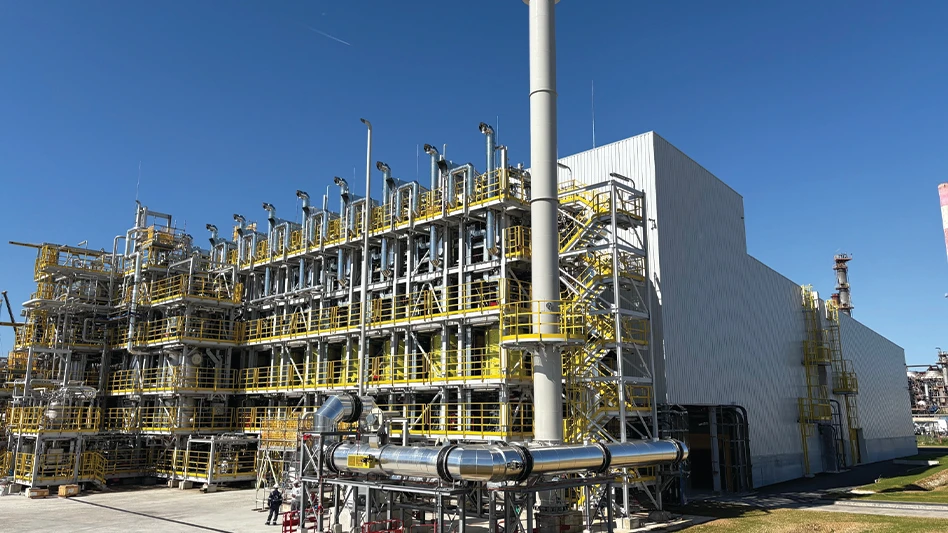
Photo courtesy of Supra Elemental Recovery Inc.
Supra Elemental Recovery Inc. has launched to recover high-purity critical minerals from postindustrial material streams. The company initially is targeting elements such as gallium (Ga) and scandium (Sc), which are used in semiconductors, aerospace, energy, defense and communications.
The Austin, Texas-based company is a spinout from the University of Texas at Austin (UT Austin). It was founded by CEO Katie Durham and Chief Operating Officer Jordan Sessler and uses technology that builds on federally supported research conducted at UT Austin, one of the nation’s leading institutions in materials science and engineering.
“Supra's mission is to shift the paradigm for critical mineral recovery in the U.S. by making it more affordable, effective and sustainable,” Jordan Sessler says.
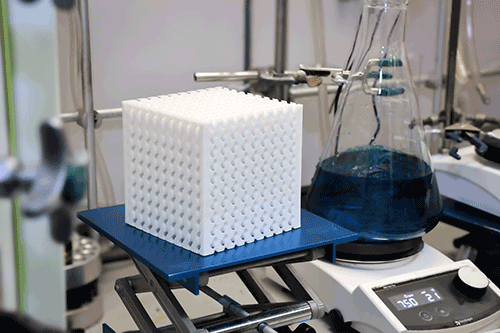
The company’s
He says an advantage of Supra’s platform is that multiple cartridges can be placed in sequence to select for different elements. “As our platform expands, this could unlock profitable recovery from extremely diverse feedstock sources by recovering an array of elements with applications across semiconductors, magnets and batteries.
“The inventors of the technology realized they could combine their novel advancements across their fields to create a proprietary critical minerals recovery platform that eliminates the need for harsh acids or toxic solvents,” Jordan Sessler adds.
He says the inventors of Supra’s technology are professors working across chemistry, materials and
“He's a longtime professor at the University of Texas at Austin, and he's been a receptor chemist for a really long time,” Jordan Sessler says of his father. “He's used his receptors and similar receptors in cancer research and treatment historically.”
Jonathan Sessler joined with
“It’s a combination of breakthrough advances in each of those fields all rolled into one platform, and then the platform can be printed in different sizes and shapes and really pretty easily integrated into existing flow sheets and recovery sheets that are already used in the real world,” he says, “which is one of the reasons why we think we can get this to market relatively quickly.”
Jordan Sessler says he went to Durham, a partner at San Francisco-based Climate Capital, for her opinion on the technology. She liked it so much, the two co-founded the company.
The technology originally was validated on cobalt and lithium, and Supra now is targeting elements such as Ga and Sc and is validating it for other elements, including lanthanides.
“Every year, billions of dollars worth of critical minerals are trapped in domestic waste streams, from industrial byproducts and mine tailings to electronic waste,"
“While rare earths aren’t rare, they’re notoriously difficult and expensive to refine at high purity,” Jordan Sessler says. “We’re making this easier and more affordable by applying advances in supramolecular chemistry, materials science and fluid dynamics to build a versatile platform technology. By refining multiple elements from multiple sources, we believe we can deliver much-needed supply chain resilience.”
Supra operates out of sponsored labs at UT Austin currently and is looking to establish a centralized pilot facility this year, Jordan Sessler says.
Durham says such a facility will allow Supra to test various feedstocks in one place with its technology
The company plans to optimize its technology ahead of commercial pilots. “We aim to produce and validate semiconductor- or defense-grade Sc and Ga by end of year,” Jordan Sessler adds.
“Supra exemplifies how world-class university research can be translated into commercially scalable solutions that advance US industrial leadership,” says Mark Arnold,
In conjunction with its launch, Supra announced the close of an oversubscribed $2 million preseed round, led by Crucible Capital, with participation from the UT Seed Fund, Climate Capital, Portmanteau Ventures and Pew Protection Trust. The funding will support continued technology development and preparation for commercial pilots, expected in 2026.
“The key to restoring America’s rare earth leadership is building refining capacity, the bottleneck standing between domestic raw resources and secure supply,” says Meltem Demirors,
Companies interested in supplying feedstock, purchasing critical minerals, or exploring partnerships can learn more at www.getsupra.com.
Latest from Recycling Today
- England's Environment Agency extension provides stability for metal shredding operators
- Schupan names new chief financial officer
- NAW looks ahead to July hearing in Oregon
- Recycle Coach partners with Bartec Municipal Technologies
- EPA proposes abandoned tire cleanup plan with focus on energy recovery
- BIR welcomes new policy officer for trade & environment
- Global Recycling Foundation recognizes Recycling Heroes
- Recycling Today Media Group launches Paper and Plastics Recycling Conference webinar series