Image courtesy of Republic Services Inc.
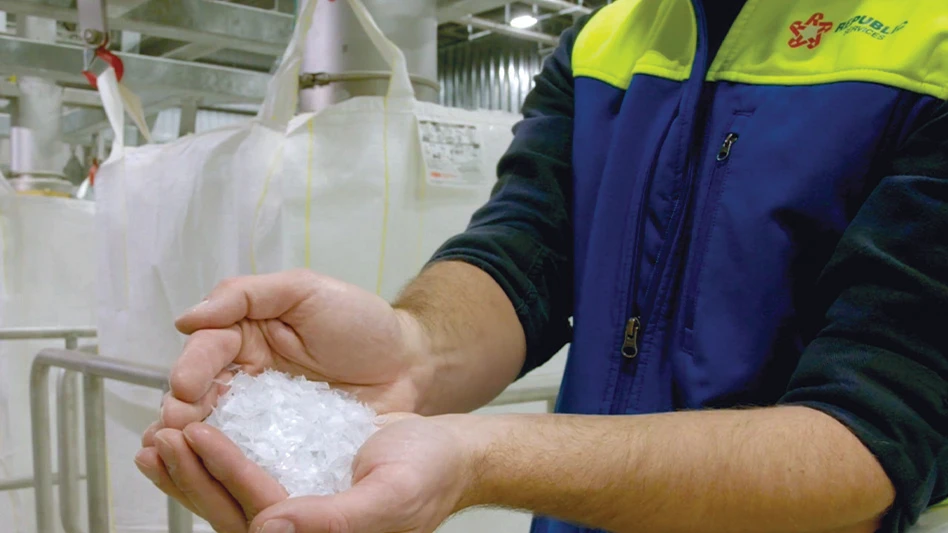
Waste and recycling services company Republic Services Inc., Phoenix, claims a recently completed product carbon footprint (PCF) study confirms that recycled polyethylene terephthalate (rPET) flake produced at its Las Vegas Polymer Center for use in packaging has a lower carbon footprint than representative rPET or virgin PET in the U.S. market.
Additionally, the company says the study confirms the material’s potential to help customers decarbonize supply chains and reduce Scope 3 emissions.
RELATED: House of Blue | Betting on quality
Republic says that, on average, the global warming potential of its bottle-grade, clear rPET flake produced in Las Vegas is 54 percent lower than the rPET flake alternatives evaluated, and 82 percent lower than virgin PET. These finding are included in an independent cradle-to-gate PCF study conducted at the Polymer Center during the first seven months of 2024, which included comparisons to representative rPET and virgin PE produced in the U.S. as well as material imported from Asia.
“We developed our Polymer Centers to enable bottle-to-bottle circularity and help meet increasing demand for high-quality recycled plastics,” says Pete Keller, Republic’s vice president of recycling and sustainability. “The rPET flake we produce is not only helping customers meet goals and requirements for recycled content in their packaging but also helping reduce their environmental impact.”
Republic says it makes an average of 5 million recycling and waste pickups daily and operates 75 recycling facilities across North America. Recycled plastics from these facilities are delivered to a Polymer Center for secondary processing, and PET is shredded and washed to produce bottle-grade, clear rPET flake ready to be remanufactured into new beverage bottles.
The company claims the lower carbon footprint of its rPET is primarily due to more effective energy use at the Las Vegas Polymer Center. The facility uses a patented equipment line that the company says uses less electricity and thermal energy per kilogram of flake than other mechanical recycling processes, for example. Also, processing is shared with other key materials recovered, and the regional utility grid has a lower carbon footprint than either the average U.S. grid or the Asian market’s grid mix considered in the PCF study.
Republic says the rPET produced at its Las Vegas location has additional environmental benefits, such as:
- Bottle-grade product: The PCF study notes that Republic’s rPET flake is bottle-grade, enabling bottle-to-bottle circularity.
- Integrated supply chain: Republic manages postconsumer recycled material from curbside to flake production, in contrast to imported rPET.
- Enhanced circularity: The Polymer Center process also recovers and recycles non-PET materials from the stream that otherwise would be disposed of through landfill or incineration.
Republic operates Polymer Centers in Las Vegas and Indianapolis, with a third facility under construction in Allentown, Pennsylvania. The company says each facility will have the capacity to produce approximately 120 million pounds of bottle-grade recycled plastics annually.
In August, Keller told Recycling Today the 10-acre Allentown site would begin construction in late October, with the potential for equipment installation to begin in April 2026. The facility is expected to be operational by the end of next year.
“Early indications are that demand for our rPET flake will be strong,” he said in August. “With our existing Las Vegas and Indianapolis facilities, Allentown will help us continue to build out our national hub-and-spoke Polymer Center network.”
Each Polymer Center mechanically processes plastics collected from homes and businesses, including PET, high-density polyethylene (HDPE) and polypropylene (PP). While PET is processed to make rPET flake for use in new bottles, HDPE and PP are sorted by color and type and sent to Blue Polymers, a joint venture between Republic and Ravago, a Luxembourg-based plastic recycling and distribution company, to be compounded, blended and pelletized, creating custom drop-in products for customers.
Latest from Recycling Today
- EPR implementation working group adopts nationwide focus
- CPM Crown to open European operations hub
- Mardi Gras sustainability initiative collects 14K pounds of recyclables
- Reju selects site for French textile recycling facility
- Hydro’s earnings decrease year over year
- Republic Services appoints Ian Craig to board of directors
- Phoenix Public Works Department proposes solid waste rate increases
- REalloys adds general to executive ranks