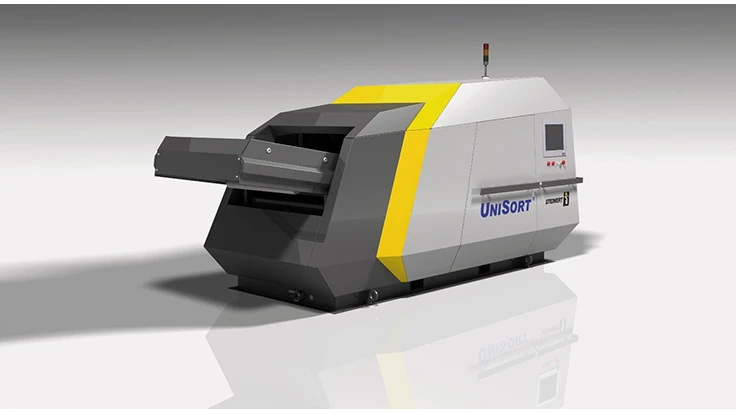
Cologne, Germany-based Steinert Group will display the UniSort BlackEye device at the IFAT trade fair in Munich in June 2016. Steinert says the BlackEye has been designed to tackle the challenge of “the pure separation of black plastics.” The new optical sorting system “enables recycling companies to produce purer granules that are so valuable that the investment in the device quickly pays off,” says Steinert.
Recycling companies who produce mixed granules from purchased black polyethylene and polypropylene (PE/PP) currently pay a market price of about €200 ($228) per tonne, depending on the material’s polyolefin (PO) content, according to Steinert. However, if they could divide the mixture into fractions such as PE and PP they would be able to obtain a price of up to €900 ($1,025) for the granules, says the firm.
Sensors in traditional optical sorting machines have to date been unable to distinguish the different types of black plastics from one another because the soot used to blacken the plastic absorbs the visible and infrared wavelengths of electromagnetic radiation. “The UniSort BlackEye closes this gap and makes a pure separation of comminuted black components possible,” says Hendrik Beel, managing director at the Steinert Group. “The investment pays off quickly because it enables operators to produce pure and, thus, more valuable granules.”
Says Beel, “The UniSort BlackEye operates quickly enough to scan belts moving at up to four metres (13 feet) per second. During this time, it can scan about 35 million detection points or up to 5,000 objects. This makes it ideal for efficient industrial applications for crushed plastic parts measuring between 10 and 30 millimetres (0.4 to 1.2 inches).” On average, the UniSort BlackEye has a throughput rate of 1 tonne of plastic flakes per hour.
A video clip of the UniSort at work can be found on YouTube at this link.
Latest from Recycling Today
- Novelis resumes operations in Greensboro, Georgia
- Interchange 360 to operate alternative collection program under Washington’s RRA
- Waste Pro files brief supporting pause of FMCSA CDL eligibility rule
- Kuraray America receives APR design recognition for EVOH barrier resin
- Tire Industry Project publishes end-of-life tire management guide
- Des Moines project utilizes recycled wind turbine blades
- Charter Next Generation joins US Flexible Film Initiative
- Vecoplan to present modular solutions at IFAT 2026