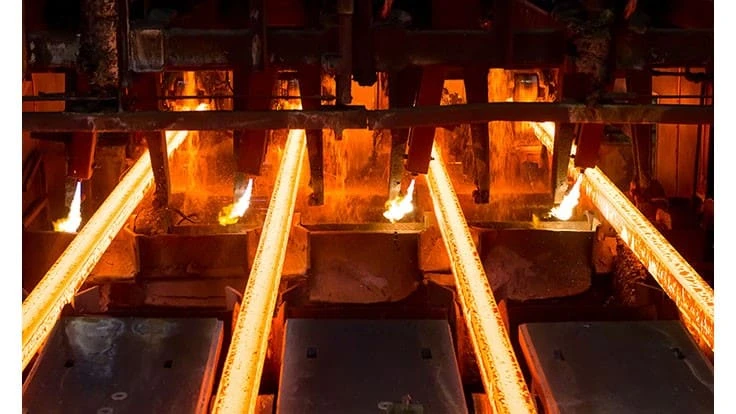
Photo courtesy of ArcelorMittal.
The United States Department of Commerce’s Steel Import Monitoring and Analysis (SIMA) system is adding melt shop and furnace location requirements for importers of finished steel heading into the U.S. The new “melted and poured” requirement, authored by the department’s International Trade Administration, will go into effect Oct. 13, 2020.
The furnace location requirement is one of several changes to the SIMA system spelled out in what is called a final rule summary published Sept. 11 in the Federal Register.
The rule came about in part as a way for nations, including Canada and Mexico, to have tariffs removed from steel products made there without enabling the shipment of steel produced in other nations and then processed downstream (rolled or galvanized) in cooperating nations to enter the U.S. tariff-free.
The Federal Register says as part of “joint understandings with Canada and Mexico,” those two nations “agreed to implement effective measures to prevent the transshipment of steel products made outside of the United States, Canada and Mexico.”
The summary article adds, “Additionally, the joint understandings allow for the countries to establish an agreed-upon process for monitoring steel trade between them, and, further, in monitoring for surges, to treat products made with steel that is melted and poured in North America separately from products that are not.”
In addition to a role in negotiating tariffs, the “melted and poured” rule also has been a factor in the new United States-Mexico-Canada (USMCA) trade agreement that has replaced the former North American Trade Agreement (NAFTA).
An import monitoring system may be in the works for the aluminum sector, with the Arlington, Virginia-based Aluminum Association saying it would be in favor of such scrutiny, although not necessarily whether it would advocate a “melted and poured” aspect to such a system.
The summary of the new steel import monitoring rules can be found on this web page.
Latest from Recycling Today
- U.S. Aluminum Co. explores aluminum fabrication plant in Oklahoma
- Sonoco completes portfolio transformation
- Eriez Shred1 data demonstrates scalable copper control
- RCI selects CurbWaste as exclusive operational management platform
- Updated: Supreme Court strikes down IEEPA tariffs
- Recycling Today Media Group launches Scrap Expo Lunch & Learn Webinar Series
- LyondellBasell scales back recycling target
- Former Liberty UK mills eyed by 3 suitors