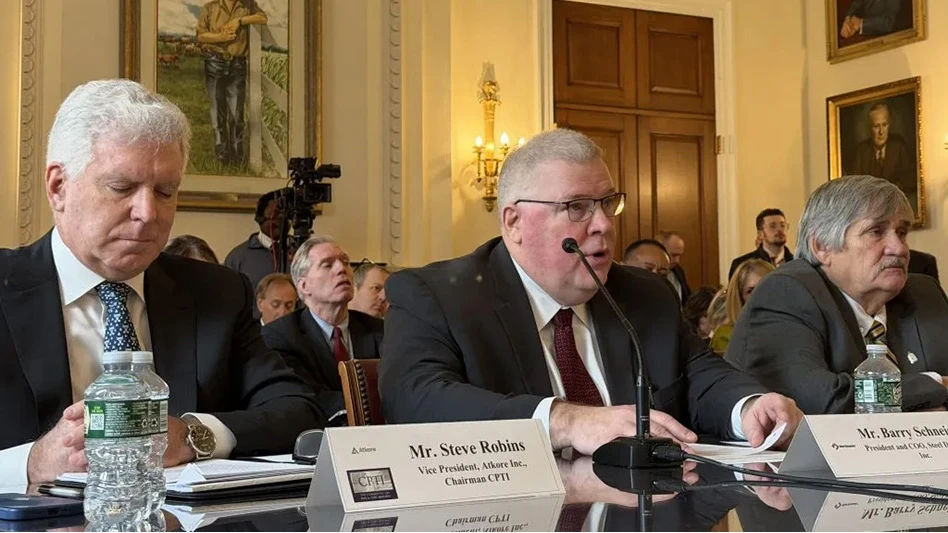
Photo courtesy of the Steel Manufacturers Association.
Representatives from recycled steel producers Steel Dynamics Inc. (SDI) and Nucor Corp. were among those testifying at a recent meeting of the Congressional Steel Caucus in Washington.
Barry Schneider, president and chief operating officer (COO) of Fort Wayne, Indiana-based SDI, urged elected officials and the Trump administration to exercise continued vigilance in enforcing the Section 232 tariff on imported steel, according to the Washington-based Steel Manufacturers Association (SMA). Schneider also serves as board chair of that organization.
Schneider characterized the steel industry as well-positioned, crediting an administration focused on rebuilding manufacturing in the United States and a Congress that delivered considerable tax changes.
At the same time, Schneider cautioned caucus members that the industry cannot afford complacency, characterizing China as continuing to ship excess steel capacity into global markets at historic levels.
“China produces far more steel than it can ever use, dumping 118 million tons on the global market last year alone,” he said. “That record is predicted to climb even higher this year, putting steelworkers everywhere at risk.”
Schneider, whose 10-page testimony statement is available through the SMA website, characterized the U.S. recycled electric arc furnace (EAF) steel sector as one that has invested heavily to compete.
Between 2022 and 2026, SMA members will have announced, started or finished new capex projects worth more than $25 billion, leading the way in the electrification and modernization of the U.S. steel industry, according to SMA.
Schneider also urged attention to how the United States-Mexico-Canada Trade Agreement (USMCA) is structured, saying the two U.S. trading partners have not been as vigilant at keeping out Chinese steel or manufactured items made with such steel.
“Producers of steel-intensive goods in both countries continue to rely on steel from non-market, excess-capacity sources, including China,” Schneider said. “Between 2020 and 2024, Mexico’s steel imports from China surged by 59 percent, while Canada’s rose by nearly 75 percent.”
Joining Schneider on the panel was Ben Pickett, executive vice president of Nucor and vice chair of SMA. The organization says Pickett told lawmakers U.S. steel companies such as Nucor are helping to build a dynamic and secure domestic economy and creating high-wage jobs for American workers.
Latest from Recycling Today
- DOWA: Center of catalytic converter recycling
- Ocean Legacy Foundation expands plastic testing laboratory services
- CMI, HCPA publish aerosol recycling guide for MRFs
- 2026 Plastics Recycling Conference: A look at PCR contracts
- Remade Institute hosts Circular Economy Tech Summit & Conference in March
- Befesa sees record performance in 2025
- North Carolina county receives FRC foam recycling grant
- Cascades tissue business falls short in Q4