Recycling Today archives
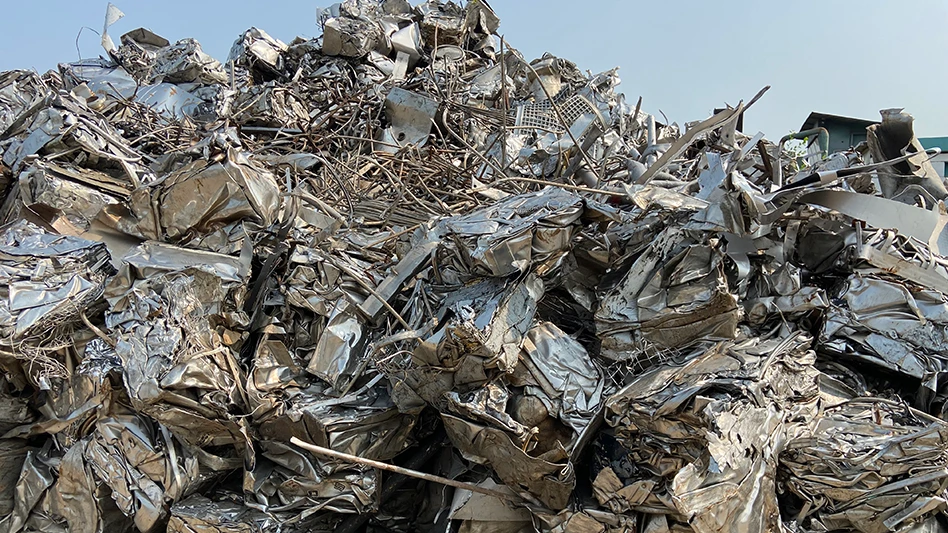
Trade measures enacted by governments around the world are contributing to uncertainty—and likely decreased activity—in the cross-border trading of recycled stainless steel, according to panelists at the Bureau of International Recycling (BIR) Stainless Steel & Special Alloys Committee meeting in Bangkok in late October.
Mahiar Patel, managing director of the Singapore office of Germany-based Cronimet Group, which has global operations, said his company is not yet certain how the “Trump effect,” characterized by widespread tariffs on imported metal, will play out for stainless steel recyclers in the United States.
“Everybody was still in a bit of a dilemma as to how these policies will implement and directly benefit the stainless processors like ourselves and several others,” he said.
Patel said U.S. metals production may benefit more than the rest of the world on an immediate basis.
“By default, we will see less stainless [scrap] being exported from the U.S., and, of course, the incentive schemes are pretty attractive,” he said. “So, in the coming years, or the immediate one or two years, you will see some effect. Other countries in the Far East, which import a lot of that American scrap, will miss out on that scrap.”
Emily Sanchez, chief economist of the Washington-based Recycled Materials Association (ReMA), told delegates regarding the global trade dispute environment and scrap export bans proposed in some nations, “In the medium term, at least, I don’t see how it can’t be an environment that becomes more restrictive, before we have a situation where we can return to rational [behavior].
“Policymakers involved in putting these kinds of policies forth don’t yet have an understanding of how the market for recycled materials is fundamentally different from the market for primary materials, and that impacts what they expect to get out of their stated objectives when it comes to these policies.
“On one hand, you’ll continue to have this global push towards decarbonization [and] meeting circular economy goals. These, logically, should favor more open trade for recycled stainless. On the other hand, we also have this troubling trend towards increased resource nationalization. In the U.S., for example, [the country is] seeing raw materials, increasingly, as a strategic national resource, something that needs to be retained within the economy, rather than seeing it as a commodity that should be traded openly.”
Trade restrictions placed on exporting recycled materials tend to trigger retaliatory measures in other countries that can create a “race to the bottom” and fragmented markets that don't serve anyone, according to Sanchez.
“The real risk involved is that these types of measures can become entrenched, and—once entrenched—it’s really hard to reverse," she said.
Vegas Yang, CEO of Taiwan-based HSKU Raw Material Ltd., said the market in China continues to struggle following the U.S. tariff measures, which also are affecting finished and semifinished stainless steel export orders in India.
But in the U.S., according to "BIR World Mirror" contributors Yang cited, the stainless market is healthy, supported by the 50 percent import tariff, with information showing domestic melt shop rates as above 80 percent capacity.
Mills in the U.S. are reportedly profitable due to stable consumption and less competition from imports. The special alloys sector there, meanwhile, has a 10-year future order book from the aerospace and industrial sectors, according to BIR committee members.
Dhruv Goel, founder and CEO of India-based information services company BigMint, said India is the largest importer of recycled stainless steel, but said trade measures have melt shop operators seeking alternatives.
“We feel that the usage of nickel pig iron (NPI) will increase,” Goel said. “Imported stainless steel scrap will remain very important for the Indian market, but there will be limitations. Jindal, which is the largest stainless steel producer in India, has invested in an NPI plant in Indonesia. Many countries would like to contain or restrict the outflow of stainless steel scrap, so [metals production] companies have to look for alternatives.”
In Europe, the Carbon Border Adjustment Mechanism (CBAM) is due to be implemented next January.
“In principle, CBAM is good news for Europe’s scrap industry, and also, if it really takes off, should be good for the environment around the world,” Yang said. “But of course, as with many new regulatory developments, its introduction brings uncertainty and increased bureaucracy.”
The BIR October 2025 World Recycling Convention & Exhibition was Oct. 26-28 at the Centara Grand Convention Centre at Centralworld in Bangkok.
Latest from Recycling Today
- Fleetio launches AI capability to accelerate fleet maintenance approvals
- The Metals Agency receives approval for export credit insurance
- Recycle Ann Arbor extends drop-off station operating hours
- Sybilion seeks to help manufacturers confidently address volatility
- Rio Tinto, Prysmian partner on low-carbon aluminum solutions for data centers
- Unilever criticized for plastics approach
- USTR to study additional steel, aluminum tariffs
- Electrified Materials adds processing capacity