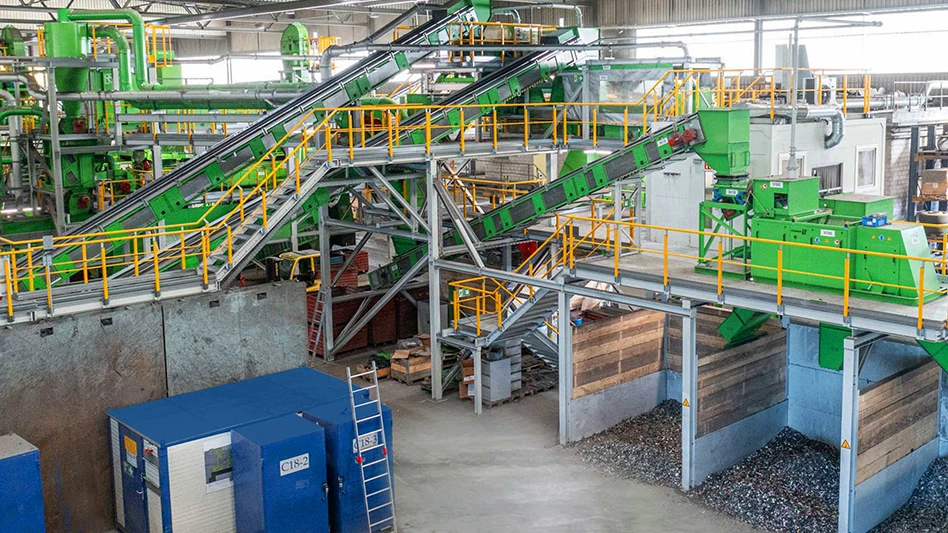
Photo courtesy of weeeSwiss Technology and the Stadler Group
The weeeSwiss Technology AG subsidiary of Germany-based Stadler Group says a global landscape of evolving regulations, shifting material values, new safety demands and digitalization is creating opportunities for electronics recyclers and their technology suppliers.
Zurich-based weeeSwiss Technology provides advanced process engineering, selecting optimal machinery, designing turnkey plants and contributing in-depth market knowledge across the entire waste electrical and electronic equipment (WEEE) value chain.
According to the firm’s Jochen Apfel, a surging volume of discarded electronics is accompanied by rising demand for recycled materials, turning electronic scrap into a competitive market.
“We see very positive trends for the e-waste recycling business, as both volumes and raw material prices are continuously rising,” Apfel says. “The market is demanding recycled materials, and the trend is shifting from mining to urban mining. Even manufacturers are increasingly looking for ways to reuse recycled materials.
“More short-lived, low-value devices—including products such as chargers, earbuds, small digital accessories and battery-powered toys that quickly become waste—are entering the market."
An influx of low-quality products complicates sorting and reduces the economic value of recovered fractions, according to weeeSwiss.
On the design for recycling front, manufacturers can improve recycling outcomes by simplifying product design, reducing the number of materials used and by ensuring easy access to lithium batteries to reduce fire risks and allow safe, efficient removal before and during recycling, according to Apfel.
“Regulations are making cross-border movements more complicated and expensive, which in turn leads to a lack of recycling capacity within many countries,” he says.
That shift is accelerating investment in domestic processing in many nations and the development of a national recycling infrastructure. Rising precious metal prices, particularly gold, and the pursuit of rare earth elements also are helping to drive the adoption of advanced recovery techniques.
“To meet this need, we’ve just developed a new process capable of separating precious metals from very fine fractions, which in the past were often lost,” Apfel says. “Technology is evolving precisely in our direction, allowing us to separate high-purity fractions much earlier in the process than was previously possible."
Safety and fire prevention remain priorities at weeeSwiss and Stadler plants, according to the technology vendors, with attention paid to the fire risks posed by lithium-ion batteries.
“In our weeeSwiss Module 1, we separate large batteries and, for the smaller ones, we design the preshredder to avoid breaking the batteries, reducing fire risk,” Apfel says. “If a battery catches fire, a fire detection system triggers an extinguishing system and leads the material directly into a safe bunker. We also use an explosion suppression system in case explosive material is not sorted out. We are developing solutions for automatic battery separation in combination with manual sorting.”
The companies say their turnkey plant design-and-build approach has been implemented worldwide, with projects undertaken in Europe and the United States and expansion underway in South America, Africa, Asia, the Middle East and Australia.
The firms say a high-performance e-scrap plant built for Immark AG in Regensdorf, Switzerland, now sets new benchmarks for throughput, purity and fire safety in the sector.
Apfel predicts more projects lie ahead.
“Together with Stadler, we aim to not only maintain technology leadership but also to become the market leader in providing e-waste plants. We are developing processes that turn our long-term goal into reality: producing materials from our recycling plants of such high quality that they can be sold directly to manufacturers.”
A video profiling the Inmark installation in Switzerland can be found on YouTube.
Latest from Recycling Today
- Fleetio launches AI capability to accelerate fleet maintenance approvals
- The Metals Agency receives approval for export credit insurance
- Recycle Ann Arbor extends drop-off station operating hours
- Sybilion seeks to help manufacturers confidently address volatility
- Rio Tinto, Prysmian partner on low-carbon aluminum solutions for data centers
- Unilever criticized for plastics approach
- USTR to study additional steel, aluminum tariffs
- Electrified Materials adds processing capacity