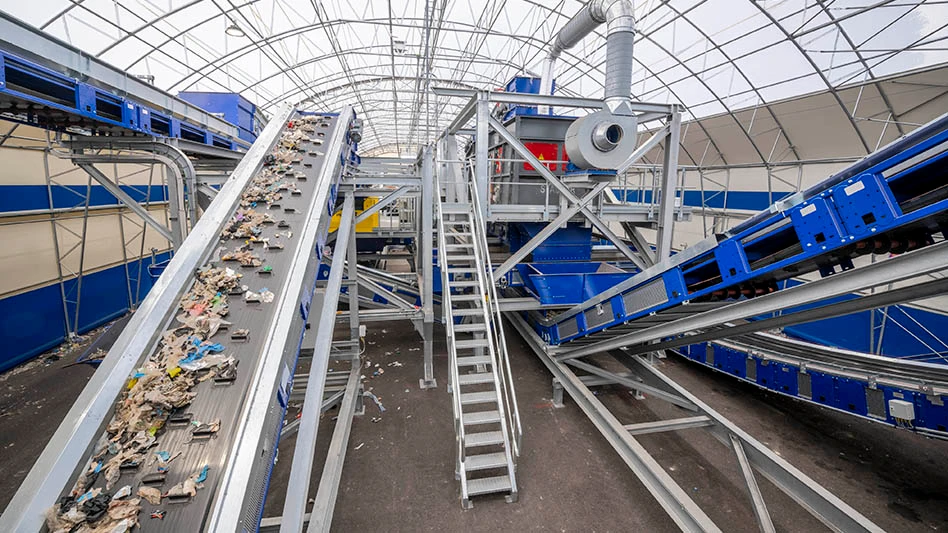
Photo courtesy of Stadler
Germany-based recycling and sorting equipment vendor Stadler Anlagenbau GmbH has engaged in numerous collaborative efforts to improve the recycling prospects of materials including paper, plastics and textiles.
“The pressure to reduce waste, recycle more, and move towards a closed-loop circular economy is unprecedented,” says Willi Stadler, CEO of the Stadler Group, a family business with roots tracing back to 1791.
“At Stadler, we believe that for progress to be made towards this goal, the effective collaboration of all the members of the value chain is essential—this means the involvement and coordination of industry associations, authorities at local and government level, the European Commission, research institutes and universities, designers and users of the products and packaging, suppliers of sorting plants and technologies like us, and the recycling industry as whole,” Willi Stadler says.
The company takes part in research projects to explore solutions to recycle more materials from different streams of discarded materials. “Working with partners, such as universities and research institutes, significantly strengthens our position as a plant and equipment manufacturer,” says Julia Stadler, chief development officer of the Stadler Group.
In the packaging sector, Stadler is collaborating with Germany-based consultancy RecycleMe in part by offering its Test and Innovation Centre in Slovenia to provide customers of RecycleMe the opportunity to analyze the sorting behavior of their packaging “under current and real-life conditions” at material recovery facilities (MRFs).
“Our cooperation with Stadler allows us to conduct sorting tests under the best conditions, using the latest technology, simulating the sorting process in practice and with representative packaging quantities,” says Sabrina Goebel, managing director at RecycleMe.
Stadler also is taking part in a project in the Flemish part of Belgium with Multi2Recycle and Pack4Food in that nation to evaluate the recyclability of multilayer flexible food packaging materials in function of their composition and the resulting shelf life of food products.
In November, Stadler partnered with Everwave, a German startup with the mission of combating plastic waste in rivers and oceans. The aim is to combine Stadler’s solutions in plant engineering with Everwave’s holistic approach to protecting the environment from waste with a focus on emerging and developing countries.
As part of the effort, Stadler will develop and test what it calls a flexible solution for a mobile sorting container in order to set up a low-threshold infrastructure for waste management in nations without a MRF recycling infrastructure.
In the paper sector, Stadler cites its work with RWTH Aachen University of Germany on the EnEWA project, which started in 2021. That effort is devoted to “unlocking the untapped potential of obtaining recyclable paper from the lightweight packaging, residual and commercial waste streams,” according to Stadler.
In the emerging textiles recycling space, Stadler has designed and built what it calls “the first industrial-scale fully automated mixed textile waste plant in the world in Sweden, and is actively involved in further research.”
The firm also is taking part in projects such as “EOL-Model” at the Institute of Textile Technology (ITA) at RWTH Aachen University, which also involves collaboration with “several companies along the textile recycling chain,” according to Stadler.
That project uses near-infrared (NIR) spectroscopy to analyze textiles with a focus on mixed materials containing polyester. “Our tests were made possible thanks to Stadler,” says Amrei Becker, a researcher at the ITA. “We were supported in the evaluation by the company's experienced employees and were thus able to show that the NIR spectra of blended textiles actually differ and that different blends, for example, polyester and cotton, can be detected.”
In Germany, Stadler also cooperates in the ReVise-UP project funded by the German Federal Ministry of Education and Research (BMBF), which intends to improve the process efficiency of mechanical recycling of postconsumer plastic packaging.
In its home region, Stadler says it collaborates with several schools in Altshausen. “Initiatives such as our new ‘Wissensfabrik’ – The Knowledge Factory – [will] enable us to give children and young people an understanding of STEM [science, technology, engineering and math] professions,” Willi Stadler says.
“As 2023 comes to an end and I look back at what we have achieved, I am proud of the work that Stadler has done in collaboration with so many great partners and institutions. I want to thank them all for giving us the opportunity to be a part of all these projects and work together to make the circular economy a reality."