Photo courtesy of Anlagenbau GmbH
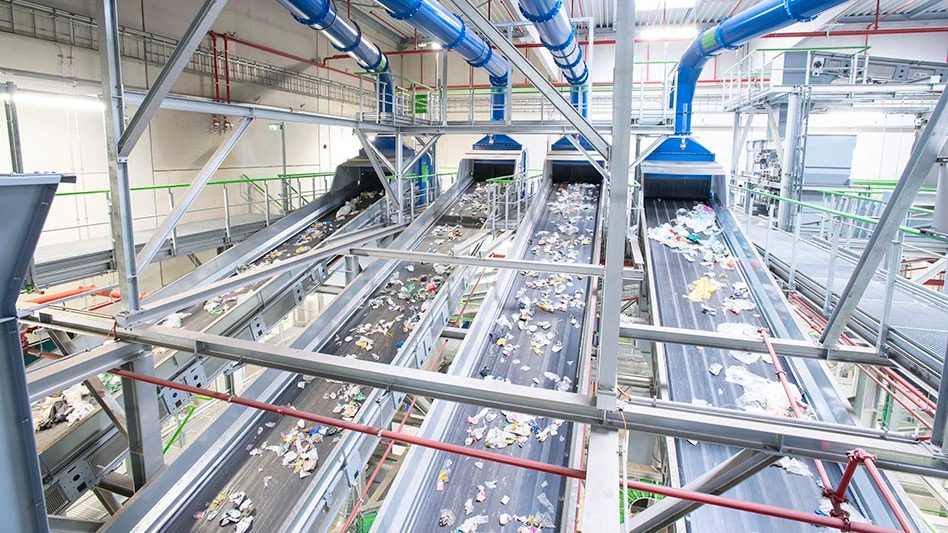
Germany-based recycling and sorting equipment maker Stadler Anlagenbau GmbH has helped install what it calls one of Europe’s most advanced automated recycling facilities, engaged in sorting lightweight packaging (LVP) for PreZero Sorting Austria GmbH in Sollenau, Austria.
PreZero is the international environmental service provider of the Germany-based Schwarz Group, operators of the Lidl retail grocery chain.
Stadler says Sollenau was chosen as the location to fill a geographic gap in the PreZero recycling network, enabling shorter transport routes and thus reduced emissions.
The Sollenau facility, which was commissioned late this summer, has been designed to process nearly 105,000 metric tons of LVP material annually across two modules, the facility combines innovation and scalability to help Austria achieve its sustainability ambitions.
“This project was undertaken under a very tight schedule and required continuous coordination with all involved trades working in parallel,” says Benny Kalmbach, a project manager at Stadler. “Despite the logistical challenges, we delivered a complex, high-performance facility on time through close collaboration with PreZero, [magnetic and sensor sorting equipment provider] Steinert and all onsite partners."
The Sollenau facility, which Stadler says is highly integrated and automated, accepts household lightweight packaging and plastic bottles and lightweight packaging from commercial sources.
The process begins with the transfer of material from bunkers using an overhead gantry crane. After a size reduction stage, the resulting material is sorted into different grain sizes.
A total of 35 near-infrared (NIR) sorters from Steinert are used throughout the process, says Stadler, including in a role separating film materials from the wider stream using NIR sorters with air separation. That film fraction then passes through four redundant sorting stages with further NIR sorters.
“Stadler successfully overcame challenges like integrating the artificial intelligence (AI)-based fire protection system, ensuring high automation and meeting strict safety and environmental standards,” says Marya Brandt, a project Manager at PreZero. “Their tailored approach enabled the smooth implementation of a complex, future-ready facility.”
Ferrous and nonferrous metals and beverage cartons are removed during dedicated sorting stages, while the 3D material stream is sorted into several final product fractions across multiple NIR sorting stages.
Each sorting line includes recovery NIR units from Steinert that recirculate misclassified materials back to the start of the process, designed to reinforce high sorting accuracy and optimal material recovery rates.
The system also incorporates a BatterySort system provided by Germany-based WeSort.AI, designed to provide early detection and safe removal of potentially fire-causing batteries.
Other features of the plant include intermediate buffering systems, redundant sorting lines and fully automated baler control tied to boost the quality of final output of up to 20 material fractions, according to Stadler.
Operating continuously was a key requirement for the plant as specified by.
“One of our priorities in this project was to design a system architecture that ensures maximum availability and operational flexibility,” says Julius Henn, a project manager at Stadler. “By integrating redundant sorting lines, intermediate buffering and fully automated systems, we created a facility that can operate continuously, even during maintenance.”
Another automation feature involves 14 volumetric flow sensors developed in-house by Stadler and designed to continuously monitor material throughput, enabling real-time adjustments to maintain a stable, balanced feed to each sorting line, the company says.
“Volume flow sensors ensure a consistent and balanced material flow throughout the entire plant,” says Julia Stadler, co-CEO of Stadler. “For instance, our patented screen-cut-control solution enables precise distribution across multiple sorting lines, forming the basis for automated operation and long-term process stability.”
“This built-in redundancy ensures continuous plant availability, minimizes downtime and maintains high throughput even during technical servicing. It makes a real difference by increasing operational efficiency and reliability," PreZero Project Manager Tristan Merk adds.
According to Stadler, PreZero has already observed the impact of the Sollenau plant’s innovations.
“PreZero is very satisfied with the facility’s performance,” Brandt says. “It meets high standards in safety, efficiency and material recovery, making it a key contributor to regional recycling and sustainability goals.”
The plant is expected to make a contribution to regional recycling rates by improving sorting precision and material recovery.
“PreZero tasked Stadler with delivering a highly automated, safe and efficient sorting system tailored to complex recycling needs,” Merk says. “Stadler exceeded these expectations by designing and implementing a cutting-edge facility that integrates AI-based safety and meets the highest standards in sustainability and performance.”
Stadler, with roots tracing back to 1791, engages in the planning, production, modernization, optimization, assembly, startup, conversion, disassembly, maintenance and servicing of components of recycling and sorting systems.
Latest from Recycling Today
- Fleetio launches AI capability to accelerate fleet maintenance approvals
- The Metals Agency receives approval for export credit insurance
- Recycle Ann Arbor extends drop-off station operating hours
- Sybilion seeks to help manufacturers confidently address volatility
- Rio Tinto, Prysmian partner on low-carbon aluminum solutions for data centers
- Unilever criticized for plastics approach
- USTR to study additional steel, aluminum tariffs
- Electrified Materials adds processing capacity