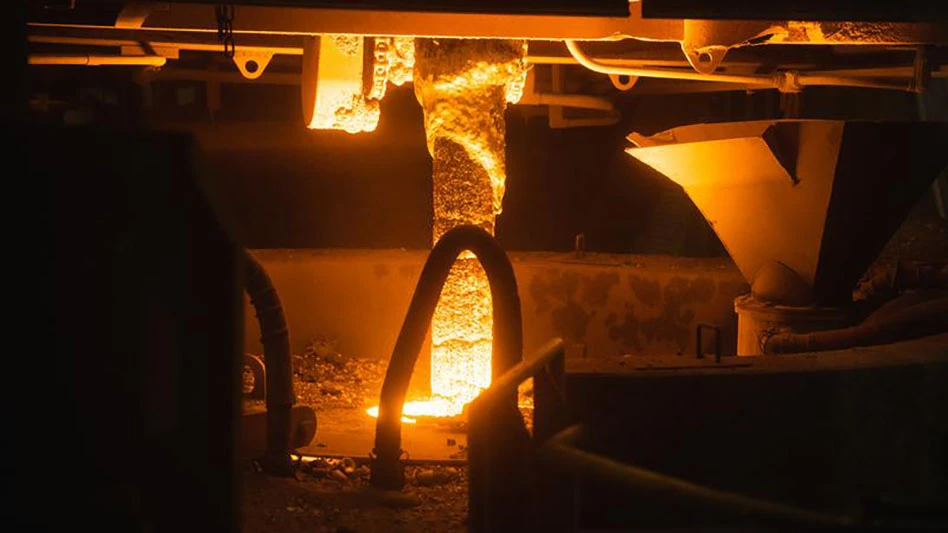
Photo courtesy of SSAB
Sweden-based steelmaker SSAB has reported declining second-quarter 2025 revenue and earnings per share compared with the comparable quarter in 2024.
SSAB's spring 2025 revenue of slightly less than $2.7 billion was off by about 9.4 percent compared with a year earlier. The company’s earnings per share figure of 20 cents per share represents a 23.4 percent decline compared with 26 cents in the second quarter of 2024.
“The [earnings] decrease compared to last year was mainly related to lower prices of standard steel,” SSAB President and CEO Johnny Sjöström says. “The operating result improved compared to the previous quarter, primarily driven by increased prices for SSAB Americas. The market in Europe saw a weakening, and SSAB will take appropriate measures during the third quarter.
“The turbulence of tariffs and trade barriers resulted in increased uncertainty during the second quarter. The direct impact of the U.S. steel tariffs on SSAB is limited as the local production accounts for most of SSAB’s sales on the U.S. market. However, certain special products, mainly high-strength steel for the automotive industry, are exported from [northern Europe].”
In Europe, he says SSAB’s blast furnace/basic oxygen furnace-to-EAF conversion projects in Luleå and Oxelösund are progressing.
“The rationale of the projects is to lower costs, improve the product mix and largely remove CO2 emissions,” Sjöström says.
The executive also notes that SSAB and Volvo Cars have signed an agreement for the delivery of SSAB Zero steel starting this year and for the purchase of high-quality scrap steel from Volvo Cars’ production.
“The scrap will be recycled and used in the new electric arc furnace in Oxelösund to make steel without fossil carbon dioxide emissions," Sjöström says.
Latest from Recycling Today
- U.S. Aluminum Co. explores aluminum fabrication plant in Oklahoma
- Sonoco completes portfolio transformation
- Eriez Shred1 data demonstrates scalable copper control
- RCI selects CurbWaste as exclusive operational management platform
- Updated: Supreme Court strikes down IEEPA tariffs
- Recycling Today Media Group launches Scrap Expo Lunch & Learn Webinar Series
- LyondellBasell scales back recycling target
- Former Liberty UK mills eyed by 3 suitors