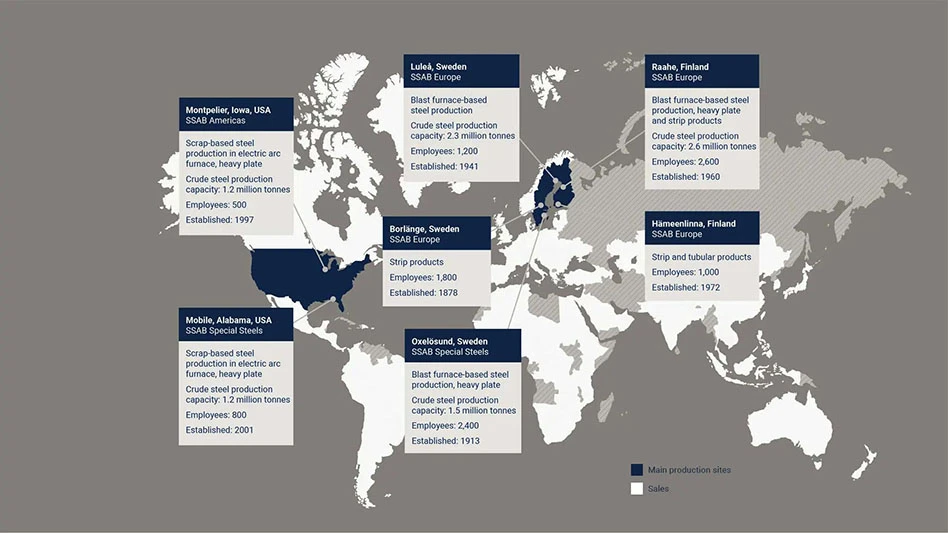
Graphic courtesy of SSAB
SSAB, a Sweden-based steelmaker with recycled steel mills in the United States, saw its earnings decline by nearly 25 percent in 2025 compared with the year before, while its revenue fell by almost 7 percent.
CEO Johnny Sjöström says the company's fourth-quarter results were affected by planned maintenance costs but that its end markets largely were healthy.
“SSAB Special Steels’ unique products and global distribution model contributed to stable prices despite a weaker market and SSAB Europe’s shipments of high-strength steels to the automotive segment were at a relatively good level,” Sjöström says. “SSAB’s strong position [in] the United States heavy plate market, where margins were better than in Europe, was another factor that supported the [profitable] result during the year.
“So far, there have been limited direct impacts of the U.S. steel tariffs, as SSAB is well-positioned with its premium strategy and significant local production in the U.S. Only a limited volume of special products, especially high-strength steels for the automotive industry, are exported from the Nordics [SSAB mills in Sweden and Finland].”
Sjöström says SSAB remains on track with converting its blast furnace/basic oxygen furnace mills in Sweden to electric arc furnace (EAF) technology.
“SSAB’s transformation to modern, fossil-free steel production is proceeding and the strategic investments during 2025 were executed according to plan,” he says. “The conversion of Oxelösund continues and the construction of the new EAF is underway. The construction of a highly efficient minimill in Luleå commenced in the summer of 2025. The transformation projects are key elements of SSAB’s strategy to further expand its premium leadership.”
Sjöström also endorsed European Union actions, including trade measures, planned or underway to support regional steelmakers.
“In January 2026, the EU’s Carbon Border Adjustment Mechanism (CBAM) became fully operational with the goal of creating a more level playing field,” Sjöström says. “SSAB expects these measures to improve the supply-demand balance in the European market.”
Latest from Recycling Today
- Fleetio launches AI capability to accelerate fleet maintenance approvals
- The Metals Agency receives approval for export credit insurance
- Recycle Ann Arbor extends drop-off station operating hours
- Sybilion seeks to help manufacturers confidently address volatility
- Rio Tinto, Prysmian partner on low-carbon aluminum solutions for data centers
- Unilever criticized for plastics approach
- USTR to study additional steel, aluminum tariffs
- Electrified Materials adds processing capacity