©Markus Winkler
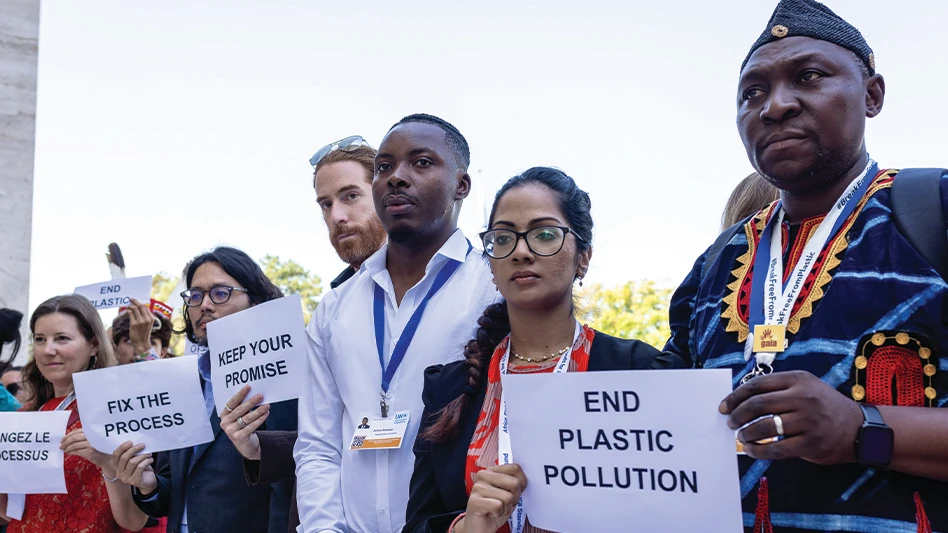
The sixth United Nations Intergovernmental Negotiating Committee (INC-5.2) has begun to stall, according to some international groups observing the proceedings.
As plastics treaty talks have entered their second week, language focused on plastic production caps, the elimination of “harmful chemicals of concern” and the ability to participate on a voluntary or mandatory basis all have remained points of division between a majority of countries deemed "ambitious” and a number of the world’s largest oil and gas producers, including the United States.
RELATED: Plastics treaty talks set to begin sixth phase
Along with the U.S., countries such as China, Russia, Saudi Arabia and others have held the position that a treaty should focus on international standards for product design, recycling and reuse of plastic already in the environment, while a majority of countries, including Canada, Mexico, the United Kingdom, European Union member states and Australia, have advocated for a treaty that covers the full life cycle of plastics, including a cap on production.
During the event, which began Aug. 5 in Geneva and will end Aug. 14, the Center for International Environmental Law (CIEL), a Washington-based nongovernmental organization (NGO), has paid particular attention to registrants. In an Aug. 7 news release, the organization claimed that at least 234 fossil fuel and chemical industry lobbyists—an increase over the 221 identified during INC-5 negotiations last year in South Korea—have registered to participate in INC-5.2.
“The strong presence of lobbyists at this stage of the negotiations raises concerns about corporate influence at a pivotal moment when negotiators are expected to finalize the treaty text and lay the groundwork for its adoption,” CIEL said. “The negotiations are intended to provide a treaty truly capable of ending plastic pollution.”
CIEL’s analysis claims that:
- Fossil fuel and chemical industry lobbyists outnumber the combined diplomatic delegations of all 27 European Union nations and the EU combined (233).
- Nineteen fossil fuel and chemical lobbyists have secured places in the national delegations of Egypt (6), Kazakhstan (4), China (3), Iran (3), Chile (2) and the Dominican Republic (1).
- Chemical and fossil fuel industry lobbyists outnumber the Scientists’ Coalition for an Effective Plastic Treaty (60) by nearly four to one, and the International Indigenous Peoples’ Forum on Plastics (36) by nearly seven to one.
“CIEL’s estimate is likely to be conservative, as our methodology relies on delegates to the talks disclosing their own connections to fossil fuel or chemical industry interests, and some lobbyists may choose to obscure that link,” CIEL wrote. “The figure does not include lobbyists from adjacent sectors, including fast-moving consumer goods and waste management sectors, all of whom have vested interests in weakening the treaty’s ambition.”
In the view of the Berkely, California-based Global Alliance for Incinerator Alternatives (GAIA), a majority of member states have continued to “allow themselves to be bullied by a small group of petroleum-producing nations.”
During a “stocktake plenary” held Aug. 9, some countries expressed frustration at the lack of progress in developing treaty text and called out perceived stalling tactics by other countries but, according to GAIA, no country took action to unlock negotiations and “exercise democracy.”
GAIA notes the “Chair’s Text,” which is being used as a negotiation starting point in Geneva, has grown “bloated,” with a text “full of brackets.”
“Consensus is clearly holding us back from reaching agreement, yet, still, countries did not have the courage to take action,” says Salisa Traipipitsiriwat of Environmental Justice Foundation (EJF) Thailand in a GAIA statement. “Consensus is clearly holding us back from reaching agreement, yet, still, countries did not have the courage to take action. Yes, voting is politically sensitive, but we need to put it on the table if we are to secure a strong treaty. It's now or never.”
GAIA says INC Chair Luis Vayas Valdivieso, also the ambassador for Ecuador, carries blame for “failing to meet this consequential moment in the talks,” adding that his proposal of work repeated the “same methods that have been proven ineffective, and in an abrupt move, he cut the plenary short before all member states queued were given the mic, which undermines a process that is supposed to be member-led.”
GAIA says countries cannot “remain locked in a fatally flawed process and expect a different outcome.” The organization points out those progressive proposals, such as production caps and product and chemical phaseouts, have the support of more than 100 countries, while more than 150 countries support a strong financial mechanism to fund treaty adherence.
“A stronger procedural action to unlock voting could have advanced text negotiations from the stalemate that continues to deadlock urgent action to address the plastics crisis,” says Merrisa Naidoo of GAIA Africa. “We are not asking for charity, we are demanding courage.”
The Washington-based World Wildlife Fund (WWF) echoed some of GAIA’s sentiments in its Aug. 11 recap of proceedings, calling for a “radical shift in behavior” from ambitious countries to “act like the majority force they have been promising themselves to be.”
The WWF has tracked the progress of what it calls “must-have elements” of a treaty, including binding global bans and phaseouts of specific plastic products and chemicals of concern; harmonized requirements on product design and systems necessary to a nontoxic circular economy; a comprehensive financing and means of implementation package; and mechanisms to enable strengthening the treaty over time.
In regard to binding global bans and phaseouts as well as harmonized design requirements, the organization says talks are heading in a “counterproductive direction,” while negotiations toward a financial mechanism and the ability to strengthen the treaty in the future are considered “on track towards ambitious text, but slowly.”
Latest from Recycling Today
- Fleetio launches AI capability to accelerate fleet maintenance approvals
- The Metals Agency receives approval for export credit insurance
- Recycle Ann Arbor extends drop-off station operating hours
- Sybilion seeks to help manufacturers confidently address volatility
- Rio Tinto, Prysmian partner on low-carbon aluminum solutions for data centers
- Unilever criticized for plastics approach
- USTR to study additional steel, aluminum tariffs
- Electrified Materials adds processing capacity