Photo courtesy of Solarcycle
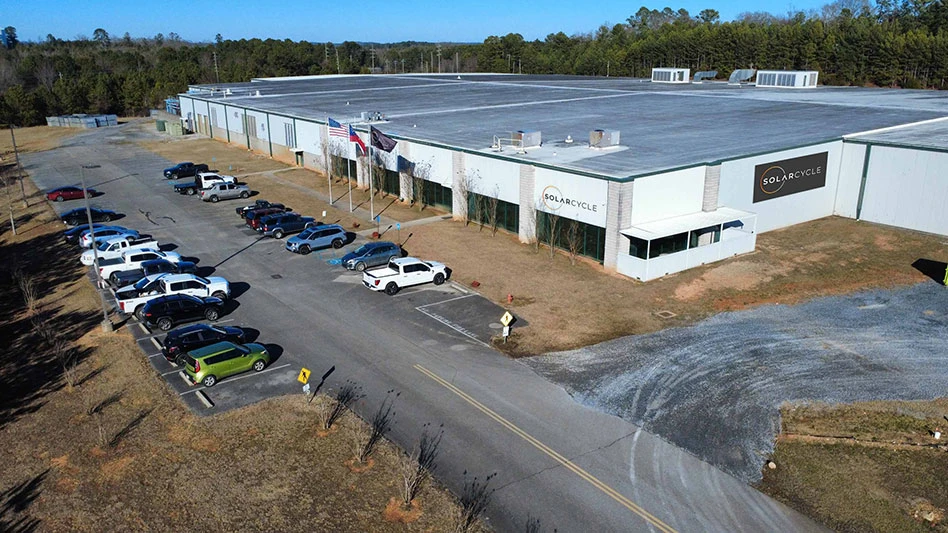
Solarcycle has begun recycling operations at its new facility in Cedartown, Georgia.
The 255,000-square-foot recycling facility is home to the Mesa, Arizona-based company’s proprietary advanced recycling technology, which delivers more than double the throughput of the company’s first-generation recycling lines. The new process recovers 96 percent of the silver, copper, aluminum, glass and other critical minerals within a solar panel, the company says.
Solarcycle announced plans for the facility in November 2024. The company also operates recycling facilities in Mesa and Odessa, Texas, and plans to announce more locations this year
The company's recycling lines are optimized for monofacial panels as it finalizes its next-generation solution for bifacial crystalline-silicon (C-Si) photovoltaic panels, according to Solarcycle. The company has said that this closed-loop process is more flexible and scalable than previous recycling solutions while achieving higher value and mass recovery rates.
“Our original technology was optimized for crystalline panels, which are the majority of the panels currently installed in the U.S.,” Jesse Simons, co-founder and chief commercial officer at Solarcycle, told Recycling Today when the company announced plans to build the recycling facility in Cedartown. “We have developed a number of innovations for this technology, including automating large portions of the disassembly line and increasing the speed and purity of the glass removal process.”
The site is processing thousands of solar panels per week and will continue to scale toward 1 million panels annually by the end of 2026. At full capacity, the facility can process up to 5 gigawatts (GW) of solar panels, or 2 million solar panels, each year, Solarcycle has said.
“Our recycling facility in Cedartown represents a step-change in how we're delivering end-of-life infrastructure,” Solarcycle co-founder and CEO Suvi Sharma says. “The next phase of our growth is all about bringing solar recycling to industrial scale and delivering winning economics for our customers so the industry can keep high volumes of critical materials in domestic supply chains as solar deployment continues to accelerate.”
The recycling facility is adjacent to the company’s future solar glass manufacturing plant, creating an integrated campus designed to recover and remanufacture high-value materials from end-of-life solar panels. Solarcycle says it has secured customer commitments covering more than 80 percent of the glass factory's planned 5 GW capacity, reflecting demand for domestically manufactured solar materials.
The project is on track to break ground in mid-2026 and begin delivery of produced glass in 2028.
Solarcycle announced that one of the companies it will supply with its “ultra-low carbon glass” is solar photovoltaic module provider Heliene, based in Canada, with a manufacturing facility in Minnesota. The company also formed a strategic partnership with Runergy Alabama Inc., a leading solar module manufacturer headquartered in Huntsville, Alabama, through which it will provide recycled glass for Runergy's solar modules and serve as its recycling partner.
In addition to these glass supply agreements, Solarcycle has announced a number of recycling agreements, including with Sol Systems and RWE Clean Energy.
Despite a challenging political climate in 2025, the solar power industry has continued to grow. According to the Energy Information Administration, utility-scale solar continues to be the fastest-growing source of electricity generation in the U.S. The agency says 70 GW of new solar generating capacity are scheduled to come online in 2026 and 2027, which represents a 49 percent increase in U.S. solar operating capacity compared with the end of 2025. Solarcycle says it expects continued growth in solar deployments to drive increased demand for end-of-life solutions.
Latest from Recycling Today
- Fleetio launches AI capability to accelerate fleet maintenance approvals
- The Metals Agency receives approval for export credit insurance
- Recycle Ann Arbor extends drop-off station operating hours
- Sybilion seeks to help manufacturers confidently address volatility
- Rio Tinto, Prysmian partner on low-carbon aluminum solutions for data centers
- Unilever criticized for plastics approach
- USTR to study additional steel, aluminum tariffs
- Electrified Materials adds processing capacity