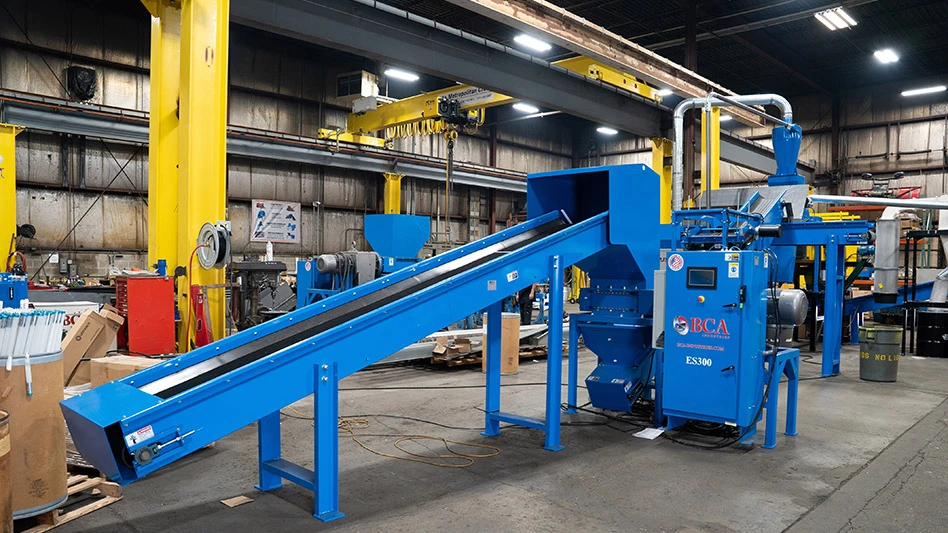
Photo courtesy of BCA Industries
Recyclers and materials processors who enter the used shredder market believing they found a bargain should keep in mind the prospect of facing component failures that ultimately raise long-term costs by hundreds of thousands of dollars, according to Milwaukee-based shredder manufacturer BCA Industries.
BCA and its industrial consultant John Neuens say such risks can be compounded when a recycler purchases a shredder made by a company that subsequently went out of business or one that was custom built and carries little to no documentation or ongoing support.
"When replacement parts are required, the absence of original drawings or specifications means they often must be reverse engineered,” BCA says.
The company also says buyers must be alert to situations where reconditioned shredders have received superficial cosmetic work and only partial testing.
“The internal state of the machine remains unknown, and wear or damage in major components like knife sets, bearings and shafts often goes unnoticed until the machine fails during operation,” the company says.
“While the appeal of seemingly lower cost, used shredders continues to draw buyers, the true costs of bringing these machines into working condition can exceed six figures,” Neuens adds.
First-time buyers, in particular, could underestimate the severity of repair requirements and the long lead times involved, he says, adding that attempts to rebuild equipment in-house or through nonspecialist channels can further inflate part costs, lead to poor performance and increase downtime.
According to Neuens, purchasing new equipment offers the greatest assurance of long-term functionality. However, when new is not an option, he says a machine rebuilt by the original manufacturer can offer an increased level of reliability and technical backing.
“There are quality machines available on the used market, but they are rare,” Neuens continues. “In most cases, equipment is sold because the owner cannot justify the cost of repairs, particularly due to high part prices.”
Buyers new to the process may lack insight into the true cost of ownership, perhaps being unfamiliar with the pricing of components such as knives and shafts, according to Neuns.
“Replacing worn shafts and knives can cost $120,000 with some shredder brands, with lead times of up to four months,” he says. “If a critical part fails and is either unaffordable or unavailable in time, the resulting downtime can be financially devastating.”
Neuens suggests that when accounting for these risks, new equipment does not necessarily have to cost more than used.
In all cases, buyers should exercise caution and conduct thorough due diligence before making a purchase, he says, and contends that a portion of the new shredder market involves a business model built around assembling machines at low cost while charging a premium for replacement parts.
Some experienced buyers understand the pricing structure, but many do not, according to Neuens, who says they consider high part costs as incidental, without realizing some manufacturers make minimal profit on the initial machine sale and rely on replacement parts for margin.
Shredder vendors likewise may not disclose catastrophic repair costs if they are not asked about them by prospective buyers.
“Buyers are rarely told that failure of a single component could result in operational and financial consequences far beyond the initial purchase price; that’s why we term them catastrophic cost parts,” Neuens says.
Regarding BCA’s options for recyclers, Neuens says the company’s ES2000 model, which has been deployed to shred ferrous and nonferrous metal, electronic scrap and end-of-life tires, uses BCA’s patented Triplus system knife technology. That feature is designed to uniformly cut material to any size in a single pass without a screen, very quickly reducing scrap to a reclaimable proportion, according to BCA Industries.
Triplus consists of a bed knife design configured to ensure the size of the end product is based on the size and geometry of the rotary and fixed knives as well as their gap distances.
When purchasing a shredder, Neuens says, recyclers may be better off considering a new machine from a reputable manufacturer that can access to technical support and the latest design enhancements created to help minimize downtime.
Latest from Recycling Today
- McNeilus names Haaker Equipment first Dealer Partner of the Year
- NWRA, SWANA issue responses to BLS fatality data
- ReMA board to consider additional nonferrous specification
- Princeton NuEnergy appoints president, chief financial officer
- Trucks & Parts names president
- Ferrous scrap supply squeeze said to have peaked
- Outokumpu loses money in 2025
- CEPI says recycled paper consumption declined in Europe in 2025