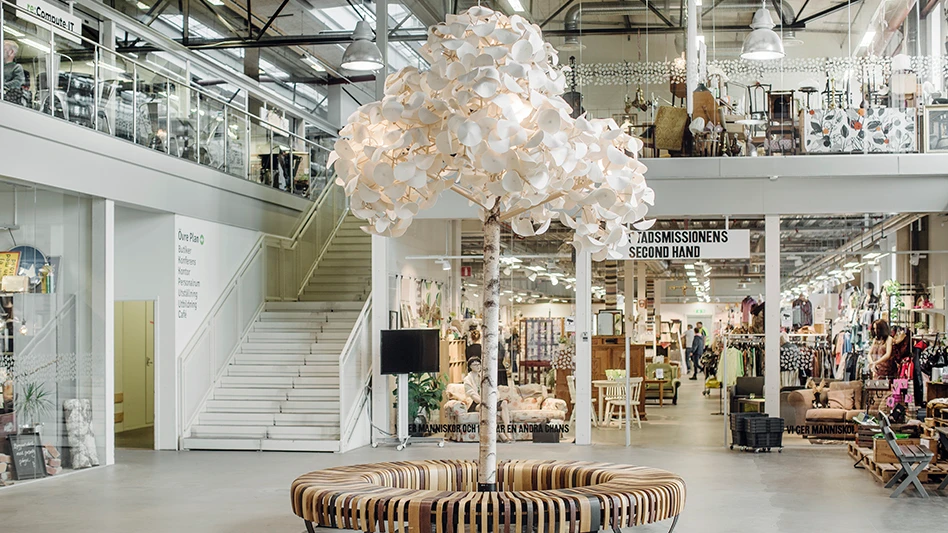
Photo by Lina Östling and courtesy of ReTuna Återbruksgalleria
A German fashion and apparel consulting firm says malls and other shopping centers facing a declining tenant mix could brighten their prospects serving as retail return and resale circularity centers.
The 202030 Think & Do Tank think tank of Berlin-based Studio MM04 has issued a white paper called “Don’t call it circular society mall.” The authors of the more than 50-page report says it contains “actionable frameworks” that go beyond merely rebranding or renaming such properties.
The think tank says collaboration between property owners, tenants, former tenants and other retailers and retail customers is feasible and can be profitable for all concerned.
“Shopping malls already have an overarching management structure connecting a multitude of stakeholders,” writes Studio MM04 in the report’s preamble. “This management structure could be used to organize and run a very local circular economy system, which needs an overarching management to cross-connect the diverse stakeholders involved in redistribution of products, reverse logistics for material flows or data collection for internal and external reporting—and to generally help realizing synergies inside between tenants and outside with neighbors.”
In the United States, some financially distressed shopping malls have been repurposed as distribution centers or for other purposes, but many have been demolished in the first half of this decade.
In a LinkedIn post announcing the release of the report, Studio MM04 writes, “Most people want to repair, rent [and] buy second-hand, but it’s inconvenient, scattered, hard to find and often too expensive. On the other hand, many shopping malls are fighting with declining traffic and empty retail spaces.”
Sizable, mostly empty malls or former superstores have the physical space and infrastructure necessary to host such activities, says the consulting firm. “But here’s the key: Making circular services accessible only works when new business models lead to different pricing systems,” writes Studio MM04. “This requires the right partners working together in a circular ecosystem.”
The firm says such activities can be “positioned as drivers of repeat visits, customer loyalty, and longer-term value creation” at money-losing properties that “must change anyway.”
The white paper offers seven examples of circular-economy focused retail centers that already exist and what can be learned from them. All seven examples are in Europe (Germany, Italy, the Netherlands, Sweden and the United Kingdom).
In a perspective that may apply to such projects if attempted in the U.S., the report’s authors say the tenant mix and marketing of a retrofitted property should appeal to more than “niche sustainability audiences” to offer services that “resonate with mainstream consumers, to be affordable, convenient, desirable and entertaining.”
Adds Studio MM04, “Framing circularity around value for money, informed customer service, convenience and quality could be emphasized as a key design principle.”
The 52-page white paper can be downloaded through a link provided in a Studio MM04 LinkedIn post.
Latest from Recycling Today
- Sims’ Houston contract confirmed by Enstructure
- Benlee calls 2025 record year
- 2026 Plastics Recycling Conference: The growing need for systemwide change
- APR recognizes plastics recycling leadership
- Trex announces leadership transition
- Caterpillar to launch redesigned rental management experience
- Struktol’s additives help transform recycled plastics
- Olympic Steel completes merger with Ryerson Holding Corp.