Steel Dynamics Inc. (SDI), headquartered in Fort Wayne, Indiana, has announced fourth quarter and full-year financial results for 2015. Excluding noncash goodwill and asset impairment charges related to the company's metals recycling operations of $1.13 per diluted share, SDI’s adjusted fourth quarter 2015 net income was $22 million, or 9 cents per diluted share, on net sales of $1.6 billion. Including the non-cash impairment charges, SDI reported a fourth quarter net loss of $253 million, or $1.04 per diluted share.
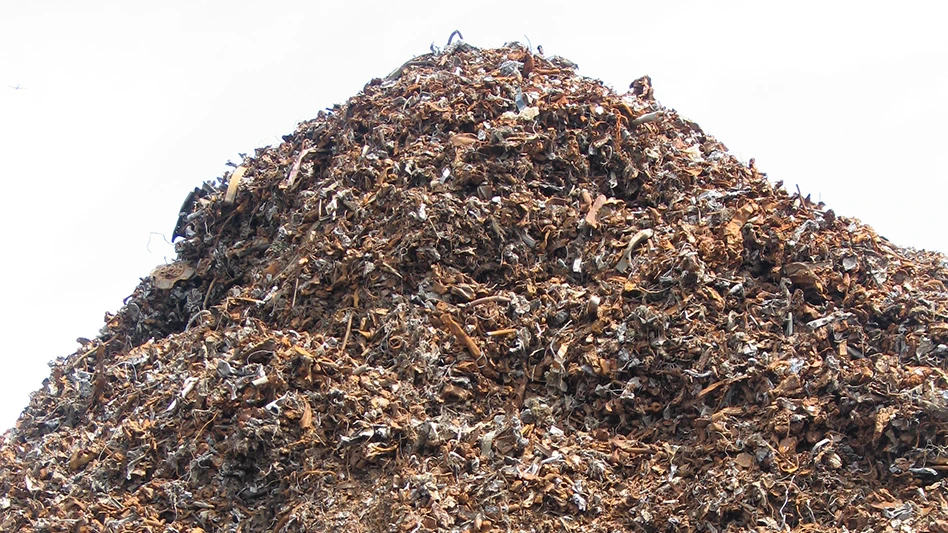
As a part of the company's annual goodwill and indefinite-lived intangible asset assessment, the fair market value of its metals recycling operations was determined to be less than its carrying value in light of the weak global scrap commodity outlook, as indicated in an SDI press release Dec. 16, 2015. Upon completion of the final assessment, it was determined that the book value of the metals recycling segment was impaired, resulting in noncash goodwill and other related asset impairment charges of $435 million, the company says.
Comparatively, 2014 fourth quarter net sales were $2.5 billion, with adjusted net income of $97 million, or 40 cents per diluted share, which excluded the impact of noncash asset impairment and purchase accounting charges of 59 cents per diluted share, the company says. Sequential third quarter 2015 net sales were $2 billion, with net income of $61 million, or 25 cents per diluted share.
“The fourth quarter 2015 market environment was one of the most challenging in recent history for our steel and metals recycling operations,” said Mark D. Millett, SDI CEO. “The domestic steel industry operated at production rates below 65 percent in November and December, representing the lowest levels this year caused by ongoing pressure from unfairly traded steel imports, customer destocking and seasonally lower demand.
He continued, “Enabled by our diversified and value-added product portfolio, our steel operations were again able to maintain a higher-than-industry-average production utilization rate at 73 percent for the fourth quarter 2015.”
Millett said the construction industry, the largest domestic steel consuming sector, continued to improve. “Steady demand in an otherwise typically seasonally slower quarter coupled with market share growth related to our recent acquisition of additional deck assets resulted in a 10 percent increase in fourth quarter 2015 fabrication shipments,” he said, adding that orders remain “robust,” reflecting growth in the nonresidential construction market.
“Our fabrication operations recorded another strong financial outcome in the fourth quarter 2015 and achieved record annual 2015 operating income of $116 million—well over twice the previous record annual results of $52 million earned in 2014,” Millett added.
He described SDI’s cash flow from operations of $330 million as “strong.” The company also generated annual cash flow from operations of more than $1 billion, recording $924 million of free cash flow after fixed asset capital expenditures. “Including our revolver and available cash of $727 million, we achieved record liquidity of $1.9 billion at the end of the year, providing a firm financial foundation for growth,” Millett added.
SDI says steel imports continued to flood the domestic market during the fourth quarter 2015, though the levels were somewhat lower than experienced earlier in 2015. Coupled with seasonally lower demand and buyer hesitancy related to uncertain raw material markets, steel and metals recycling shipments declined.
Fourth quarter 2015 operating income for SDI’s steel operations decreased 47 percent to $67 million sequentially in light of a 12 percent decrease in shipments. In addition, average steel product pricing declined more than consumed raw material scrap costs, resulting in slight steel metal spread compression, the company notes. The fourth quarter 2015 average product selling price for the company's steel operations decreased $51 to $614 per ton, while the average ferrous scrap cost per ton melted decreased $47 to $205 per ton.
Fourth quarter 2015 operating income attributable to the company's sheet products decreased 43 percent when compared with the sequential third quarter. The company's flat roll metal spread decreased in the quarter as average pricing declined more than scrap costs, and quarterly shipments also decreased 10 percent. Flat roll products, specifically commodity-grade hot roll, were the most severely impacted by high import volumes. Operating income from long products decreased 47 percent, caused by average price declines and reduced shipments of 13 percent.
SDI said its steel production utilization rate declined to 73 percent for the fourth quarter 2015, which remains higher than the average U.S. domestic steel mill utilization rate but lower than the company's third quarter 2015 rate of 82 percent.
The company's metals recycling operations recorded an adjusted fourth quarter 2015 operating loss of $16 million (excluding noncash goodwill and asset impairment charges) compared with third quarter 2015 operating income of $463,000. Based on lower domestic steel mill production utilization and traditional year-end steel mill scrap inventory reduction, fourth quarter 2015 ferrous scrap shipments declined 12 percent. Additionally, sequential quarterly ferrous scrap pricing decreased substantially, resulting in a 34 percent margin reduction, SDI says.
Its fabrication operations’ fourth quarter 2015 operating income totaled $30 million, which was only surpassed by the sequential third quarter's record of $37 million. Sustained demand supported a 10 percent increase in quarterly shipments, according to SDI, which partially offset metal spread compression as average product pricing declined more than raw material steel costs.
Despite record full-year fabrication and steel shipments (a function of including the company's Columbus Flat Roll Division shipments for a full year in 2015), annual 2015 net sales were $7.6 billion, a decrease of 13 percent from 2014’s $8.8 billion in 2014, based on significantly lower product pricing.
SDI said the dramatic drop in global commodity prices caused the average full year 2015 selling price for its metals recycling operations to decline more than 36 percent year over year.
Additionally, the average full year 2015 selling price for the company's steel operations decreased $152 per ton, or 18 percent.
As a result, annual 2015 revenue for the company's metals recycling and steel operations fell $794 million and $338 million, respectively. The average full year 2015 ferrous scrap cost per ton melted decreased $105 to $255 per ton, resulting in meaningful metal spread compression, SDI says.
Adjusted annual 2015 operating income was $398 million, with adjusted net income of $178 million, or 74 cents per diluted share, excluding noncash asset impairment and other charges related to the company's metals recycling and ferrous production operations and first quarter 2015 refinancing costs. Including these charges, annual 2015 net loss was $130 million, or 54 cents per diluted share. Comparatively, adjusted annual 2014 operating income was $612 million, with adjusted net income of $323 million, or $1.35 per diluted share, excluding charges related to the Minnesota asset impairment and Columbus acquisition. Including these charges, annual 2014 net income was $157 million, or 67 cents per diluted share.
“While underlying steel demand in certain market sectors remains steady and import levels have somewhat declined, the issue of unfairly traded steel imports persists,” Millett said. “We believe that customer steel inventories have started to realign with current demand dynamics and, when combined with scrap price stabilization and moderating steel import volumes, present an environment that could result in increased 2016 domestic steel production.
“We continue to strengthen our financial position through strong cash flow generation, record liquidity, and the execution of our long-term strategy,” he continued. “We are uniquely well-positioned for additional growth. Customer focus coupled with our market diversification and low-cost operating platforms support our ability to not only maintain our best-in-class industry performance but to also grow in a challenging environment.”
Latest from Recycling Today
- Waste Pro files brief supporting pause of FMCSA CDL eligibility rule
- Kuraray America receives APR design recognition for EVOH barrier resin
- Tire Industry Project publishes end-of-life tire management guide
- Des Moines project utilizes recycled wind turbine blades
- Charter Next Generation joins US Flexible Film Initiative
- Vecoplan to present modular solutions at IFAT 2026
- Terex Ecotec appoints Bradley Equipment as Texas distributor
- Greenwave raises revenue but loses money in Q2 2025