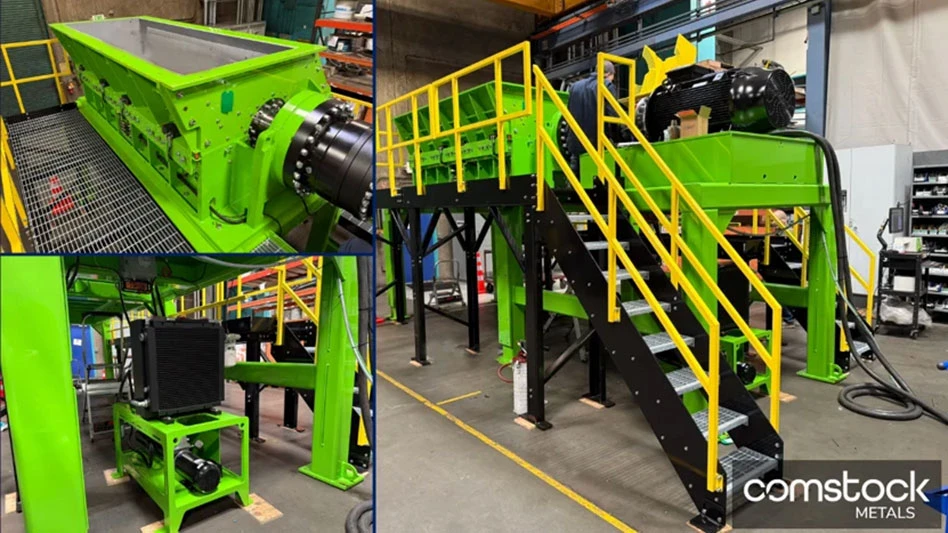
Scrap metal recyclers are creating a renewed market for baler/loggers as a way to prepare collected scrap for shipment to auto shredder plants.
“Logs are now more acceptable to operators of the large shredders,” John Sacco of Sierra International Machinery, Bakersfield, Calif., told attendees of the Steel Scrap 101 event, held in St. Louis in mid-February.
Sacco said that baler loggers that can process from 25 to 250 tons per day of ferrous scrap are being used in areas that are somewhat distant from the nearest shredder yard as a means of preparing obsolete scrap for shipment to a shredder. “It can increase the trailer weight,” he said, as opposed to shipping loose scrap.
He also remarked that are several reasons why some recyclers would rather create logs that are shipped to shredder plants rather than preparing a grade for direct shipment to a steel mill.
Logging can compress from 30 percent to 50 percent more material in a time period than baling (though not as densely), so recyclers are able to ship more material. From a cash flow viewpoint, recyclers will probably be paid more quickly by a shredder operator, and there is less chance of a load being rejected by a shredder operator compared to a mill, Sacco commented.
Preparing material for further processing at shredder plant also provides a home for material that may previously been packaged as number two heavy melt—a grade that many recyclers find is facing a dwindling demand scenario.
The Steel Scrap 101 Seminar was co-hosted by the Institute of Scrap Recycling Industries Inc. (ISRI) and the Steel Manufacturers Association (SMA), both Washington-based trade associations.Latest from Recycling Today
- Interchange 360 to operate alternative collection program under Washington’s RRA
- Waste Pro files brief supporting pause of FMCSA CDL eligibility rule
- Kuraray America receives APR design recognition for EVOH barrier resin
- Tire Industry Project publishes end-of-life tire management guide
- Des Moines project utilizes recycled wind turbine blades
- Charter Next Generation joins US Flexible Film Initiative
- Vecoplan to present modular solutions at IFAT 2026
- Terex Ecotec appoints Bradley Equipment as Texas distributor