Photo courtesy of Redwood Materials
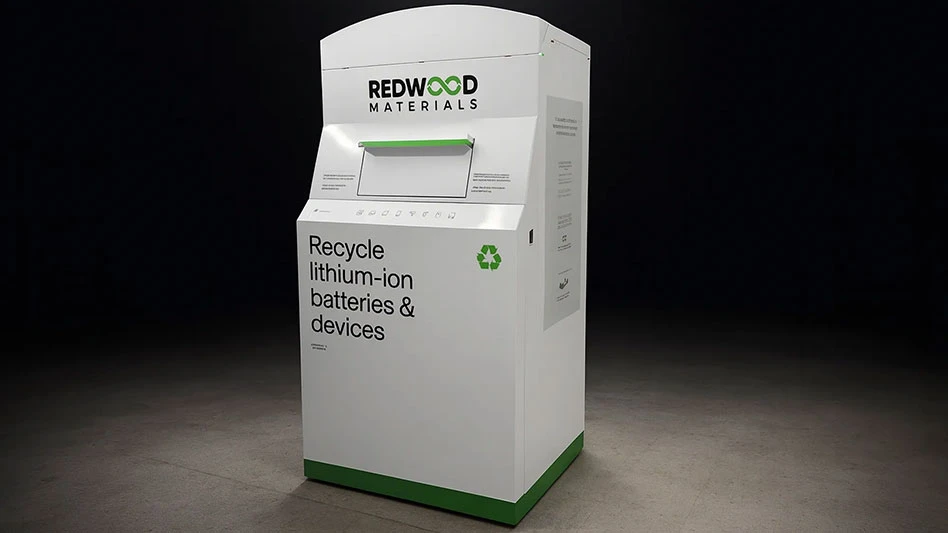
Redwood Materials has developed fully automated Battery Bins that use proprietary technology to safely collect batteries and battery-containing devices, and San Francisco, through its Environment Department, is the first city to roll out the technology.
The automated drop-off bins accept mixed batteries and battery-embedded products with zero prep or sorting required.
“Electronics are one of the largest untapped sources of critical materials, such as cobalt, nickel, lithium and copper, which are essential to powering our energy future,” Alexis Georgeson, Redwood vice president of external affairs and consumer recycling programs, says. “But today, only 16 percent of these devices are ever recycled, and these materials get stranded in America’s junk drawers or sent to landfills.
“Our new Battery Bins use first-of-their-kind, patented technology to safely capture these materials at scale,” Georgeson continues. “We’re thrilled to partner with the city and county of San Francisco, SF Environment and local businesses to make recycling easier than ever.”
The Battery Bins
Carson City, Nevada-based Redwood Materials Special Projects Senior Manager Haley Ketterer led the project to develop the Battery Bins.
She says Americans are hoarding untapped critical metals in their junk drawers because it is not easy to figure out how to recycle end-of-life batteries and small, rechargeable devices with embedded batteries, such as phones, laptops, electric toothbrushes, electric razors, headphones and small wireless devices.
“As a company, we believe that battery recycling should be free and convenient for everyone, so we started thinking, how can we make this possible?”
The Battery Bin is Redwood’s answer to that question, creating what she describes as “a scalable, safe, compliant [and] convenient solution that can be deployed nationwide.”
Ketterer says cardboard boxes at the front of stores that ask you to understand battery chemistries and prepare batteries in a certain way and plastic pails in the back of stores that don’t advertise that they accept batteries and battery-embedded devices aren’t the best ways to facilitate consumer battery recycling.
“This Battery Bin is an extension of our consumer recycling program that we've been working on for years,” she adds, which includes retail drop-off locations, community collection events and direct shipping to Redwood.
With the Battery Bins, Ketterer says Redwood Materials is addressing the “convenience gap” consumers encounter in recycling their batteries. “We are, as Americans, conditioned to recycle curbside, and every additional step that you ask people to take to do some sort of specialized recycling, the fewer folks are going to take you up on it.”
Therefore, Redwood designed a bin that is purpose-built for public spaces with high foot traffic that are already offering a recycling service, enabling those spaces to expand the categories of items they can safely and compliantly recycle, Ketterer says.
From the outside, it looks as simple as dropping a device into a slot. Inside, however, each unit is engineered with a sophisticated sensing and materials-management system operating continuously in the background.
In designing the bins, Redwood prioritized safety, compliance, ease of use for the hosts of the bins and the general public and scalability, she says.
Users of the bins do not need to prepare their batteries or devices by tapping or bagging them prior to depositing them in the bins.
“Essentially, as batteries and devices are deposited, the bin has a microcontroller that powers the whole system,” Ketter says. “It's using infrared, ultrasonic [and] positional sensing to evaluate each item by volume, so that the size of the volume it takes in the interior drum, and then to optimize the packing density.”
As a battery or device is deposited into the bin, the system deploys fire-suppressive material around the item.
“Over time, as additional batteries and devices get put in there, we deposit controlled amounts of fire-suppressing material, essentially creating a yogurt parfait of layers of fire-suppressing material, batteries [and] fire-suppressing material,” she says. “That material finds the interstitial spaces in between the adjacent batteries.”
The bins are continually self-monitored to maintain safe internal conditions, Ketterer adds. “That's something we're also able to view and have oversight on remotely.”
Redwood can monitor a dashboard for each bin that provides real-time status updates on the drum fill level, hopper fill level and temperature, with alerts generated if conditions within the bin change.
The technology also allows Redwood to know when a drum is nearing capacity and needs to be refreshed.
“We're able to anticipate, because we see the drum level creep up, when it needs to be refreshed,” Ketterer says. “We’re able to almost eliminate downtime as a result because we can schedule logistics ahead of time to make sure that residents almost never see it totally full.”
In the case that Redwood cannot service a bin before it’s full, the bin locks out so that additional batteries or devices cannot be deposited.
Ketter says bins are designed to hold hundreds of batteries or devices, but the energy density and the dimensions of each item affect the overall capacity.
San Francisco deployment
Redwood Materials has placed the Battery Bins initially at eight locations across San Francisco in partnership with SF Environment: four Cole Hardware locations, three Sports Basement stores and at 2 Embarcadero Center, with additional placements coming.
Batteries and battery-embedded products cannot be discarded in recycling, compost or landfill bins. San Francisco currently works with 60 retail collection partners ranging from hardware stores, pharmacies, and sports stores for household battery drop-off needs.
Small loose household batteries (not battery-embedded products) can be disposed of by collecting them in a clear bag and placing the bag on top of the gray or black landfill bin or in orange battery collection buckets available in apartment buildings. The ends of any lithium and 9V+ batteries must be tapped when using these collection methods.
Redwood’s Battery Bins also offer a solution that specifically targets battery-embedded devices as well as batteries.
“Battery disposal is a very serious matter, and batteries should always be disposed of properly and safely,” says SF Environment Director Tyrone Jue in a news release about the bins’ deployment. “Expanding innovative recycling options for embedded batteries is essential as the world transitions to cleaner electric technologies. We are excited to welcome Redwood Material’s new Battery Bins and add greater support and convenience to San Francisco’s battery recycling ecosystem."
Mayor Daniel Lurie adds, “These new battery recovery and recycling bins are a great example of how our city is continuing to innovate and make recycling easier and safer for everyone.”
“San Francisco continues to lead in developing solutions that protect our environment,” says Lieutenant Ken Smith, public information officer at the San Francisco Fire Department. “Providing convenient, community-based locations where residents can safely recycle batteries just makes sense, and we’re excited to see the impact of the program.”
“Helping make everyday tasks easier for our neighbors is what Cole Hardware is all about,” says Cole Hardware co-owner Rick Karp. “That's why we're excited to partner with Redwood Materials and SF Environment to make battery and device recycling safer and more convenient for communities across San Francisco.”
Initial results
Ketter says Redwood is pleased with the initial response it’s seen since deploying the bins roughly a month ago.
“We’ve had these out quietly in San Francisco the last month, and we've returned a few drums since, which has been amazing to see,” she says. “There's clearly a need. We've done almost no promotion up until this point.”
The only contamination Redwood has seen in the bins is packaging in the form of cardboard or plastic, she adds.
The collected devices are transported to Redwood’s facilities in Nevada or South Carolina for processing. They are dumped onto a shaker table to remove the fire suppressant, which can be reused. Ketterer notes that Redwood was able to recover 95-98 percent of this material from the initial drums collected through the program.
Latest from Recycling Today
- CMRA selects Vietnam for 2026 event
- Steel Dynamics foresees profitable Q1
- AF&PA joins NAW lawsuit in Oregon
- California’s ‘Truth in Labeling’ law faces federal suit
- Fayetteville, Arkansas, adopts new cart-based recycling program
- Google purchases carbon removal credits generated by Amp’s organic waste processing
- FTR forecasts toughening conditions for shippers
- The trends shaping MRF design