Image courtesy of SABIC
Global chemicals company SABIC (Saudi Basic Industries Corp.), headquartered in Saudi Arabia, recently partnered with Zuyderland Medical Center in the Netherlands to turn medical plastic scrap into new contact-sensitive packaging materials.
In collaboration with converters Coveris and Ace Srl and brand owners Artivion and Mölnlycke Health Care, SABIC says it has worked with its project partners to successfully prove the concept of recycling used medical plastic back into the medical material stream in two pilot projects.
RELATED: SABIC’s TruCircle PE used for greenhouse roofing
Staff at Zuyderland launched a medical plastic collection program in June 2024 to help address “unmet needs and challenges” of plastic scrap that otherwise would be incinerated.
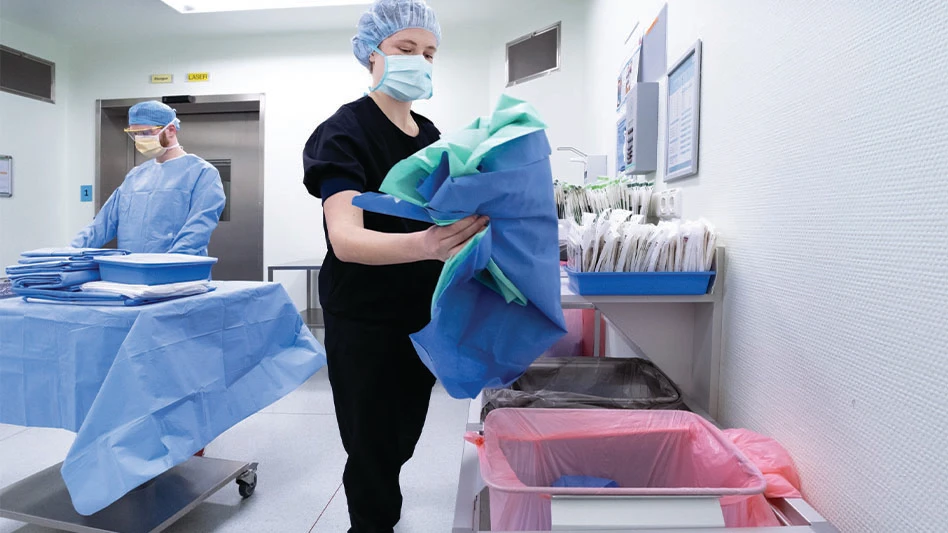
The program consists of a novel collection system for noncontaminated plastic that has not come into contact with patients, blood or bodily fluids. With the support of specialized transport company L’Ortye, plastic scrap was prepared and transported to SABIC to be converted into pyrolysis oil through chemical recycling processes.
SABIC says it then used this alternative feedstock to produce “virgin-like certified” circular polyethylene (PE) from its TruCircle portfolio. The company says the new TruCircle PE has subsequently been used in two new healthcare solutions:
- Coveris produced packaging with 25 percent content attributed to recycled medical scrap for Artivion’s guide ware used in vascular surgery.
- Mölnlycke Health Care produced surgical drapes with 49 percent content attributed to hospital-generated plastic scrap to be delivered in the ProcedurePak solution made with a material component from ACE.
“We are excited about this pioneering circular business pilot, which showcases the potential of circular plastic innovations when leading actors from across the medical ecosystem closely collaborate,” says Khaled Al-Jalawi, global circular economy director at SABIC. “Noncontaminated medical plastic waste represents a valuable feedstock opportunity, and SABIC TruCircle solutions could play a major role in advancing circularity in healthcare.”
Zuyderland board member Roel Goffin says, “We are very proud of this breakthrough after bringing together leading partners in the value chain. Our own noncontaminated medical plastic waste has been successfully turned into new material and returned for use in our own operating rooms.”
SABIC says the collaboration also has the academic backing of Maastricht University, which recently has been awarded an Interreg EU grant for a three-year project to help drive “Circular Transformation of Health and Care Systems in the Meuse Rhine Region” with partners that include SABIC and Zuyderland.
“We continuously strive to offer our customers sustainable solutions without compromising on efficacy or the safety of patients and healthcare professionals,” says Fredrik Wallefors, executive vice president of operating room solutions at Sweden-based Mölnlycke Health Care. “This pioneering collaboration with other ecosystem partners represents a promising step in exploring how advanced recycling could contribute to closing the loop for noncontaminated medical plastic waste. We are proud to be part of efforts to develop methods for circulating materials and mitigating waste related to healthcare delivery.”
ACE Business Development Director Christoph Lentz says his company, headquartered in Belgium, is proud to lead the transformation of medical laminates with its extrusion films, which are engineered for the lamination of disposable surgical drape material.
“In close collaboration with SABIC and Mölnlycke Health Care, we are integrating ISCC Plus certified circular polymers into our production processes,” he says. “This partnership reflects our shared commitment to reducing environmental impact and enhancing resource efficiency, driven by innovative recycling technologies and responsible sourcing.”
Latest from Recycling Today
- Fleetio launches AI capability to accelerate fleet maintenance approvals
- The Metals Agency receives approval for export credit insurance
- Recycle Ann Arbor extends drop-off station operating hours
- Sybilion seeks to help manufacturers confidently address volatility
- Rio Tinto, Prysmian partner on low-carbon aluminum solutions for data centers
- Unilever criticized for plastics approach
- USTR to study additional steel, aluminum tariffs
- Electrified Materials adds processing capacity