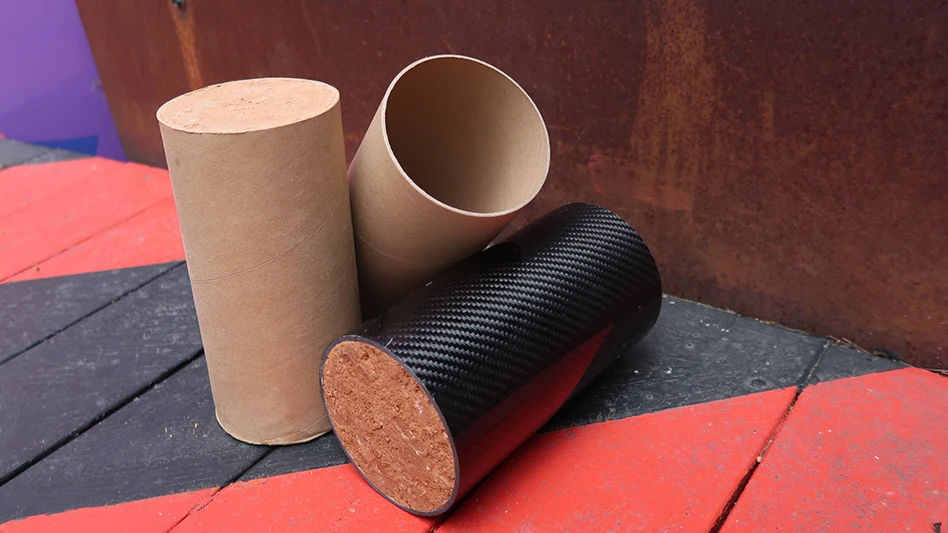
Photo courtesy of RMIT
Engineers at the Royal Melbourne Institute of Technology (RMIT) in Melbourne, Australia, have developed a new building material made entirely from cardboard, water and soil.
Named carboard-confined rammed earth, RMIT says this material uses about one quarter of concrete’s carbon footprint, reduces waste going to landfill and is reusable and recyclable.
According to RMIT, more than 2.2 million tons of cardboard and paper are sent to landfill in Australia each year. Cement and concrete production account for about 8 percent of annual global emissions.
The RMIT University team says the design was inspired by cardboard’s use in temporary structures and disaster shelters. Lead author Dr Jiaming Ma from RMIT says the development of cardboard-confined rammed earth marked a significant advancement toward a more sustainable construction industry.
“Modern rammed earth construction compacts soil with added cement for strength. Cement use is excessive given the natural thickness of rammed earth walls,” he says. “By simply using cardboard, soil and water, we can make walls robust enough to support low-rise buildings.”
Cardboard-confined rammed earth can be made on the construction site by compacting the soil and water mixture inside the cardboard formwork, either manually or with machines. Emeritus Professor Yi Min ‘Mike’ Xie, the study’s corresponding author and leading expert in the field of structural optimization, says this advancement can spearhead a leaner, greener approach to construction.
“Instead of hauling in tons of bricks, steel and concrete, builders would only need to bring lightweight cardboard, as nearly all material can be obtained on site,” Xie says.
“This would significantly cut transport costs, simplify logistics and reduce upfront material demands.”
Ma says cardboard-confined rammed earth could be an effective solution for construction in remote areas.
In a separate study lead by Ma, carbon fiber was combined with rammed earth, proving it had a comparable strength to high-performance concrete.
“Rammed earth buildings are ideal in hot climates because their high thermal mass naturally regulates indoor temperatures and humidity, reducing the need for mechanical cooling and cutting carbon emissions,” he says.
Latest from Recycling Today
- Ocean Legacy Foundation expands plastic testing laboratory services
- CMI, HCPA publish aerosol recycling guide for MRFs
- 2026 Plastics Recycling Conference: A look at PCR contracts
- Remade Institute hosts Circular Economy Tech Summit & Conference in March
- Befesa sees record performance in 2025
- North Carolina county receives FRC foam recycling grant
- Cascades tissue business falls short in Q4
- GFL renews share repurchase programs