Prices paid by North American steel mills for ferrous scrap are remaining stable throughout the summer of 2011, with August spot prices within a few dollars of July’s figures. (Click here to view the numbers for the month.)
According to the Raw Material Data Aggregation Service (RMDAS) of Management Science Associates (MSA), Pittsburgh, spot buyers in early and mid-August paid within $10 per ton of what they paid in July for all grades across all regions.
National price averages for three of the largest grades tracked by RMDAS either decreased by a few dollars in August or, in the case of No. 1 Heavy Melting Steel (HMS), remained flat.
Mill buyers were able to pay, on average, $8 less per ton for the prompt industrial composite grade (consisting of No. 1 busheling, No. 1 bundles and No. 1 factory bundles) in August. Prices for the grade remain slightly greater than $500 per ton at $504.
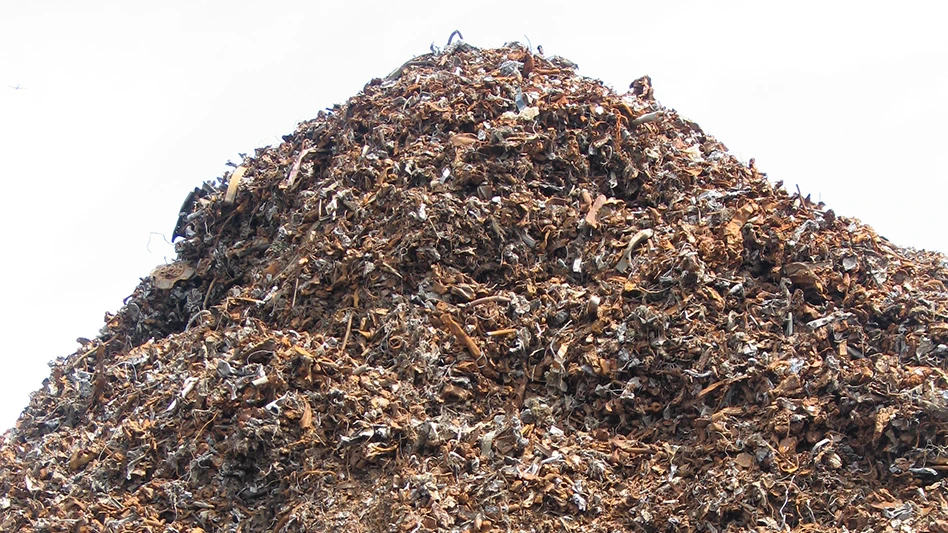
Spot buyers of No. 2 Shredded Scrap paid an average of $447 per ton in August (down $4), with the grade trading at a slightly lower price of $440 per ton in the North Midwest region (Illinois, Iowa, Kansas, Minnesota, Missouri, Nebraska, Wisconsin, the Dakotas and northwest Indiana).
A scrap recycler in the Great Lakes region reports that material flows have been steady throughout the summer, as peddlers and small generators remain active thanks in part to the high prices being paid for red metal scrap.
The automotive industry is generating some prompt scrap in both the traditional Midwest locations as well as in the South. The scrap industry around Chattanooga, Tenn., is benefiting from the ramping up of Volkswagen’s automotive assembly operations there.
Volkswagen now employs 2,000 people in the city, according to a late July report in The Chattanoogan newspaper. Production of the Volkswagen Passat at the plant began in May of 2011, and economic development officials in the area are touting additional jobs and industrial activity that will be created from component suppliers to the plant.
The construction unemployment rate remains lofty, according to the Associated General Contractors of America (AGC), although it may have stabilized. “When it comes to construction employment, for every state adding jobs there is another one shedding just as many or more,” says Stephen Sandherr, CEO of AGC.
Among the states exhibiting gains in construction employment (and, presumably, activity) between July 2010 and July 2011 were: Texas (23,800 jobs; 4.2 percent growth); Illinois (15,400 jobs; 8.2 percent growth); California (13,100 jobs; 2.4 percent growth) and Michigan (9,600 jobs; 8.0 percent growth). By percentage, other states with rebounding construction sectors include North Dakota (19.0 percent growth; 4,000 jobs) and Oklahoma (6.0 percent growth; 4,000 jobs).
Figures for domestic steelmaking collected by the American Iron and Steel Institute (AISI) show the industry’s output has remained stable during the summer.
In the week ending August 13, 2011, domestic raw steel production was 1.88 million tons with a mill capacity rate of 77 percent. That figure is up from the 1.65 million tons produced in the comparable week of 2010—an increase of 14.3 percent.
The mid-August steel output figure is up 0.2 percent from the previous week, indicating a pattern of steady output for the steel industry in North America.
The Raw Material Data Aggregation Service (RMDAS) Ferrous Scrap Price Index is based on data gathered from a statistically significant compilation of verified ferrous scrap purchase transactions.
RMDAS is a service of Management Science Associates Inc. (MSA), Pittsburgh. Those seeking more information about RMDAS can contact MSA’s Jeralyn Brown at 724-265-6574 or via e-mail at JBrown@MSA.com.
Latest from Recycling Today
- Equipment from the former Alton Steel to be auctioned
- Novelis resumes operations in Greensboro, Georgia
- Interchange 360 to operate alternative collection program under Washington’s RRA
- Waste Pro files brief supporting pause of FMCSA CDL eligibility rule
- Kuraray America receives APR design recognition for EVOH barrier resin
- Tire Industry Project publishes end-of-life tire management guide
- Des Moines project utilizes recycled wind turbine blades
- Charter Next Generation joins US Flexible Film Initiative