Even as China’s economy cools down from its former peak, its government is taking measures to help ensure its paper industry has access to recovered fiber collected domestically and brought in from overseas.
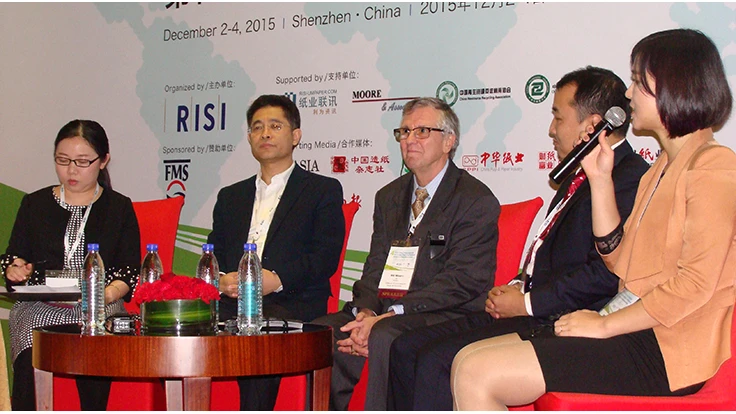
Different presenters at the 2015 RISI China International Recycled Fiber Conference, which took place in early December in Shenzhen, China, referred to efforts within that nation to promote a healthy supply of recovered paper.
During a panel discussion, the topic of the stronger U.S. dollar was tied to China’s ability to buy recovered paper from North America. “America’s supply, relatively speaking, will become more expensive,” said Tang Yanju of the Beijing-based China Resource Recycling Association (CRRA) regarding the situation for Chinese papermakers if the Chinese yuan continues to depreciate against the dollar.
“If U.S. supply is expensive, the demand [for it] will go down,” concurred Guo Yongxin of the China Paper Industry Chamber of Commerce. China’s government has already provided some relief on this front in the form of a 50 percent value added tax (VAT) rebate for buyers of imported recovered fiber. “We’ve achieved a success, but that is not enough,” said Guo, adding his organization would prefer a 100 percent VAT rebate.
That same rebate has yet to be extended to transactions pertaining to domestically recovered scrap paper, which would seem to be at odds with a Chinese central government “circular economy” policy to boost recycling.
The CRRA’s Tang said the exclusion of domestic recovered fiber for the VAT rebate “is bad news for domestic recovery.”
What has been bad news for recovered fiber importers in China is the customs and environmental agency inspection process. Said Guo, “It takes too long and it adds costs to the manufacturer. We are voicing that to the [Chinese] State Council.”
Chen Xi, a general manager with Beijing-based Gezhouba Group, a state-owned enterprise that a CRRA study found to be the fourth largest recovered paper collector within China, called recycling “an important pillar for the Chinese economy.”
Chen said “renewable resources are a fundamental part” of China’s 13th Five-Year Plan, which runs from 2016 to 2020. Recycling, he said, “has sound market prospects and government support.”
Tang told attendees collection of recovered fiber has been strong in China’s largest cities and is beginning to strengthen in other parts of the country. “Given the westward transfer of the papermaking industry and the government’s requirement on relocation of [mills], forward-looking packaging companies have built recovered paper collection networks in Hebei, Hubei, Hunan and Jiangxi provinces.”
The 2015 RISI China International Recycled Fiber Conference was Dec. 2-4 at the JW Marriott Hotel in Shenzhen, China.
Latest from Recycling Today
- Interchange 360 to operate alternative collection program under Washington’s RRA
- Waste Pro files brief supporting pause of FMCSA CDL eligibility rule
- Kuraray America receives APR design recognition for EVOH barrier resin
- Tire Industry Project publishes end-of-life tire management guide
- Des Moines project utilizes recycled wind turbine blades
- Charter Next Generation joins US Flexible Film Initiative
- Vecoplan to present modular solutions at IFAT 2026
- Terex Ecotec appoints Bradley Equipment as Texas distributor