From well less than 1 million metric tons in 1995 to more than 8 million metric tons last year, China’s import of recovered paper could swell to more than 10 million metric tons by the end of this year. In fact, from 1993 to 2003, consumption of recovered paper is up 12 percent per year, and net imports are up 28 percent per year, according to a RISI (Resource Information Systems Inc. of Bedford, Mass.) forecast.
MACRO-ECONOMIC FACTORS. With more than $50 million in direct foreign investment in each of the last two years, China has surged ahead in leading global growth figures. The central government reported 2003 growth of 9.1 percent, well above a target rate of 8.5 percent. More concerning was the further 9.7 percent charge ahead in the first quarter of 2004. By late April, China’s President Hu Jintao reacted by condemning excessive growth in fixed-asset investment and in redundant construction.
Within weeks, the government had established a series of actions to cool the economy and to curb inflation. Such steps included limiting price controls; providing for more comprehensive examinations of banks’ books to discourage risky loans; setting stricter limits on converting farmland to industrial or residential use; and re-evaluating previous government approvals of projects in overheated sectors like steel, cement and real estate.
A Fortune magazine article "Why China Won’t Hit a Wall," published May 3, 2004, quotes Jonathan Anderson, a UBS Securities economist in Hong Kong, as saying he "draws a distinction between periods of overheating, when economies grow at rates that can’t be sustained, and bubbles, when asset prices and productive capacity soar so far beyond underlying demand that they pose significant risk of a sudden collapse." The article continues, "What’s happening in China, he argues, is the former, not the latter. The most likely scenario, in his view, is that China will manage a soft landing, with real growth slowing from last year’s torrid 11.5 percent to a more sustainable 7.5 percent in 2005."
As if inflation weren’t enough, other macroeconomic factors loom large for China, including China’s currency peg—a fixed arrangement between the renminbi (RMB) and the U.S. dollar. China has held the rate steady since 1994. Mounting pressure has led to a review of the peg and for the first time since the Asian financial crisis in 1997, Guo Shuqing, head of the body that manages China’s $416 billion in foreign currency reserves, has outlined a rough timetable for removing constraints on the country’s closed capital account.
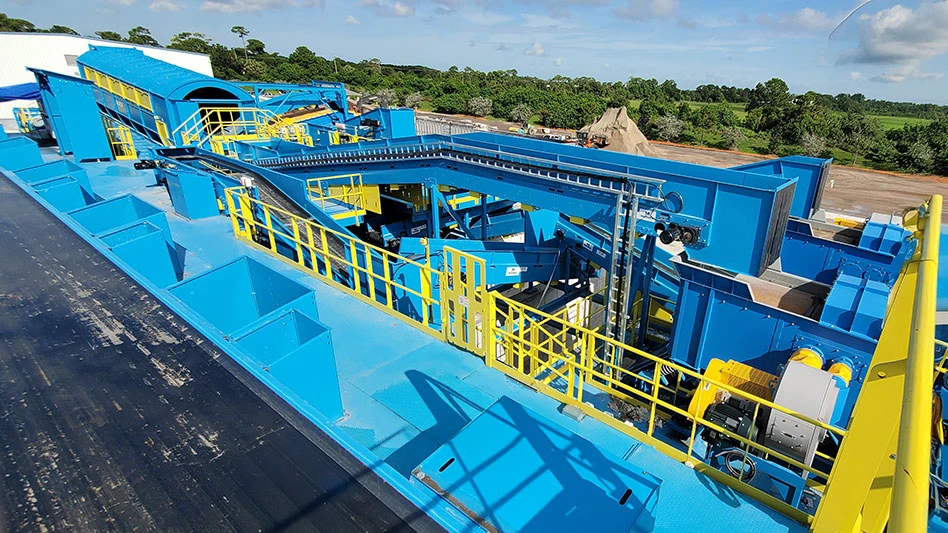
 China's recovered paper imports could grow to more than 10 million metric tons this year. |
Commenting on what has become a flashpoint issue, Shuqing argues in support of the Beijing sentiment that the RMB may not have to be revalued. Still, according to a Feb. 12, 2004, article in the International Herald Tribune, "…hints that China might let its currency rise 5 percent to 10 percent against the dollar in the next months raised hopes in the U.S. of a smaller trade deficit."
Going further, Morgan Stanley Chief Economist Stephen Roach argues that China is not causing the U.S. trade deficit. The same International Herald Tribune article quotes Roach as saying: "Rather than blame China for its trade deficit, he argues, the United States should recognize that it has a trade imbalance because it spends beyond its means." If the deficit with China were to close, Roach says, a similar one would open with another country. "The rich world has ganged up on China."
KEY ISSUES.
The developments in the recovered paper industry should be described as evolutionary rather than revolutionary. Key issues affect participants similarly across the globe, whether on the "supply-side" or "demand-side."In an effort to understand the leading edge of change, one should look at key issues affecting recovered paper trade, including: the shipping industry’s capacity problems; new regulatory concerns; European and intra-Asian exports; and new mill capacities in China and Europe.
Containerized shipments have revolutionized global trade. Overall, sea-borne trade now amounts to about 6 billion metric tons of goods annually, accounting for more than 90 percent of world trade by volume, a rise of about 50 percent since 1990, according to a March 8, 2004, article in the Financial Times. As well, it is no secret among industry participants that recovered paper is the largest volume item shipped from the United States.
Recently, however, a problem is looming on the horizon. A lack of cargo carriers and equipment has caused imbalances throughout the Far East trade lanes with North America and Europe. And there is one root cause: China’s emergence as an economic power.
According to a report by Kevin Morrison and Andrew Ward of the Financial Times, ship builders are having a hard time keeping up with demand for sea going vessels. They report that the dry docks of Hyundai Heavy Industry in South Korea are overwhelmed with orders, and this is no different throughout Northeast Asia, the heart of global shipbuilding. A Hyundai official says they have 180 ships on their order book, which is enough to keep their yard busy for three years.
The problems don’t stop there, however, as terminals around the world struggle to service ever growing vessels and volumes.
Congestion becomes normal and the "just-in-time" logistics approach can quickly become "just-too-late." The number of containers handled by mainland Chinese ports rose 35 percent last year, says Paul Dowell, a container ship analyst at London-based Howe Robinson.
One wonders how the shipping industry will keep up with this pace of growth. Tim Bond, global head of interest rate strategy at Barclays Capital told the Financial Times, "I see the rise in shipping rates as a metaphor for the lack of investment in the old economy during the investment boom of the late 1990s." Ask any North American or European-bound shipper and you know who is now paying the bill.
Freight rates on some routes have quadrupled in the past year as ship owners have enjoyed their best return in decades—and therein lies the "rub" for many a recovered paper shipper. With low rates for the return leg of the journey, what is to keep a ship owner from returning the container empty? Many lines have resorted to such tactics in order to "turn-around" much-needed containers. Expect this story to continue as the lack of balance in the equation is only now being addressed with new capacities.
Even then, you may count yourself fortunate to get containers on the vessel as the next key issue comes in view: heightened regulatory controls on the import of recovered paper.
PROTECTING HER SHORES.
In order to regulate scrap imports including recovered paper, the General Administration of Quality Supervision, Inspection and Quarantine (AQSIQ) of the People’s Republic of China has issued new regulations under Notice No. 115 – 2003. In short, "Overseas Enterprises" exporting scrap materials as raw materials to China are required to register with AQSIQ.Notice No. 48 issued by the body May 8, 2004, explains the details of the registration process. "Applicants will have to prove that they are an authorized operator within their home country, have a clean record on compliance with customs and environmental regulations and have a permanent office or processing plant. On top of that, candidates will need to document their internal quality control processes and financial stability," a June 7 news item on www.paperloop.com reads. Prompting the need for such rules are the illegal exports of commingled waste. It has been estimated that some 300,000 to 500,000 metric tons per year of commingled waste are illegally imported as recovered paper from Europe.
Martin Kleiweg de Zwaan, chairman of the Dutch Recycling Federation and president of the European Recovered Paper Association, commented to PPI Asia News in April that China currently purchases about 75 percent of Europe’s recovered paper exports, some 3 million metric tons per year.
According to press reports, one trader recently faced demurrage costs in excess of $300,000 after the Chinese authorities diverted his cargo to India. ERPA called for a halt to the practice in a statement March 15.
GLOBE TROTTING.
From 2000 to 2003, more than 7 million tons of pulp and paper capacity has been shuttered in North America, and it is evident what is happening with the supply that once fed that capacity. Last March, exports to China accounted for 47.3 percent of overall exports, bringing China’s first quarter market share to 48 percent, according to an article titled "OCC leading price charge on exports" May 25 in The Paper Stock Report.During the same quarter, exports to other Asian countries were off significantly from the year prior. Exports to Korea were off 6.5 percent, those to India were off 24 percent, those to Taiwan were off 22.8 percent, those to Thailand were off 34.3 percent, and those to Japan were off 44.1 percent. Increasingly, China is setting its sourcing footprint on foreign shores. RISI forecast estimates place the U.S. share of China’s import of recovered fiber at 62 percent by 2006. But it doesn’t tell the whole story. For that, one has to consider growing Japanese and European exports.
Similar to Germany in the early ‘90s, the Japanese government has deregulated the export of recovered fiber in light of concerns about sufficient waste disposal capacity shortfall in the 1990s. Upon opening in 2001, exports shot up immediately, climbing to 1 million metric tons by 2002. According to recent export clearance figures released by Japanese customs, China accounted for more than half (472,757) of the 808,679 metric tons of recovered paper exported through April this year.
Nearest was Thailand at 181,123 metric tons. Importers of the material report Japanese quality to be superior in cleanliness and consistency. Although RISI forecasts show recovery rates driven to high levels (65 percent in 2003), it is certain that this fiber flow will play its part in the mix of global fiber supply in Asia. An interesting trend shows the country closing 600,000 metric tons of capacity between the third quarter of 2002 and the first quarter of 2004. One should consider similar trends in Europe.
Kicked off by the excess supply created by Germany’s mandated collection system in the early ‘90s, recovered fiber exports have been a mainstay of many merchants’ business plans. While recovery rates are already high in Northern Europe, the EU’s goal of 56 percent total recovery shows consistent improvement.
Countries such as Germany, the Netherlands and Belgium have made export to China a mainstay of their business portfolio, and, similar to the United States in the early ‘90s, domestic mills have awakened to the reality that export is here to stay. Familiar signs of the ‘92 to ‘96 U.S. boom in recycle-based paper mill growth is taking hold, yet some 600,000 metric tons of European capacity was shuttered in the last year alone, Andrew Rettman of Paperloop’s Brussels Bureau says. Whether in the East or West, new replaces old, and the tides of a far-off shore move further inland as new capacities compete for their share of the globe’s recovered fiber supply.
ASIA’S SPRINT.
As Asian container-board capacities sprint forward against their creeping North American counterparts, China’s role looms large. From 2002 and 2003, more than 2.14 and 1.2 million metric tons of capacity has been raised with a total of 19 projects. In 2004, the outlook was initially strong with 1.95 million metric tons in new capacity forecast.However, Asia has tripped in her sprint toward new capacity, and many projects may not be fully realized as expected.
Still, new capacities outside Asia are coming forward, and Europe leads the way in the West with almost 2 million metric tons of its own in the next five years.
Certainly, the strain on available supplies will test buying capacities of many traders in the next years. How then can one find balance when forging links to the growing markets in China and the rest of Asia? It begins with the acceptance of change.
ACCEPTING CHANGE.
China is at the beginning of its apprenticeship as the world’s workshop. A quick study, many would do well to take note of its global footprint. Those who fail to do so may miss the needed opportunity to balance their portfolio of valuable commodities.Certainly there will be challenges along the way, such as new regulatory requirements, but the market is evolving into a more professional and well-organized trade. Gone are the days that one could close the door on an export container and send it off into a "black hole." Mills in North America and Europe, too, would do themselves a favor to understand the permanent nature of the presence of Asian export trade.
As consumers, we all enjoy the bounty that Asia shares. Why should it be such a foreign idea that there are two sides to the trading loop? It is natural for raw materials to find their way home before becoming new products again.
The question, then, is really one of change. How accepting are we of the challenges that lie ahead for our industry? What are we doing, as governments, as consumers, as producers, as traders and as recyclers to ensure the sustainability and good health of our industry? At one time, we called it "waste paper" but those words never really represented the true value of the product.
The author is managing director with America Chung Nam – Europe and can be reached by e-mail at wberg@acneurope.nl.
Latest from Recycling Today
- Greenwave raises revenue but loses money in Q2 2025
- Recycled steel prices hold steady
- EY says India’s need for scrap imports will continue
- Coming full circle
- Amcor, DCM introduce fertilizer packaging with 35 percent recycled content
- Comstock Metals gets closer to commissioning commercial-scale solar panel recycling facility
- Washington selects Circular Action Alliance as PRO
- Smurfit Westrock expands in Latin America