Photo courtesy of Redwood Materials
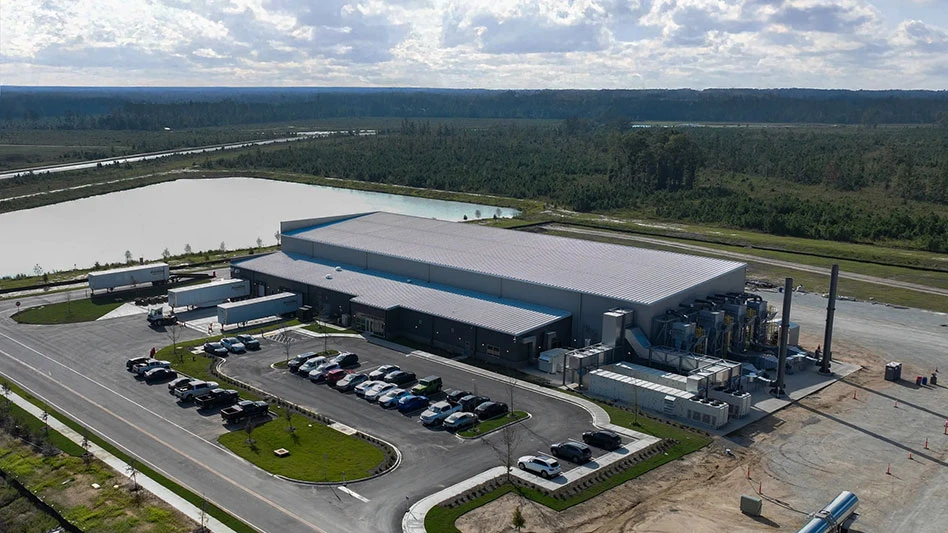
Redwood Materials, headquartered in Nevada, has announced that it has begun operations at its 600-acre campus in Berkeley County, South Carolina. The first of the facilities on the campus has started up, recovering critical minerals.
The company announced the selection of the site in December 2022, saying at that time that the campus would be dedicated to the production and recycling of battery materials for electric vehicles and other applications. Redwood plans to produce 100-gigawatt hours of cathode and anode metals per year and employ 1,500 people over the next decade as it grows its operations at the site near Charleston, South Carolina.
Redwood says the facility’s startup marks “a small but significant start toward what will become one of the world’s largest recovery, refining and manufacturing campuses."
RELATED: Innovating to serve
“South Carolina has long been a leader in advanced manufacturing—from textiles to automotive to aerospace,” the company says. “With Redwood’s campus ramping up, the state is taking its next step into critical minerals. By keeping these resources at home, South Carolina is strengthening both the state and the nation—rebuilding American industry through high-value manufacturing, energy security and local job creation.”
With recycling operations now online in South Carolina, Redwood says it is helping transform the U.S. into a nation that can secure and reuse its own resources, including lithium, nickel, cobalt and copper.
According to the company, it is on par with the largest U.S. source of nickel and the only domestic source of cobalt operating at scale. “Our operations also represent one of the most significant and only new domestic sources of lithium and copper to come online in decades.”
Redwood claims that roughly 90 percent of all lithium-ion batteries processed in North America come through its facilities, with its Nevada campus producing more than 60,000 metric tons of materials last year.
“Critical minerals are costly to mine and concentrated in fragile supply chains dominated by China,” the company says. “Yet as one of the world’s largest markets for EVs, consumer electronics and power tools, America already holds a tremendous stockpile of lithium, cobalt, nickel, copper and manganese locked inside the products we use every day. Within the U.S. fleet of 5 million electric vehicles alone lies an estimated 2.25 million metric tons of these materials—resources we can unlock first through reuse in stationary storage systems and later through recovery of the underlying minerals.”
Redwood is seeking to recover, refine and redeploy these resources here for America’s advantage. “This strategy turns yesterday’s imports into tomorrow’s strategic stockpile, making the U.S. stronger, more competitive and less vulnerable to supply chains controlled by China and other foreign adversaries,” according to the company, which points out the national security concerns related to critical minerals such as nickel and cobalt, which commonly are used in aerospace and defense alloys, while copper is essential to industrial wiring and power transmission.
Latest from Recycling Today
- U.S. Aluminum Co. explores aluminum fabrication plant in Oklahoma
- Sonoco completes portfolio transformation
- Eriez Shred1 data demonstrates scalable copper control
- RCI selects CurbWaste as exclusive operational management platform
- Updated: Supreme Court strikes down IEEPA tariffs
- Recycling Today Media Group launches Scrap Expo Lunch & Learn Webinar Series
- LyondellBasell scales back recycling target
- Former Liberty UK mills eyed by 3 suitors