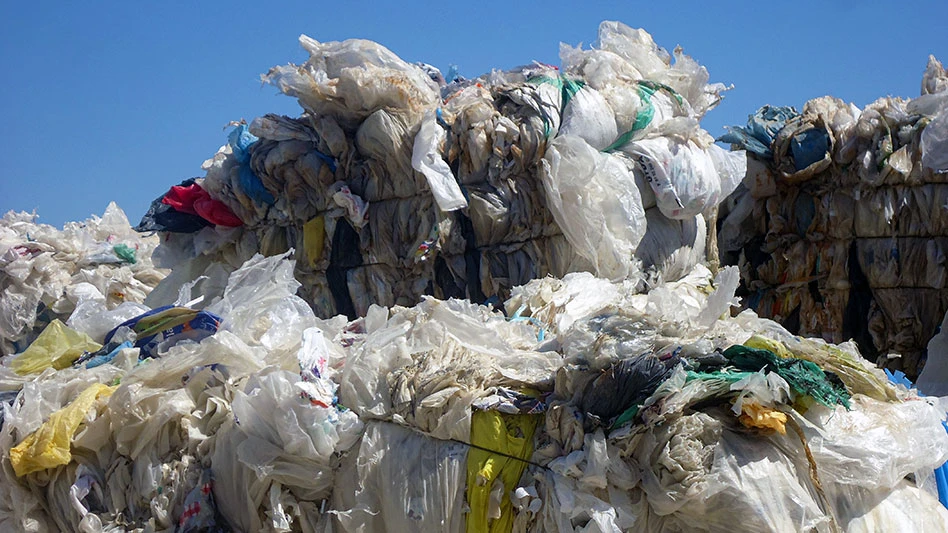
Much of the glass, paper, cardboard and plastic put out for collection each week for recycling in the United Kingdom will have to be dumped in landfills unless the government makes clear what can be exported free to developing countries, the head of Britain's largest waste recycling operation has warned.
In an escalating row between the Environment Agency and the recycling industry, John Viviani, head of Grosvenor Waste, has accused the government of frustrating exports by insisting on over-zealous environmental standards.
"Millions of metric tons of recycling activities across the UK are at serious threat of stopping because the Environment Agency is branding all household recycling material as hazardous waste," he said in a statement to the Guardian.
Last week it was revealed that officials in the Netherlands had rejected 2,000 metric tons of paper being sent to China by Grosvenor, which handles more than 400,000 metric tons of waste a year, mainly from London and south-east England. A further 4,000 metric tons was stopped from leaving Britain. It is believed that, in both cases, the paper was mixed with plastic and other waste.
The company, which has been subsidized with £750,000 (US$1.4 million) of government cash to invest in machinery to improve recycling rates, has been forced to close down part of its operation in Kent. Grosvenor is being investigated by the EA for potentially illegally exporting waste.
Viviani claimed that the industry no longer knew how much contamination of waste was allowed in its exports and that EA inspectors were interpreting the law subjectively.
"In all the years of Grosvenor's recycling operations we have never experienced anything like this before.
"Grosvenor and others in the industry are desperate to move away from the current method [of inspection], based on a personal subjective assessment by EA officers," he said.
Under international law, separated waste can be exported free, but mixed rubbish is classed as hazardous waste, and attracts heavy export license and inspection fees. Grosvenor claims that a certain amount of contamination of waste streams is inevitable and that waste will not be exported if the government insists on the highest standards.
"There is significant disagreement within the Environment Agency as to what is, or is not, acceptable. This has left the industry second-guessing what individual EA field officers are expecting, adding to the confusion and inconsistency. Frustrating exports would once again place Britain bear the bottom of the European recycling league," said Viviani.
Britain depends on developing countries to recycle its rubbish. More than 7.2 million metric tons of waste paper a year are collected for recycling, but because of insufficient capacity at home, more than 4 million metric tons of that are exported. Up to 1million metric tons of plastic, hundreds of thousands of tonnes of electronic waste and large amounts of steel, aluminum and glass are also exported. It is cheaper to send most waste to China than to Scotland.
"Stopping exports to countries like China would have an immediate and catastrophic effect on recycling schemes across the country and damage public confidence in the value of recycling as material would go to landfill," said Viviani.
The EA, which is working with other European countries to reduce illegal exports, yesterday vigorously denied that it was frustrating waste exports, or targeting Grosvenor.
"British recycling is not under threat and we are not targeting any company. I am unaware of any company having to landfill because of the Environment Agency. We are quite clear about what is legitimate. Companies can comply with international law without difficulty," said David Jordan, the EA's deputy director of operations.
Claire Wilton, a waste campaigner for Friends of the Earth, yesterday supported the government. "The Environment Agency must crack down on illegal exports of recycling to stop poor communities in other countries suffering the brunt of our pollution.
"UK companies should stop grumbling about meeting environmental standards. Recycling in other EU countries hasn't suffered because of these laws. The solution is more home-grown recycling facilities that will create jobs and shift us out of the recycling relegation zone." The Guardian
Latest from Recycling Today
- Danieli to supply shredder to Australian company
- Equipment from the former Alton Steel to be auctioned
- Novelis resumes operations in Greensboro, Georgia
- Interchange 360 to operate alternative collection program under Washington’s RRA
- Waste Pro files brief supporting pause of FMCSA CDL eligibility rule
- Kuraray America receives APR design recognition for EVOH barrier resin
- Tire Industry Project publishes end-of-life tire management guide
- Des Moines project utilizes recycled wind turbine blades