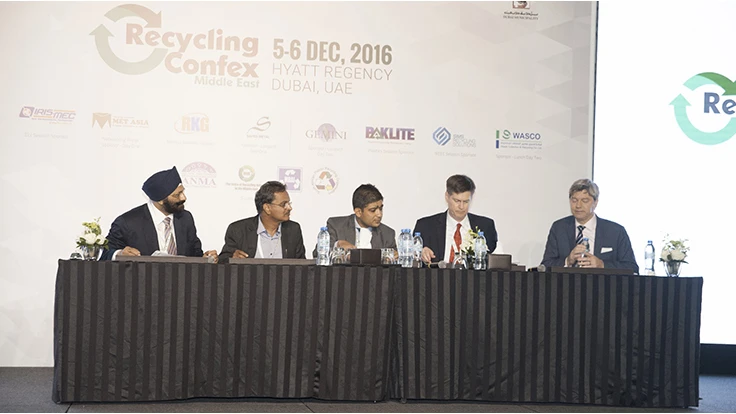
Newsprint production and newspaper distribution numbers in North America and Europe have dropped alarmingly since 2008, but India’s readers are defying the trend toward abandonment of ink-on-paper communication, according to presenters at the 2016 Recycling Confex Middle East, which took place in Dubai, United Arab Emirates (UAE), in early December.
Vikas Mahajan of India-based Mahajan Recycle Resources says India’s growing school age population and its expanding office work force will drive demand for printing and writing (P&W) papers in that nation for the next several years. He cited forecasts that show graphic paper sectors, including newsprint experiencing increased output in India through 2027.
That growing mill sector will be hungry for more recovered fibre, including the old newspapers (ONP), old magazines (OMG) and sorted office paper (SOP) grades. While India may recycle most of its OCC (old corrugated containers), its current low recycling rates for grades like ONP and SOP mean its overall paper recycling rate is possibly just 22%.
Mahajan said programmes like Wealth out of Waste (WOW) are “working to educate people to understand the value of fibre [currently] being dumped I the garbage.”
The Pathankot, Punjab-based recycler said India will need to find its own ways to increase its paper recycling rate as it cannot necessarily emulate models from North America or Europe. “There is no best way to collect [scrap paper],” he commented. “We do it differently in India, in Europe, in the United States, the Middle East, et cetera.”
S. Kalyanasundaram, a general manager with India-based Tamil Nadu Newsprint and Papers Limited (TNPL) said the company’s de-inking plant relies on imported SOP, sorted white ledger (SWL) and other grades of scrap paper to go along with domestically purchased material. The company also has a board mill that consumes OCC and boxboard cuttings.
He said in 2016 TNPL would likely consume about 78,000 tonnes of scrap paper sourced in India and about 133,000 tonnes of imported recovered fibre. He said TNPL has had recent issues with a “shortfall in receipt quality” with much of its imported fibre, including high moisture levels; plastic mixed into the fibre; and kraft paper and other brown grades in the SOP.
Michael McManus of Indonesia-based Asia Pulp & Paper said the company has the capacity to produce up to 21.5 million tonnes of paper annually and currently consumes about 2 million tonnes annually of recovered fibre, including the ONP, OMG and de-inked pulp grades.
The company’s internal forecasts show packaging demand will continue to rise in Asia in a business environment where “there is already so much demand for recovered fibre that we bring it in from North America.”
AP&P’s research also shows that people in general and younger people in particular are striving to make “green” choices in their packaging purchase decisions. He said an AP&P survey showed that 71% of respondents in the 18-to-24-age range are “influenced by sustainability” when they make a purchase and 42% will pay more to make a sustainable purchase.
The 2016 Recycling Confex Middle East was 5-6 December at the Hyatt Regency Dubai in the United Arab Emirates.
Latest from Recycling Today
- Equipment from the former Alton Steel to be auctioned
- Novelis resumes operations in Greensboro, Georgia
- Interchange 360 to operate alternative collection program under Washington’s RRA
- Waste Pro files brief supporting pause of FMCSA CDL eligibility rule
- Kuraray America receives APR design recognition for EVOH barrier resin
- Tire Industry Project publishes end-of-life tire management guide
- Des Moines project utilizes recycled wind turbine blades
- Charter Next Generation joins US Flexible Film Initiative