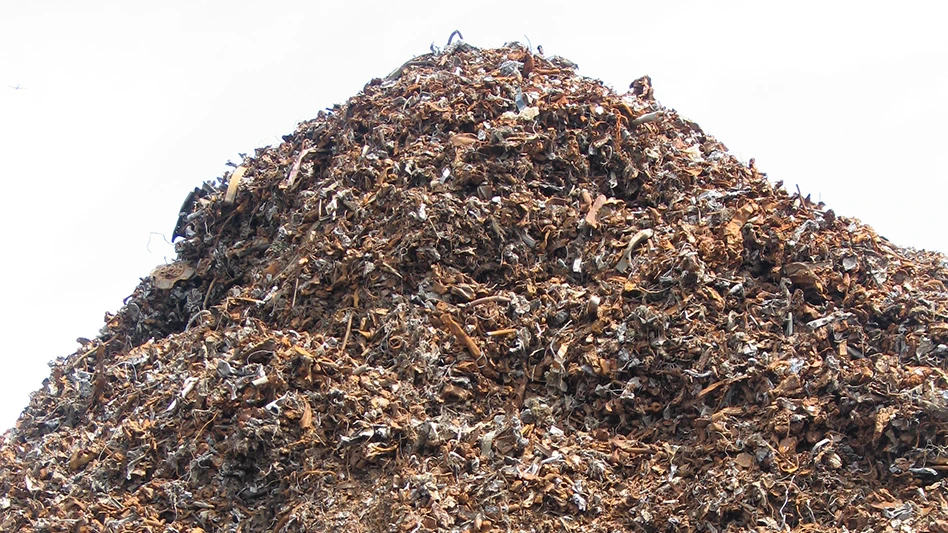
The Akron, Ohio, City Council voted last month to shut down Larry Hardesty's recycling operation in Akron, calling it an eyesore that neighbors have complained about for years.
The council wants to revoke Hardesty's 1997 conditional-use permit for Summit Transfer & Recycling, a process that will require public hearings. The Ohio Environmental Protection Agency doesn't like the piles, either, and has referred the case to its Columbus office.
Although some smaller piles are in compliance, the central mountain -- at least 30 feet high, covering about 1.6 acres -- is definitely not, Hardesty acknowledges.
Hardesty estimates that of the 80,000 cubic yards of debris on his property, 40,000 hasn't even been processed.
He believes he is the victim of city and state bureaucracy that strangled his dream with red tape.
``Now I'm sitting on a three-year mountain of material and the city is throwing a fit,'' he said.
Akron wants him to stop taking in material and eliminate the scrap he has accumulated.
Hardesty also may be the victim of economic forces in Ohio that make his enterprise -- one of the first in the state -- a long shot.
The City Council approved his plan in 1997 with the understanding that most of the material would be composted leaves and brush, with some construction debris.
Hardesty said, however, that changes in the law made it easier to take yard waste to dumps, so he turned to construction debris for the majority of his business.
Although he had spent 20 years helping a steel mill and other companies take care of environmental problems, he says he had never run a business.
He opened in 1998 and realized within two years that he needed more equipment to reduce the labor required to hand-pick anything worth saving.
More equipment required that he take in more material to justify the cost, so the mountains began growing.
The easiest material to sell is metal, such as nails -- extracted from wood pallets -- and aluminum. Wood can be burned as boiler fuel or processed into garden mulch. Asphalt roofing shingles can be reused in blacktop. Concrete block and brick can be reduced to ``clean fill'' for road repair and other applications.
One of Hardesty's oldest customers is Randy Katz, co-owner of City Scrap & Salvage, which buys nails and other metals. However, those materials need extra processing before they can be resold.
``We process the scrap to the steel mill specifications and the majority of it goes to Timken down in Canton,'' Katz said. ``They take the steel and melt it down.''
It can take up to a year for materials to accumulate into large enough batches to sell. While Hardesty was accumulating, his neighbors were complaining about the piles of debris, which particularly were visible during the winter, when the trees were bare.
In July 2002, a city official notified Hardesty that he was violating his zoning agreement.
``He pulled into our gate and he had orders to comply and his orders said cease all operations immediately,'' Hardesty said. ``You could have knocked me down with a feather.''
Thus began a series of appeal hearings that Hardesty said kept him in limbo until Oct. 31, 2003, when the city approved a revised site plan that included a requirement to build a dirt berm planted with trees to obscure the neighbors' view.
Hardesty believes he is 85 percent compliant with what the city wants. He has made the berm, although he says he can't afford the $20,000 he says it would take to plant the trees.
City Zoning Administrator John Moore said Hardesty isn't even close. ``The place is a mess,'' he said. ``He's way out of compliance.''
While Hardesty has been working on that, he also has battled the Ohio EPA over how much he had to recycle and how fast. The EPA also has concerns about piles of shredded material leaching chemicals into nearby wetlands.
``We had to say it's starting to look like a landfill,'' said Dave Dysle, an environmental specialist with the Ohio EPA.
The Ohio Department of Natural Resources has developed markets for other recyclables such as paper, plastic, glass and aluminum, but nothing for recycled construction debris.
``I'm sure the gentleman's heart was in the right place, but there's just not much of a market for it at this time,'' said recycling division chief Ron Kolbash.
That could change with a program that began July 1. Part of a new $1-a-ton tipping fee at construction landfills will go toward developing markets for recycled debris.
``If (Hardesty) can hang on for a while, there might be an opportunity for him down the road,'' Kolbash said.
The irony isn't lost on Hardesty.
If eventually he has to ship all his materials to a landfill, part of the tax he'll pay will develop markets that might have saved his business.
``I've been out there slogging and trying to create markets,'' he said. Akron Beacon Journal
Latest from Recycling Today
- Ocean freight interruptions poised to continue
- Danieli to supply shredder to Australian company
- Equipment from the former Alton Steel to be auctioned
- Novelis resumes operations in Greensboro, Georgia
- Interchange 360 to operate alternative collection program under Washington’s RRA
- Waste Pro files brief supporting pause of FMCSA CDL eligibility rule
- Kuraray America receives APR design recognition for EVOH barrier resin
- Tire Industry Project publishes end-of-life tire management guide