Photo by DeAnne Toto
According to the U.S. Environmental Protection Agency, textiles accounted for nearly 6 percent of the municipal solid waste generated in 2018, the most recent data available on the agency’s website. More recently, the fast fashion industry has contributed to the growth of textile waste in the U.S., with Eric Joo, head of North America feedstock operations at Reju, saying that clothing typically is worn seven times before being discarded.
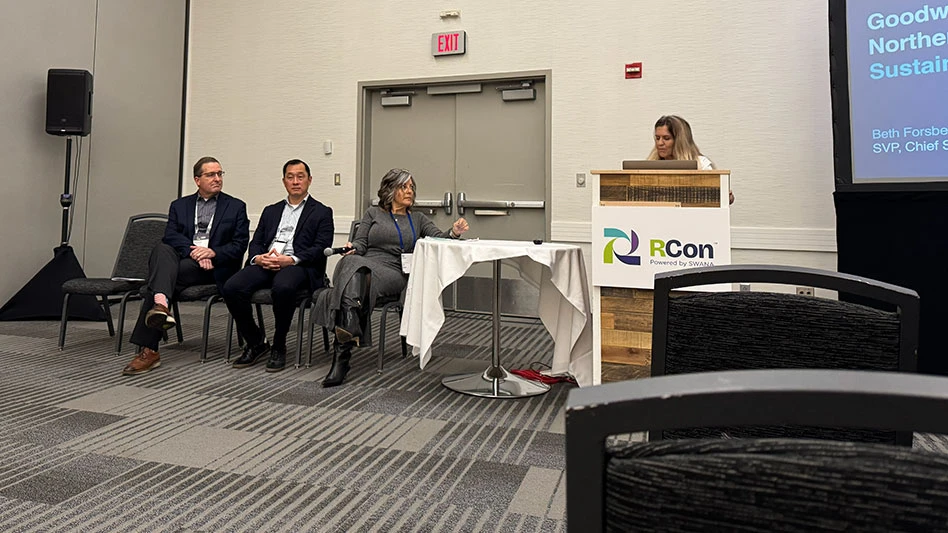
Joo was among the panelists who spoke during the RCon session Partnerships to Achieve Textile Circularity about a partnership among Goodwill Industries Inc., WM and Reju could help to disrupt the cycle of textile waste.
True to its mission
“In a nutshell, sustainability is at the heart of what Goodwill has done since our founding in 1902,” said Beth Forsberg, senior vice president and chief sustainability officer at Goodwill of Central and Northern Arizona. “Our model is to collect and sell and salvage.”
She added that the nonprofit also is beginning to embrace repair and recycling.
With more than 150 Goodwill locations nationally, Forsberg urged attendees to reach out locally to learn more about the capabilities their locations offer.
“We all have different capacities, but we all share a heart to serve a mission. And how we serve the mission is through the repurposing of goods,” she said, adding that learning more about recycling and engaging with the right people will allow Goodwill locations to expand their service to that mission.
Goodwill diverts 4.4 billion pounds of donated goods annually from landfill, Forsberg said. As the organization looks to derive more value out of the materials it handles, she said, “It gives us an opportunity to engage players on the different side of things to make sure to do our part, and that is to provide feedstock to partner with municipalities, partner with waste haulers, innovators, all of the above.”
That’s how Goodwill and WM began engaging on textile waste, which Forsberg described as “the biggest problem of our time right now.”
“We have clean, dry feedstock. We have partners that are willing to enact change with us. And we're embracing the opportunity to create jobs, generate revenue and literally disrupt in a positive way to be able to be part of the solution.”
Playing to their strengths
Raymond Randall, senior manager of textile recycling at Houston-based WM, said he’s fascinated by the changes taking place in the textile space around circularity.
In his previous role leading WM’s Innovation Group, Randall was responsible for parsing emerging trends and technologies to determine WM could help develop solutions, which led him to textiles.
Randall said WM has been working in the textile space since 2019, engaging primarily with brands and retailers to handle preconsumer material, dead stock, overstock and product returns.
In his current role at WM, he’s responsible for strategy integration and supply chain engagement that will ultimately help shift the textile industry toward greater circularity, according to moderator Colleen Foster of HF&H Consultants LLC of California.
Randall said a number of factors are compounding that have led WM to conclude that textiles will not continue to be managed as they have been at end of life, including California's textile recycling legislation, the Responsible Textile Recovery Act of 2024; Massachusetts ban on landfilling textiles; and emerging technologies that include textile-to-textile recycling and digital passports in Europe that will facilitate sorting.
More recently, WM launched a curbside collection program in April of last year in Troutdale, Oregon, as well as one north of San Francisco in a town called Albany, California, this September. Residents place their textiles in plastic bags at the curb for WM to collect.
“We think quarterly collection is roughly the right frequency,” Randall said. “If you do it every week, the operational costs are too high, and you're not going to get that much material. If you do it once a year, nobody wants to hang on to their stuff all that long.”
WM also has launched multifamily textile collection pilots. “We've got a couple that have been going up in the Pacific Northwest for a little while, and then we're looking at some pilots in Phoenix. They're going to launch hopefully [in December] or early in Q1 of the next year.”
Once WM collects the textiles, they are taken to Goodwill locations and evaluated to remove items that are viable for resale and reuse through that organization.
While Forsberg said the quality of the textiles collected through WM was different from the quality of donations Goodwill traditionally receives, they did include reusable items.
She added that donors effectively could be presorting items they are donating directly to Goodwill, removing the mismatched socks and stained T-shirts.
“It did not look like what I would consider trash, so I think the intent was solved,” Forsberg continued. “It was just a little less quality in general.”
Sorting for recycling
“What's not viable for resale and reuse, we send to a facility that we opened up in Greenville, South Carolina,” Randall said, noting that the site uses robotics, air classifiers and near-infrared optical sorting technology to sort the textiles according to fabric composition.
Randall noted that WM’s textile sorting facility is demonstration-scale, with the ability to sort 3,000 tons per year. “I think the economics probably start to pay off when it's about 10x that size, but this allows us to test the technology and make sure we understand how the technology works.
“I believe we will build more of these,” he continued. “I think we're going to need to have these scattered around the country just to help with the logistical cost of moving this material around.”
The demonstration facility also allows WM to get a better understanding of the end markets for the textiles it’s sorting, with Randall saying the company has been able to find markets for all the material it’s recovering at the site. Anything that isn't viable for reuse, fiber-to-fiber recycling or downcycling is sent to an alternative fuel facility, which he described as “one step above waste to energy.”
Polyester depolymerization
Reju, which has a pilot Regeneration Hub in Frankfurt, Germany, comes in on the fiber-to-fiber recycling side.
The company, which is owned by Technip Energies of France, uses a depolymerization technology developed by IBM known as VolCat to recycle end-of-life polyester fabrics. VolCat allows the selective breakdown of polyesters that IBM first applied to technologies like semiconductor lithography and microelectronics packaging.
Joo said polyester makes up about 59 percent of the textile stream and has been growing annually. While roughly 88 percent of polyester is made using recycled materials, largely polyethylene terephthalate bottles, the company’s goal is to improve textile-to-textile circularity.
Reju is developing its first full-scale Regeneration Hub in Europe at the Chemelot Industrial Park in Sittard, Netherlands.
Joo said the company is looking to establish long-term agreements with potential suppliers that will enable them to build out the collection and sorting infrastructure. He added that he suspects Reju will have to do some additional sorting once the textiles arrive at its Rejuvination Hubs.
“We know what purity and exact requirements that we need, but we found that it's difficult to get those very, very precise requirements [from suppliers]. We'll need to do a little bit of work ourselves on our end after we receive material like any good operational company.”
RCon was hosted by the Solid Waste Association of North America in Columbus, Ohio, from Nov. 12-15. RCon 2026 will be in St. Louis from Sept. 29 to Oct. 2.
Latest from Recycling Today
- The Metals Agency receives approval for export credit insurance
- Recycle Ann Arbor extends drop-off station operating hours
- Sybilion seeks to help manufacturers confidently address volatility
- Rio Tinto, Prysmian partner on low-carbon aluminum solutions for data centers
- Unilever criticized for plastics approach
- USTR to study additional steel, aluminum tariffs
- Electrified Materials adds processing capacity
- ERI files suit alleging theft of trade secrets