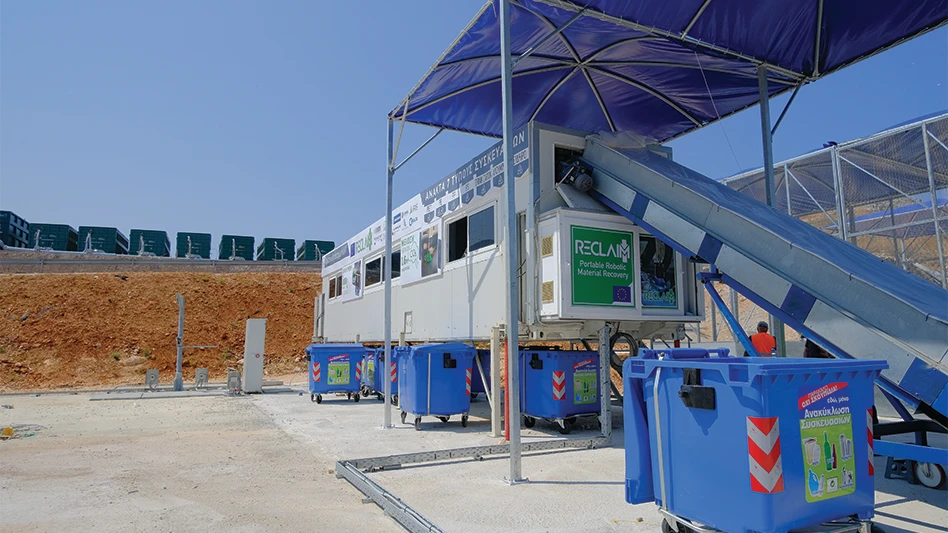
Photo courtesy of the Reclaim project
The European Union-funded Reclaim project has successfully deployed a portable, artificial intelligence- (AI-) driven robotic material recovery facility (prMRF) in the Mediterranean summer destination of Kefalonia, the largest of Greece’s Ionian Islands, project coordinators say.
The portable facility enables on-site sorting of recyclables from municipal solid waste, and project leaders say it increases material recovery efficiency and reduces the need for costly material transport to mainland facilities, which also helps cut carbon emissions.
“Until now, portable material recovery facilities have lacked the integration of smart, high-tech solutions that could enhance their productivity,” Reclaim says. “As a result, waste sorting in these niche sectors has largely relied on manual sorting. Reclaim project’s prMRF addresses this gap.
Reclaim says the most remarkable feature of its sorting system is the portable and compact design, which fits inside a standard shipping container. Project leaders say this feature allows for rapid deployment in remote areas or alongside existing recycling plants in tourist-heavy island destinations, bringing close-to-source material recovery of recyclables.
Reclaim notes that while the prMRF is designed for remote islands and underserved areas, the equipment also can be deployed in locations where significant scrap generation demands quick treatment, such as large-scale events like festivals and sporting events; transport hubs like airports and shipping ports; and mountain regions.
The setup
According to Reclaim, the prMRF is “neatly embedded” and supported by what it describes as state-of-the-art material categorization technology.
Before sorting begins, an AI-driven computer vision module identifies and categorizes material entering the conveyor belt using RGB images. This is complemented by the material identification abilities of hyperspectral imaging, enabling accurate material classification.
Subsequently, five robotic recycling workers, or RoReWos, pick and sort items. Reclaim says these are low-cost, custom-built robots designed specifically for sorting tasks that don’t require delicate handling of objects. They are equipped with pneumatic actuators for fast picking. Reclaim says their simple design and application-specific build allow the robots to significantly improve the cost efficiency ratio measured as the number of sorted items per Euro invested.
Currently, Reclaim says the robotic system can achieve an average of 120 picks per minute, but easily can be upgraded with additional robotic sorters to reach even higher productivity. The robots also can be mounted with interchangeable grippers with higher gripping efficiency depending on the material type.
Additionally, Reclaim says a key feature of the prMRF unit is its operational flexibility. The equipment can be remotely monitored via a web-based interface that gives the production manager access to real-time performance insights. With the interface, Reclaim says managers can continuously monitor the activity of the robotic systems, track the success rates of their actions and quickly detect any irregularities caused by unexpected events.
Collectively, Reclaim says the robotic sorting technologies will recover around 6,500-plus items per hour of plastic packaging, metal packaging and drink cartons while saving an estimated 1.6 tons of carbon emissions daily. Reclaim adds that the decentralized material recovery approach consumes 36 percent less fuel by reducing roundtrip transfer of residual material to centralized MRFs, and 12 percent faster material processing thanks to onsite sorting.
“Having successfully validated prMRF in real-world continuous waste treatment, we are now expanding our focus to new frontiers, such as transportation hubs, mountain regions and suburban areas where local-scale waste management with the support of prMRF can outperform current practices,” says Michalis Maniadakis, Reclaim project coordinator. “We are seeking visionary partners and investors to leverage the expertise we have gained with prMRF technology, scale up installations and drive together a future for smarter, more sustainable resource recovery.”
Next steps
Moving forward, Reclaim says its prMRF will continue to be tested on real plastic packaging, metal packaging and drink cartons to identify specific areas for improvement in the system’s next version.
The evaluation results will offer practical insights into the development of an upgraded version of the prMRF for alternative locations, Reclaim says. For example, the Reclaim consortium already has initiated discussions with mountain municipalities in Italy and with stakeholders at the new Heraklion airport in Crete.
Reclaim says the prMRF commercialization efforts will adopt a hybrid approach to include not only the integrated prMRF system itself, but also individual innovations such as the bimodal material classification technology and the RoReWos.
“The Greek state is keenly anticipating the results of prMRF’s deployment in Kefalonia, aiming to leverage its success in shaping effective policies for managing municipal recyclable waste in island regions,” says Manolis Grafakos, secretary general for waste management coordination of the Ministry of Environment and Energy of the Greek government.
The Reclaim project has received funding from the EU’s Horizon 2020 Research and Innovation Programme under grant agreement No. 101070524.
Latest from Recycling Today
- Fleetio launches AI capability to accelerate fleet maintenance approvals
- The Metals Agency receives approval for export credit insurance
- Recycle Ann Arbor extends drop-off station operating hours
- Sybilion seeks to help manufacturers confidently address volatility
- Rio Tinto, Prysmian partner on low-carbon aluminum solutions for data centers
- Unilever criticized for plastics approach
- USTR to study additional steel, aluminum tariffs
- Electrified Materials adds processing capacity