Photo courtesy of Recirculate
Recirculate, a European Union-funded project based in Finland, says it is developing a “state-of-the-art” electric vehicle (EV) battery disassembly system using artificial intelligence (AI) and robotics.
Project leadership says it has successfully completed its first phase: the creation of a set of tools and machine learning models for the robotic dismantling of an EV battery from pack to cell level. It views this development as an innovation addressing a pressing bottleneck in the battery industry: safe, efficient and automated disassembly.
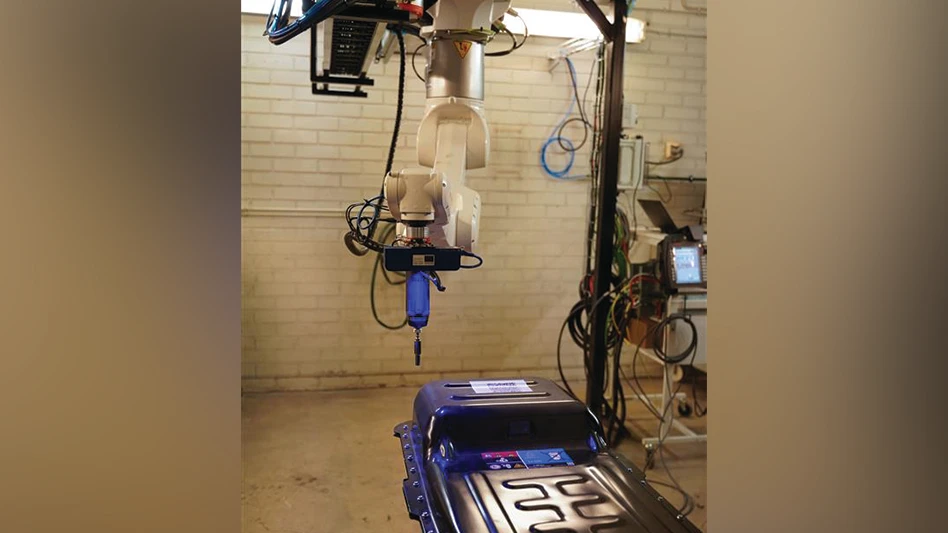
Recirculate says the system is designed to dismantle batteries in two key phases—from battery pack to module, and from module to cell level. Centria University of Applied Science’s team is leading work on this development within Recirculate and created a purpose-built robotic cell using a KUKA KR10 industrial robot. Recirculate says the robot, equipped with specially designed tools and a mobile linear track, can autonomously detect, unscrew and remove components of high-voltage battery packs.
“There are approximately 50 screws on the lid alone,” says Tomi Pitkäaho, principal lecturer in research, Centria University of Applied Science. “We’ve trained a machine learning model to locate and identify each screw, extract their exact coordinates and send this data to the robot. With a depth camera installed directly on the tool, the robot can precisely determine not just the ‘x’ and ‘y’ position, but also the z-depth for each component.”
Recirculate says the system uses multiple machine learning models to identify and extract critical components including screws, connectors and wiring. Once the lid is removed using a vacuum gripper, specialized robotic tools are used to dismantle internal components. The models not only recognize the elements but also analyze wire orientations to determine optimal disassembly strategies.
“We’ve developed tools that can detect and manipulate parts with remarkable precision,” Pitkäaho says. “From training datasets to model architecture and deployment, it took 18 months of dedicated work by our team of robotics, AI and ML [machine learning] experts.”
Beyond disassembly, Recirculate says its team has created a battery identification model that can recognize batteries eve in the absence of QR codes or digital product passports. Currently, project participants claim the model can identify battery types from manufacturers such as Ford and Tesla with nearly 100 percent accuracy, enabling the system to automatically select the correct disassembly program.
“This is one of the first working, real-world examples of battery disassembly using machine learning and robotics,” Pitkäaho says. “Until now, most efforts have been purely academic. We’re proud to bring this into industrial application through Recirculate.”
The project team says it is focused on expanding its proprietary training dataset in order to scale the solution and extend its compatibility to other battery types.
Latest from Recycling Today
- Fleetio launches AI capability to accelerate fleet maintenance approvals
- The Metals Agency receives approval for export credit insurance
- Recycle Ann Arbor extends drop-off station operating hours
- Sybilion seeks to help manufacturers confidently address volatility
- Rio Tinto, Prysmian partner on low-carbon aluminum solutions for data centers
- Unilever criticized for plastics approach
- USTR to study additional steel, aluminum tariffs
- Electrified Materials adds processing capacity