Photo by DeAnne Toto
The waste and recycling industry is among the most dangerous occupations in the U.S., with the fatality rate for refuse and recyclable materials collectors increasing in 2023, according to the U.S. Department of Labor’s Bureau of Labor Statistics (BLS) 2023 National Census of Fatal Occupational Injuries. The occupation of refuse and recyclable materials collectors, in particular, was ranked the fourth deadliest job in 2023, jumping from seventh in 2021 and 2022.
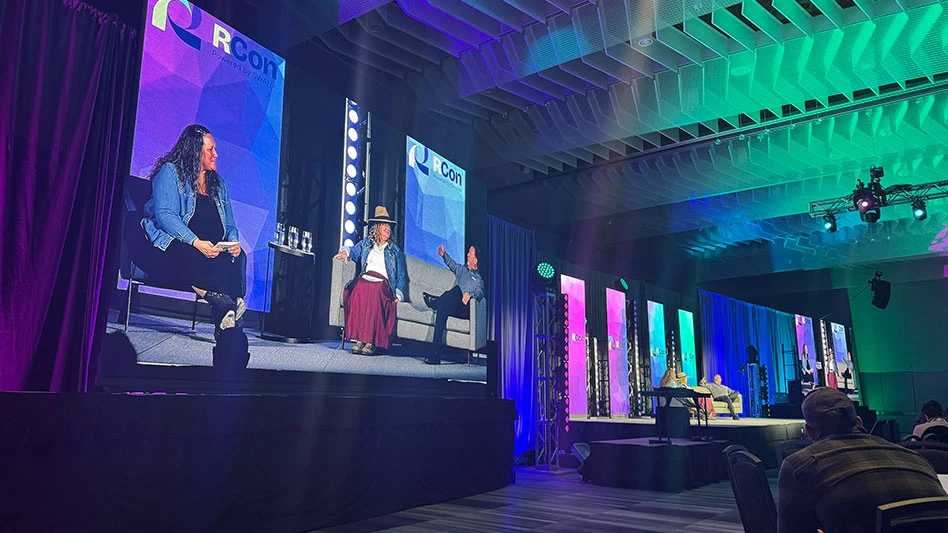
The opening general session at RCon addressed the issue of industry safety in a presentation from Erin Gilchrist of Fleet Unfiltered Consulting LLC, who later moderated a conversation between Suki Janssen, director of Georgia’s Athens-Clarke County Solid Waste Department, and James Moore, director of the Merced County Regional Waste Management Authority in California.
The role of culture
Gilchrist, who is based in Columbus, Ohio, the site of RCon this year, told the audience, “You face unique challenges and hazards, but it's really just about controlling what you can, and you can control your approach to safety culture in your organizations.”
She said culture is a competitive advantage and the character of an organization, adding, “When you do safety right, you succeed everywhere.
“Organizations with strong cultures attract top talent, they adapt faster, they retain customers longer,” Gilchrist said. “Culture makes your company a place where people want to work and one that customers trust, and customers stick around when they get that good feeling about you.”
An organization’s culture is shaped by the worst behavior the leader is willing to tolerate, she continued. “We promote what we permit.”
She advised against “prioritizing” safety, noting that priorities often change. Instead, safety should be viewed as an organizational value because values have permanence. “Values are like the heart and soul of an organization, and they're non-negotiable, so when safety is a value, it becomes more like who you are rather than what you do.”
The pillars of safety culture
Gilchrist offered four pillars that she believes truly define safety culture.
1. Leading from the top
“Leaders should model, not mandate,” she said, adding that policy changes should come from an organization’s leadership team.
It’s also important to establish a safety committee with an executive team sponsor and representation from various departments, including fleet; environmental, health and safety; risk management; human resources; legal; and procurement.
“All initiatives should include the frontline associates like technicians and drivers because their input is so critical,” she added. “Safety should always feel rooted and never feel optional.
2. Hiring and empowering the right people
“We all know that there are fundamental best practices like pre-employment drug screenings and background checks and hiring for fit and for culture,” Gilchrist said. While good culture starts with who an organization hires, investing in your workforce through training, healthy communication and a consistent accountability structure also are important, she added.
“It's not just getting the right people in the door; it's what you do with them after they get there that matters most.
“People want to be held accountable, believe it or not; they want structure," she continued. "They don't want to have to guess what you expect and what you need. So consistency around accountability is mission critical.”
Employees also should have a role in shaping policies and be encouraged to report unsafe practices.
3. Enabling tools and technology
“I think making safety easy is the key here,” Gilchrist said. “Invest in the right technology because it will always pay off. If you have the right tools and tech, you're empowering them to do all of the fleet stuff, the safety stuff [and] the professional driver stuff so easily that it just becomes routine for them. Empowering drivers to self-manage with great data in an easy-to-digest format is the way to go.”
4. Making safety operational
Gilchrist said establishing a safety culture is in the details and the daily routines that are fundamental and foundational. She suggested evaluating branch managers not just on profit margin but also on their safety performance. Operationalizing key performance indicators related to safety helps to illustrate how profit margin is affected when the team doesn’t do simple, fundamental things related to safety.
Safety in action
Gilchrist then brought Janssen and Moore onto the stage and asked them how they are implementing safety as a core value.
Moore mentioned the importance of top-down leadership. “It's not just what we're telling them to do. We're showing [them] we're walking the walk, not just talking the talk.”
“It's really important for me to be present and our leaders be present at every site as much as possible,” Janssen said, noting that Athens-Clarke County has a number of operations from recycling facilities to a landfill.
She said the county also is embedding safety in its performance measures and red tagging trucks to ensure drivers are doing pretrip checks correctly.
Athens-Clarke County Solid Waste also is recognizing safe practices among its staff regularly.
“It took me years to get a line item in my budget … for safety,” Janssen said, noting this allows her to reward her staff for good safety behavior during monthly safety meetings.
She added that getting staff to report unsafe behavior still can be difficult, particularly with the county’s three-strike rule. “If you have three preventable accidents, you theoretically could get terminated from Athens-Clarke County.”
Janssen said the county has worked with its risk management staff to “personalize” that policy for the solid waste department staff to ensure those very strict safety and risk rules don't create a barrier to reporting unsafe behavior.
RCon, organized by the Solid Waste Association of North America, was Nov. 12-15 in Columbus. RCon 2026 will be in St. Louis from Sept. 29 to Oct. 2.
Latest from Recycling Today
- Fleetio launches AI capability to accelerate fleet maintenance approvals
- The Metals Agency receives approval for export credit insurance
- Recycle Ann Arbor extends drop-off station operating hours
- Sybilion seeks to help manufacturers confidently address volatility
- Rio Tinto, Prysmian partner on low-carbon aluminum solutions for data centers
- Unilever criticized for plastics approach
- USTR to study additional steel, aluminum tariffs
- Electrified Materials adds processing capacity